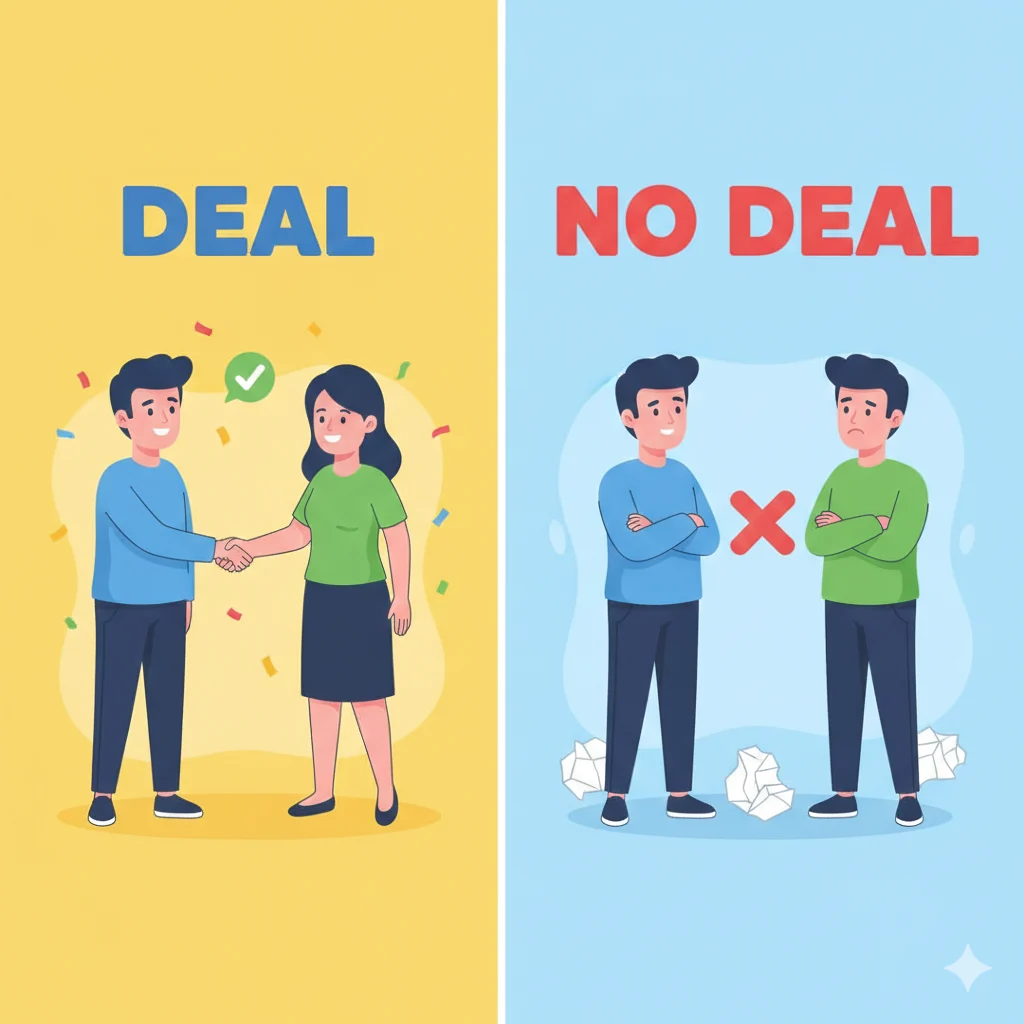
“Deal or no deal” is a phrase almost everyone has heard. Some people know it from a famous TV game show. Others hear it in daily life when someone makes an offer. But many learners of English still get confused about what deal really means and how no deal changes the meaning.
Is deal just about business?
Does no deal mean something is bad?
Can we use these words in normal talking and writing?
This easy guide will answer all these questions. You will learn the meaning, difference, and correct usage of deal or no deal with very simple words. Even a class 4 student can understand it. You will also see many real-life examples from school, shopping, and family life.
By the end, you will feel confident using deal or no deal in English.
What Does Each Word Mean?
Before we understand deal or no deal, we must know what deal and no deal mean on their own.
What does “Deal” mean?
A deal means an agreement.
It is when two or more people agree on something.
It can also mean an offer or a plan that people accept.
Part of speech:
“Deal” is a noun (a thing) and also a verb (an action).
Simple examples of “deal”
- I made a deal with my brother to share my toys.
- The shop gave me a good deal on shoes.
- Let’s deal with this problem together.
Small story:
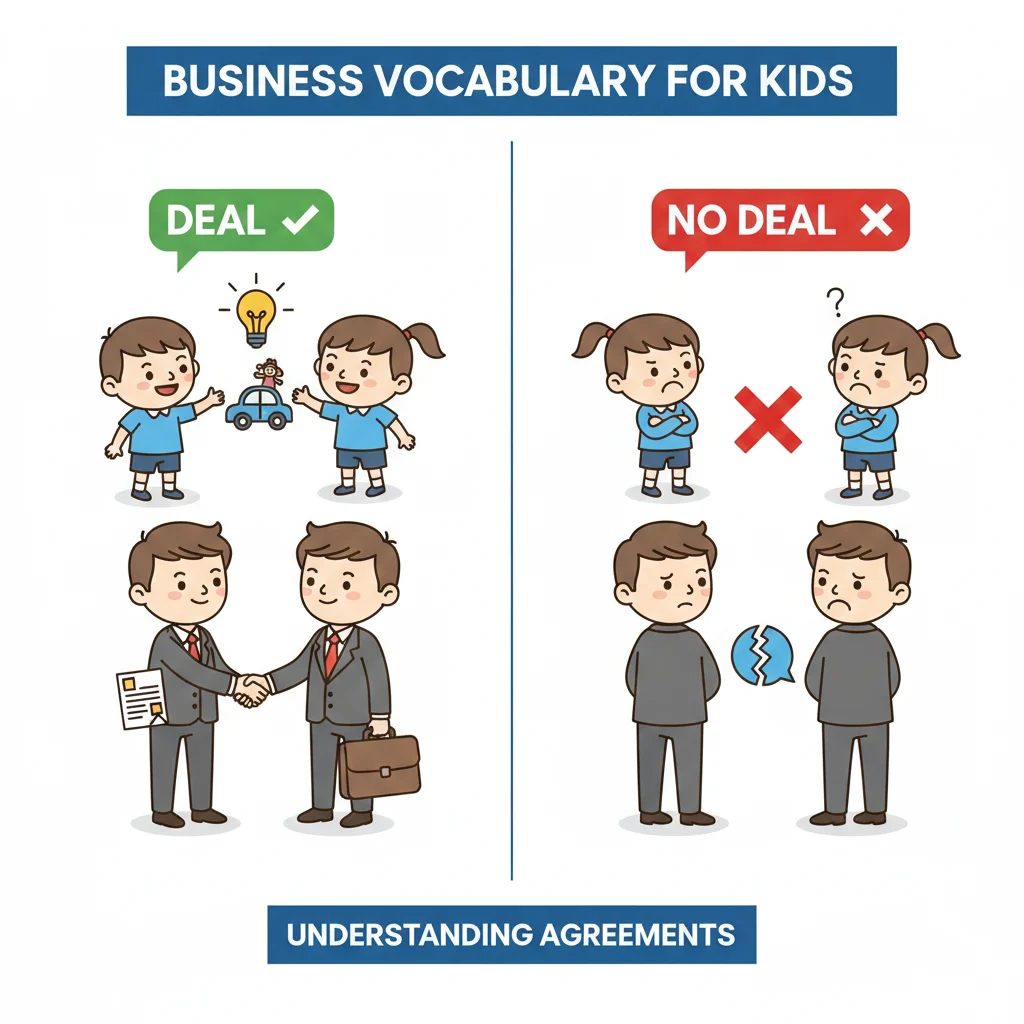
Ali wants to trade his comic book for Sara’s pencil box. They both agree. That agreement is called a deal.
What does “No Deal” mean?
No deal means no agreement.
It means someone does not accept the offer.
It shows that a person says no to the deal.
Part of speech:
“No deal” is a phrase. It is often used when someone refuses.
Simple examples of “no deal”
- If you don’t help me, it’s no deal.
- The buyer said no deal to the high price.
- He wanted more money, so there was no deal.
Small story:
If Ali asks for Sara’s pencil box but she says no, then there is no deal.
The Key Difference Between Deal and No Deal
The main difference is very simple:
- Deal = Yes
- No deal = No
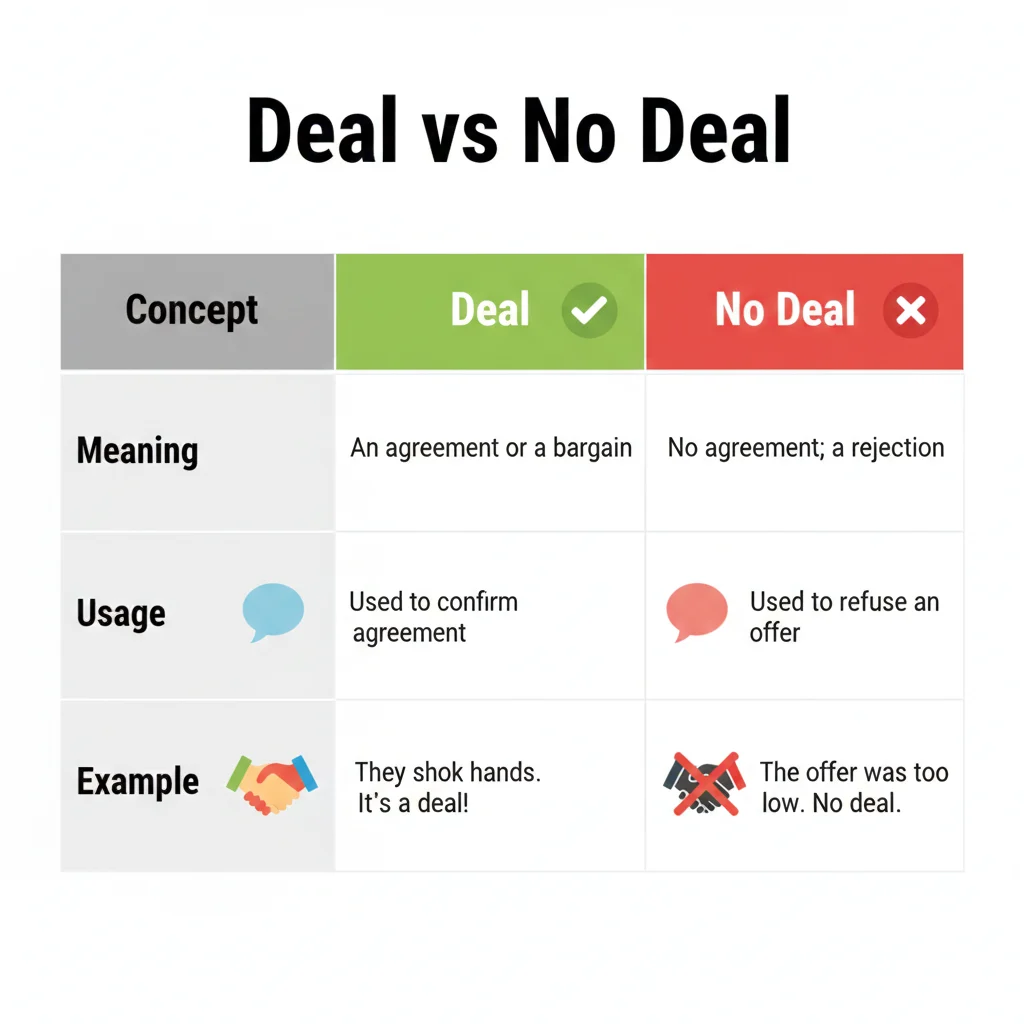
Here is a clear table to help you remember.
| Point | Deal | No Deal |
|---|---|---|
| Meaning | An agreement | No agreement |
| Shows | Someone accepts | Someone refuses |
| Feeling | Positive | Negative |
| Example | “Okay, deal!” | “Sorry, no deal.” |
Quick Tip to Remember
Think of a handshake.
If people shake hands, it is a deal.
If they turn away, it is no deal.
Common Mistakes and How to Avoid Them
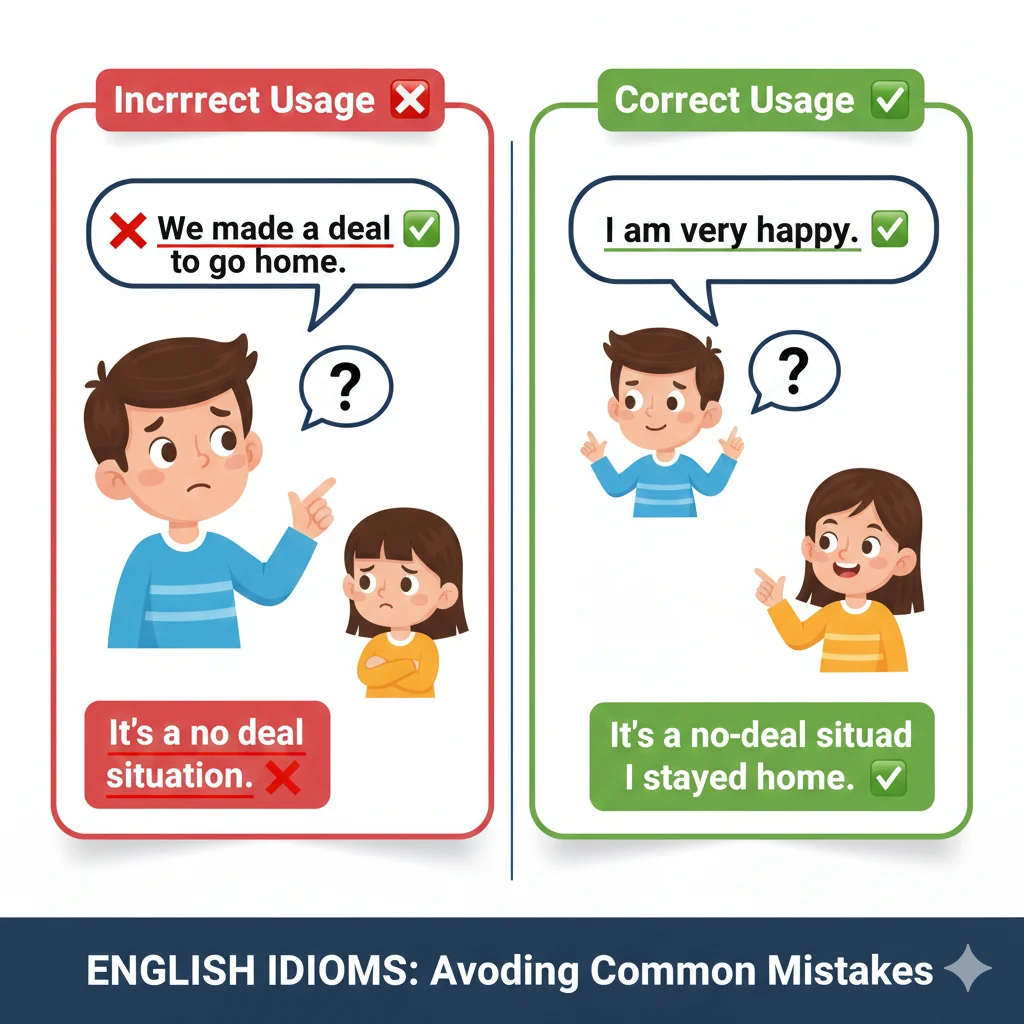
Many learners make small mistakes when using deal or no deal. Let’s fix them.
❌ Wrong:
I did no deal with him.
✔ Correct:
I made no deal with him.
Why?
We say make a deal or have a deal, not “did a deal.”
❌ Wrong:
This is a no-deal.
✔ Correct:
This is no deal.
Why?
In simple English, we do not add a dash. We just say no deal.
❌ Wrong:
He dealed with me.
✔ Correct:
He dealt with me.
Why?
The past form of deal is dealt, not dealed.
When to Use “Deal”
Use deal when:
- You agree with someone
- You accept an offer
- You make a plan with someone
Simple real-life examples
- “You do the homework and I clean the room. Deal?”
- I got a good deal on my school bag.
- We made a deal to play after dinner.
- Dad and I have a deal about bedtime.
- That sounds fair. It’s a deal.
In school:
Teacher: “Finish your work and you get extra playtime.”
Students: “Deal!”
When to Use “No Deal”
Use no deal when:
- You do not like the offer
- You refuse
- You say no to an agreement
Simple examples
- You want my toy but give nothing? No deal.
- That price is too high. No deal.
- If you don’t help me, it’s no deal.
- Mom said no deal to more TV time.
- He didn’t like the plan, so it was no deal.
Memory Hack
Imagine a red stop sign.
No deal = stop = no agreement.
Quick Recap: Deal vs No Deal
- Deal means yes, we agree.
- No deal means no, we do not agree.
- Deal is positive.
- No deal is negative.
- Use deal when you accept.
- Use no deal when you refuse.
Advanced Tips (Simple Version)
The word deal comes from an old English word that meant “to share or divide.” Over time, it started to mean “to agree.”
In exams and formal writing, deal is often used like this:
- “They reached a deal.”
- “The company made a deal.”
In texting, people often write:
- “Deal 👍”
- “No deal ❌”
Using the wrong one can change the meaning a lot. Saying deal when you mean no deal can confuse people.
Mini Quiz
Fill in the blanks.
- You clean the room and I cook. ________
- I don’t like that offer. ________
- We made a ________ to play after school.
- That price is too high. ________
- He said yes, so it’s a ________.
(Answers: Deal, No deal, deal, No deal, deal)
FAQs
1. What does “deal or no deal” mean?
It means choosing to accept (deal) or refuse (no deal) an offer.
2. Is “deal” positive?
Yes. It shows agreement.
3. Is “no deal” rude?
No. It is just a polite way to refuse.
4. Can I use it in daily talk?
Yes. People use it all the time in daily life.
5. Is “deal or no deal” only from TV?
No. It is also used in normal English.
Conclusion
Now you know the clear meaning of deal or no deal. A deal means yes and agreement. No deal means no and refusal. These two simple words are very powerful in daily English. You can use them while talking with family, friends, or even at school.
Practice using them in small sentences every day. The more you use them, the easier they become. Learning small things like this makes your English better step by step.

English novelist and poet Thomas Hardy (1840–1928) explored human struggles, social constraints, and tragic love with deep realism and vivid storytelling.