Many English learners often get confused between “effect” and “affect.” Even native speakers mix them up because they sound almost the same and sometimes appear in similar kinds of sentences. But the truth is simple: each word has a different job in a sentence. Once you understand that job, you will never make a mistake again.
In this easy, friendly guide, you will learn the meaning of each word, the difference between effect and affect, when to use them, and how to choose the correct word every time. You’ll also see real-life examples, common mistakes, grammar tips, a comparison table, and a fun memory trick.
Whether you are a student, a beginner in English, or someone who wants to write better messages, emails, or essays — this explanation will make everything crystal clear. Let’s start!
What Does Each Word Mean?
Meaning of “Effect” (Noun)
Effect is usually a noun.
A noun means a thing.
So effect = result or outcome of something happening.
Think of it like this:
If something happens, the effect is what comes after.
Easy Examples of “Effect”
- The effect of the rain was a big puddle in the yard.
- Her smile had a positive effect on everyone.
- The medicine had no effect on him.
Mini Story to Remember
If you drop a stone into water, the effect is the ripples that appear.
Effect = the result.
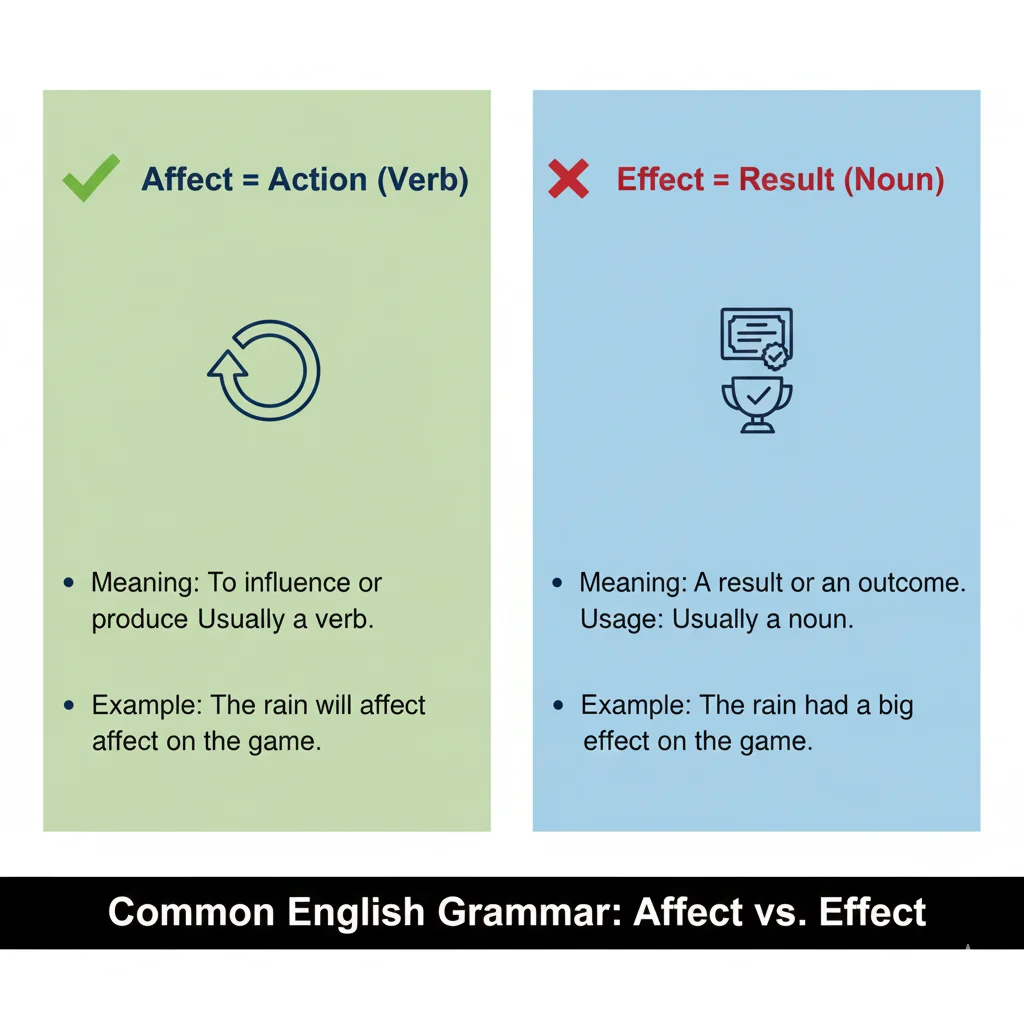
Meaning of “Affect” (Verb)
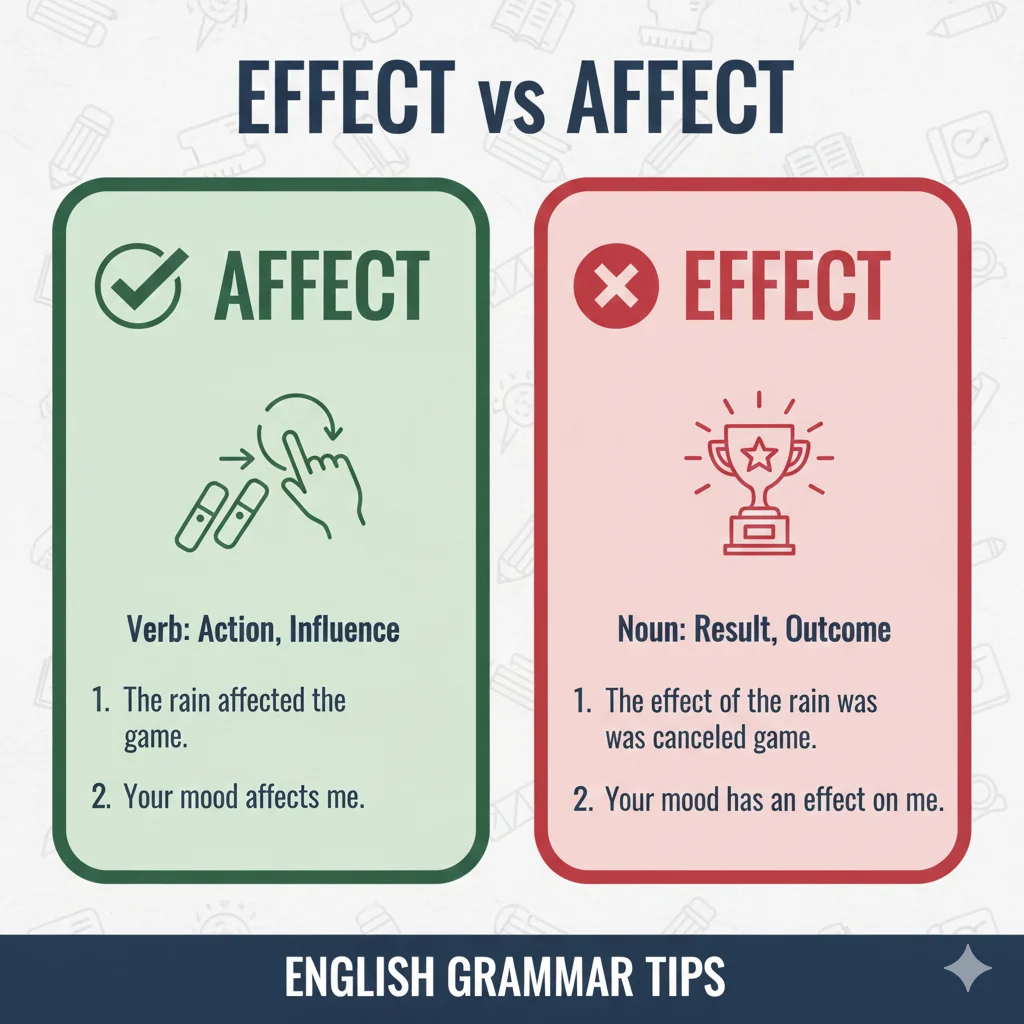
Affect is usually a verb.
A verb is an action.
So affect = to change or influence something.
Easy Examples of “Affect”
- Loud noise can affect your sleep.
- His kind words affected my mood in a good way.
- The cold weather affects plants.
Mini Story to Remember
If you push the swing, you affect its movement.
Affect = to influence.
The Key Difference Between Effect and Affect
The main difference is:
- Affect = verb = action
- Effect = noun = result
Comparison Table: Effect vs Affect
| Word | Part of Speech | Meaning | Simple Rule | Example Sentence |
|---|---|---|---|---|
| Affect | Verb | To influence or change | Think “A for Action” | The weather affects my mood. |
| Effect | Noun | The result of something | Think “E for End result” | The effect of the weather was a dark, cloudy day. |
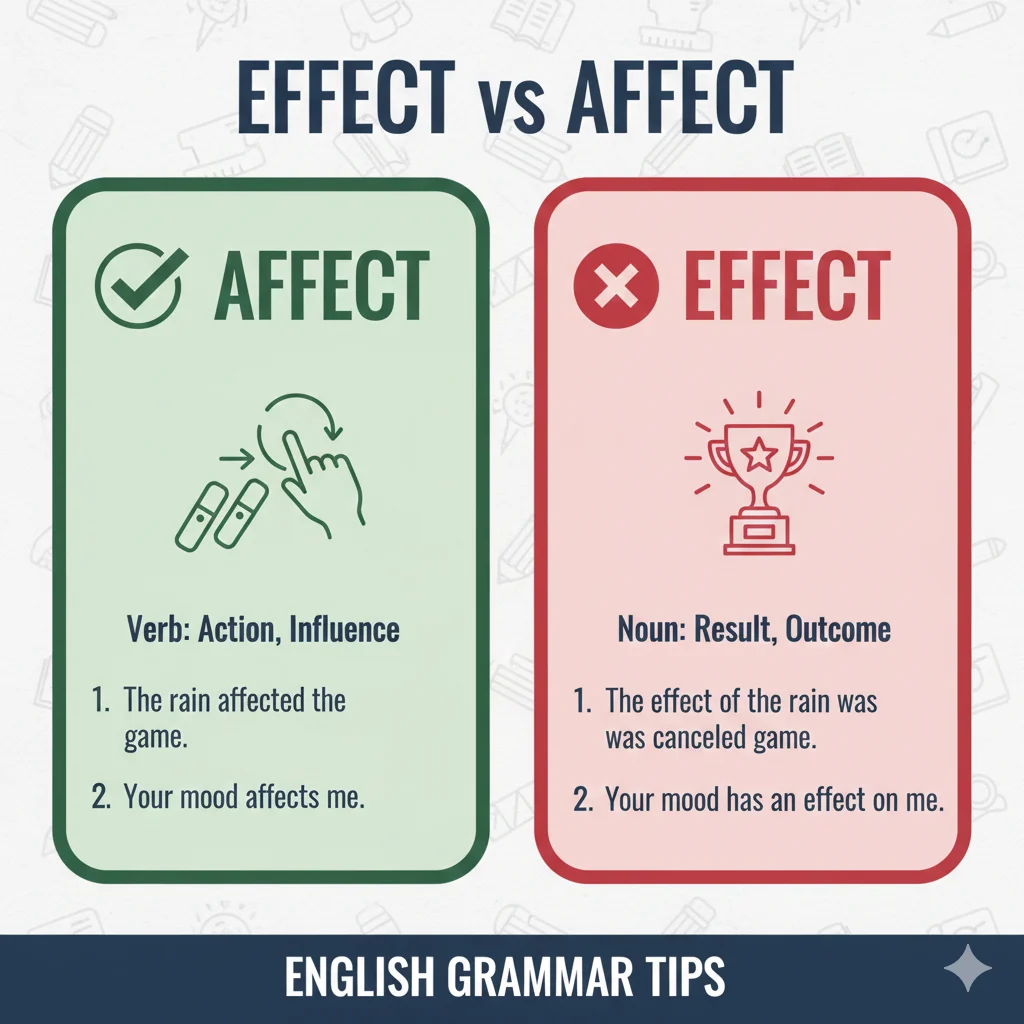
Quick Tip to Remember
✔ Affect = Action
✔ Effect = End result
Both start with the same letters — A for Action, E for End.
Common Mistakes and How to Avoid Them
Mistake 1: Using “effect” as an action
❌ The rain effected my clothes.
✔ Correct: The rain affected my clothes.
Why? Because getting clothes wet is an action (influence/change), so use affect.
Mistake 2: Using “affect” as a result
❌ The affect of studying was good marks.
✔ Correct: The effect of studying was good marks.
Why? Because “good marks” is the result.
Mistake 3: Thinking the longer word means something fancy
Many people assume “effect” sounds smarter.
But grammar doesn’t depend on what sounds fancy — it depends on meaning.
When to Use “Affect”
Use affect when something is changing, influencing, or impacting something else.
It always shows an action happening.
Use “affect” in sentences like:
- When feelings change
- When actions cause change
- When something influences another thing
Examples
- Noise can affect your concentration during exams.
- Drinking too much soda can affect your teeth.
- Missing sleep affects your energy.
- The teacher’s words affected him deeply.
- Rainy days affect my mood.
Real-life situations
- In school: “Bad handwriting can affect your grades.”
- At home: “Cold air affects babies more than adults.”
- Online: “Internet speed affects video quality.”
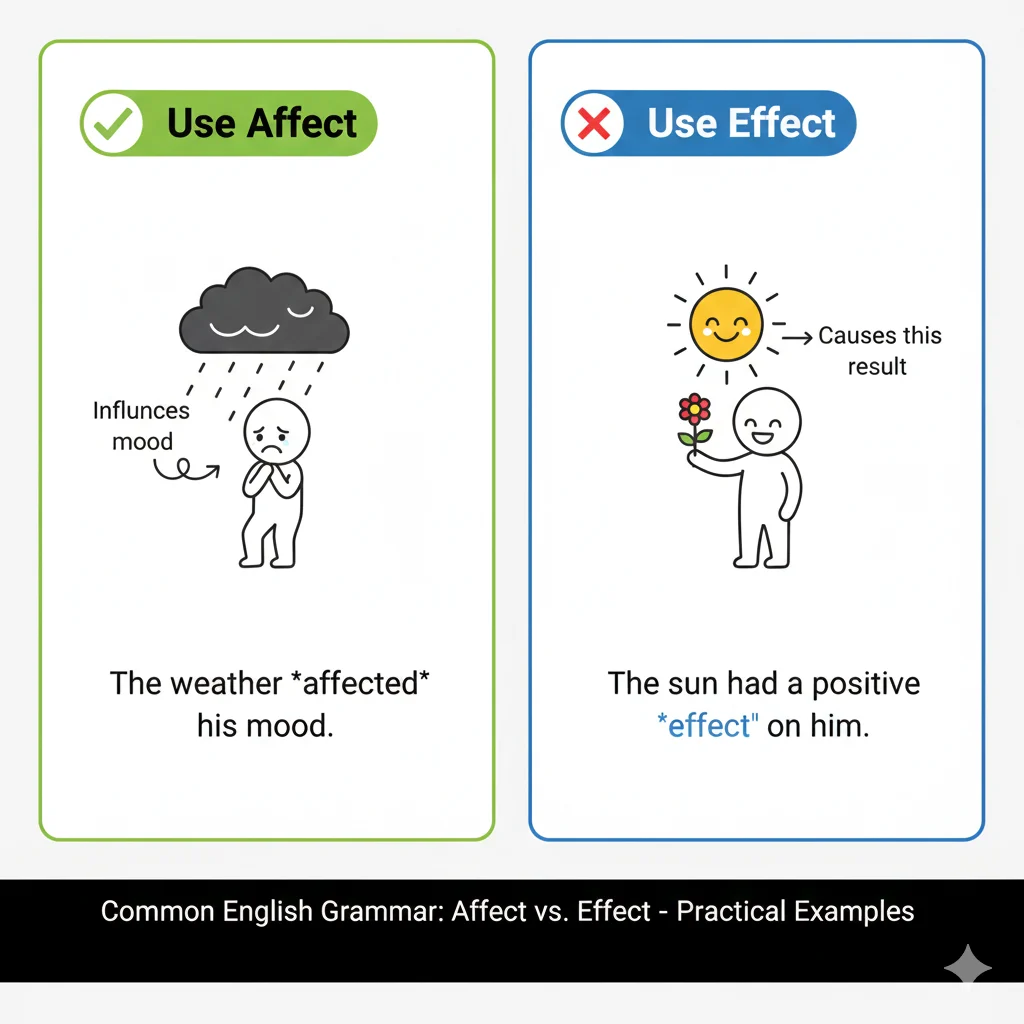
When to Use “Effect”
Use effect when you are talking about the result of an action.
It is a thing (noun), not an action.
Use “effect” in sentences like:
- The result of an action
- The outcome of a change
- The end product
Examples
- The effect of no sleep is tiredness.
- The effect of pollution is dirty air.
- Exercise has a good effect on your body.
- The effect of kindness is happiness.
- The effect of the new rule was faster work.
Memory Hack
If you can put “the” before the word, and it still makes sense —
it is probably effect.
Example:
✔ The effect
❌ The affect
Quick Recap: Effect vs Affect
- Affect = verb = action = to influence
- Effect = noun = result = outcome
- Affect shows what is happening
- Effect shows what happened after
- A for Action, E for End result
Advanced Tips
1. Rare case: “Effect” as a verb
Sometimes in business or formal writing, “effect” can be a verb meaning to bring about or to cause something to happen.
Example:
- The manager plans to effect major changes.
But this is very uncommon and not used in everyday English.
2. Rare case: “Affect” as a noun
Used in psychology to mean emotion or mood.
Example:
- The patient had a flat affect.
This is used only in medical or psychiatric contexts.
3. Using the words in essays or exams
Teachers often expect correct usage because it shows clear writing.
Using them properly makes your writing look professional.
4. In texting or social media
People often type quickly and mix them up.
But using the correct word helps your message look clean and smart.
Mini Quiz: Test Yourself!
Fill in the blanks with effect or affect.
- The loud noise can ______ your focus.
- The new rule had a great ______ on students.
- Poor sleep ______ health in many ways.
- The ______ of the fire was visible smoke.
- Weather changes can ______ your mood.
- The medicine had no ______.
- Stress can ______ your appetite.
(Answers: 1. affect, 2. effect, 3. affects, 4. effect, 5. affect, 6. effect, 7. affect)
FAQs
1. What is the simple difference between effect and affect?
Affect means to influence (action).
Effect means the result (outcome).
2. Is effect a noun or verb?
“Effect” is mostly a noun meaning the result of something.
3. Is affect a noun or verb?
“Affect” is usually a verb meaning to influence or change.
4. How can I remember effect vs affect easily?
Think: Affect = Action, Effect = End result.
5. Can affect ever be used as a noun?
Yes, in psychology. It means a person’s emotional expression.
Conclusion
Now you clearly understand the difference between effect and affect, how to use them, and how to avoid the most common mistakes. Remember the simple rule: Affect is an action, and effect is a result. With this small trick, you can choose the right word in school assignments, daily conversations, texting, essays, or professional writing.
Learning English becomes easier when you break ideas into small, simple parts — just like we did here. Keep practicing, try the examples, and test yourself using the mini quiz anytime. With regular use, choosing the correct word will become natural and effortless.
Keep learning — every small step improves your English!

Caribbean-born novelist Jean Rhys (1890–1979) explored alienation, identity, and female psychology with lyrical, haunting, and emotionally rich prose.