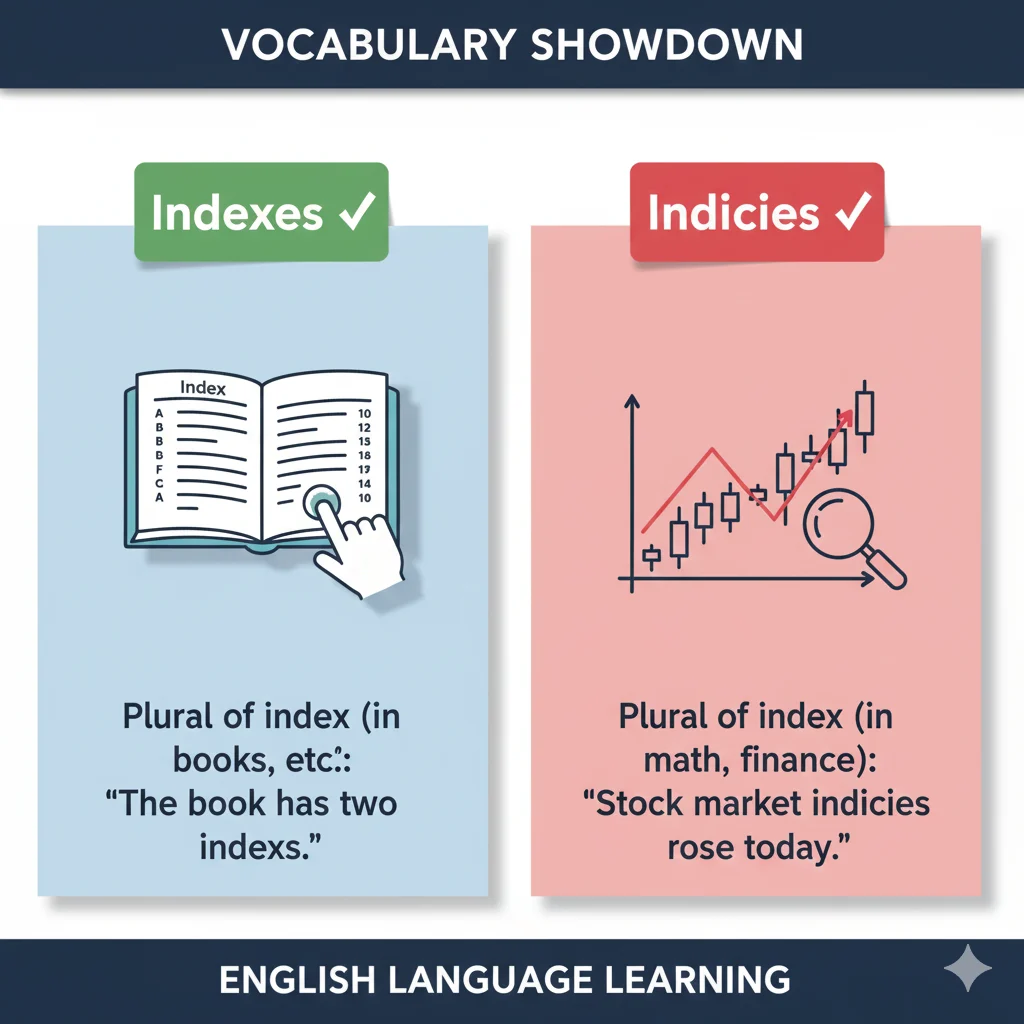
Many English learners and even native speakers often get confused between indexes and indices. Both words are plural forms used in similar contexts, but they are not always interchangeable. Using the wrong one in writing or conversation can sound awkward or overly formal.
In this article, we will clearly explain what indexes and indices mean, how they are used, and the key differences between them. You will see simple examples, common mistakes, and practical tips for remembering which one to use.
By the end of this guide, even beginners will be able to confidently choose the correct word in sentences, reports, or essays. Whether you are a student, professional, or someone who just loves learning English, this guide makes it easy to understand indexes vs indices without confusion.
What Does Each Word Mean?
Indexes
Definition:
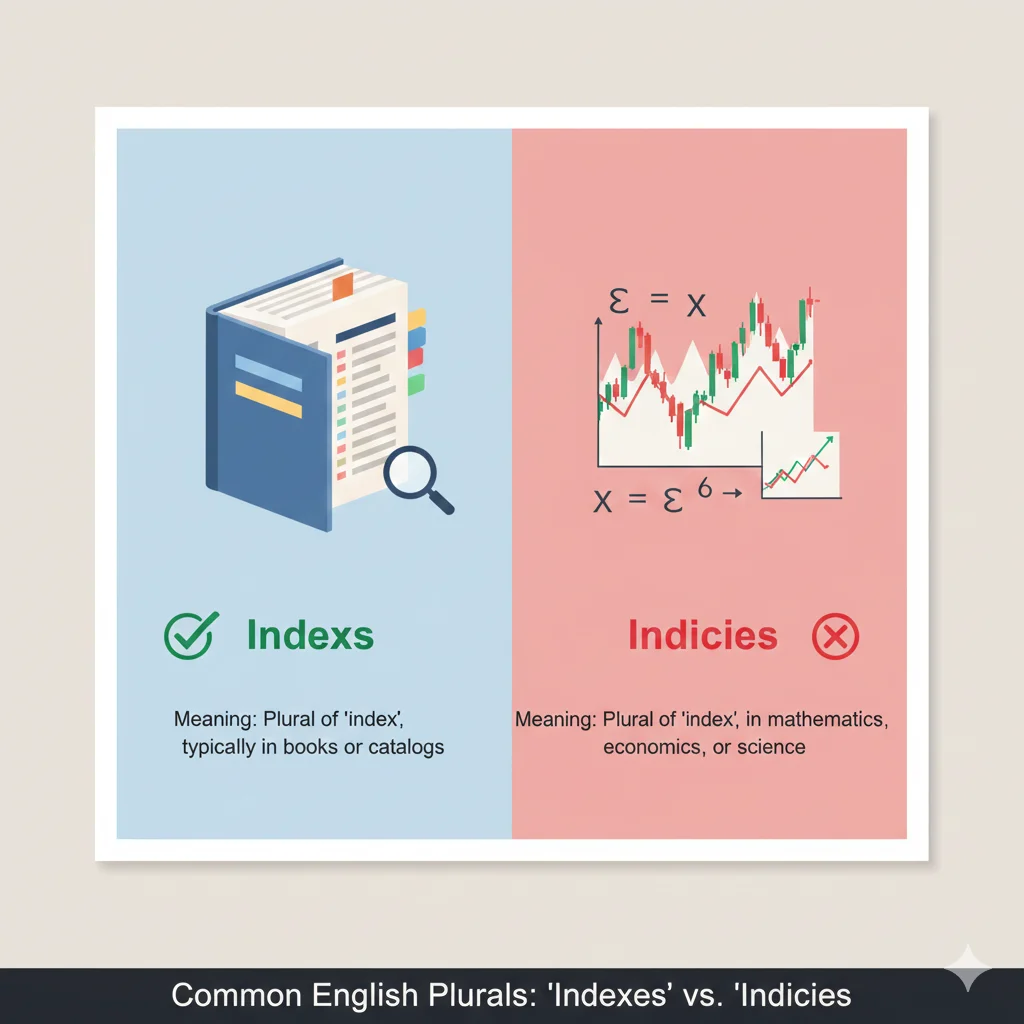
“Indexes” is the standard plural form of the word index. An index is usually a list, table, or number that shows information in an organized way.
Part of Speech:
- Noun (plural: indexes)
Simple Examples:
- The book has several indexes at the end for easy reference.
- Stock market indexes help investors track company performance.
- The library maintains digital indexes of all its books.
Memorable Tip:
Think of indexes as the “everyday, regular lists” you use in school or work.
Indices
Definition:
“Indices” is the more formal or technical plural form of index. It is often used in mathematics, science, finance, or technical writing.
Part of Speech:
- Noun (plural: indices)
Simple Examples:
- The mathematician calculated the indices of all variables.
- Economic indices indicate the country’s financial health.
- Scientific papers often report indices instead of plain numbers.
Memorable Tip:
Think of indices as “fancy or technical lists,” usually in professional or academic contexts.
The Key Difference Between Indexes and Indices
| Feature | Indexes | Indices |
|---|---|---|
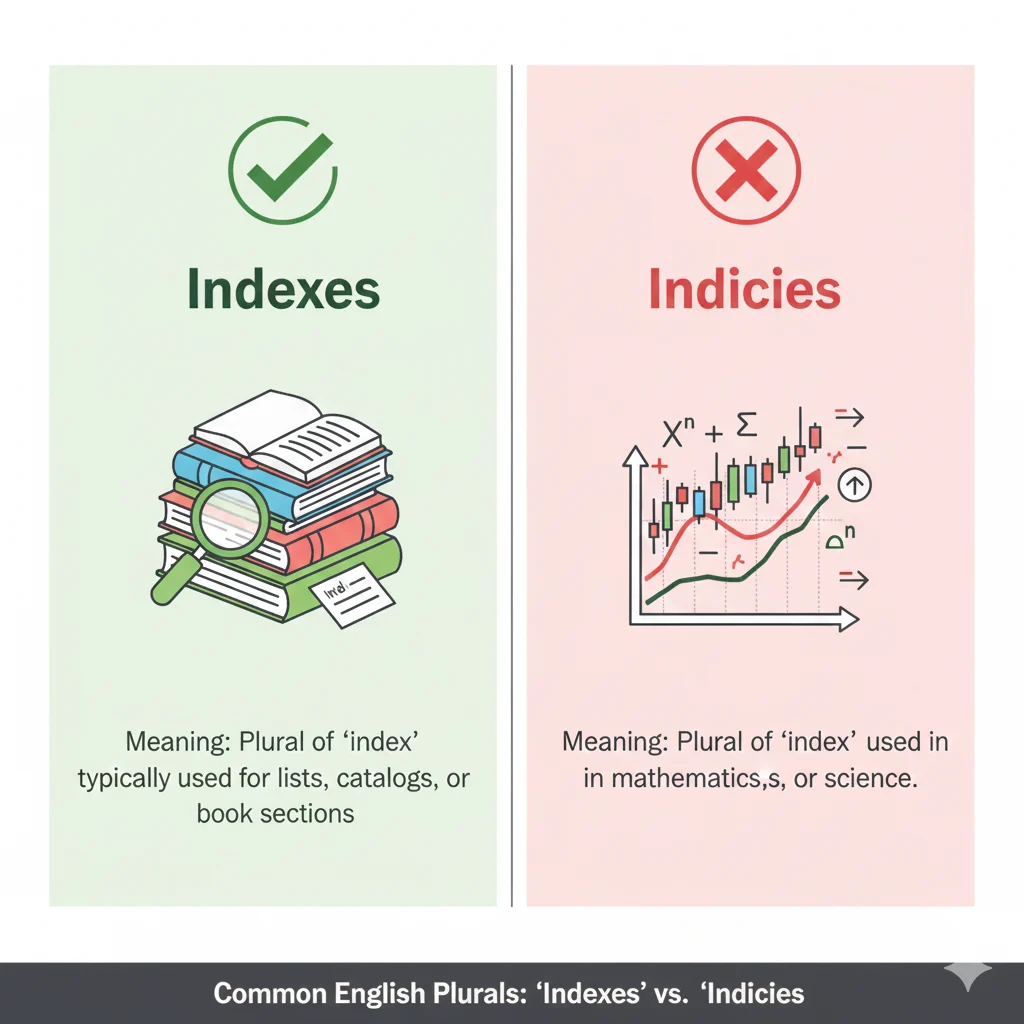
| Meaning | Plural form of index for everyday use | Plural form of index for technical use |
| Usage | Books, libraries, websites, general lists | Mathematics, science, finance, economics |
| Tone | Casual, everyday | Formal, technical |
| Examples | Book indexes, library indexes, site indexes | Stock market indices, scientific indices, data indices |
| Quick Tip | Use indexes for normal lists | Use indices for technical or formal situations |
Quick Tip:
If you’re writing for school, business, or casual purposes, indexes is safer. Use indices for math, science, finance, or academic papers.
Common Mistakes and How to Avoid Them
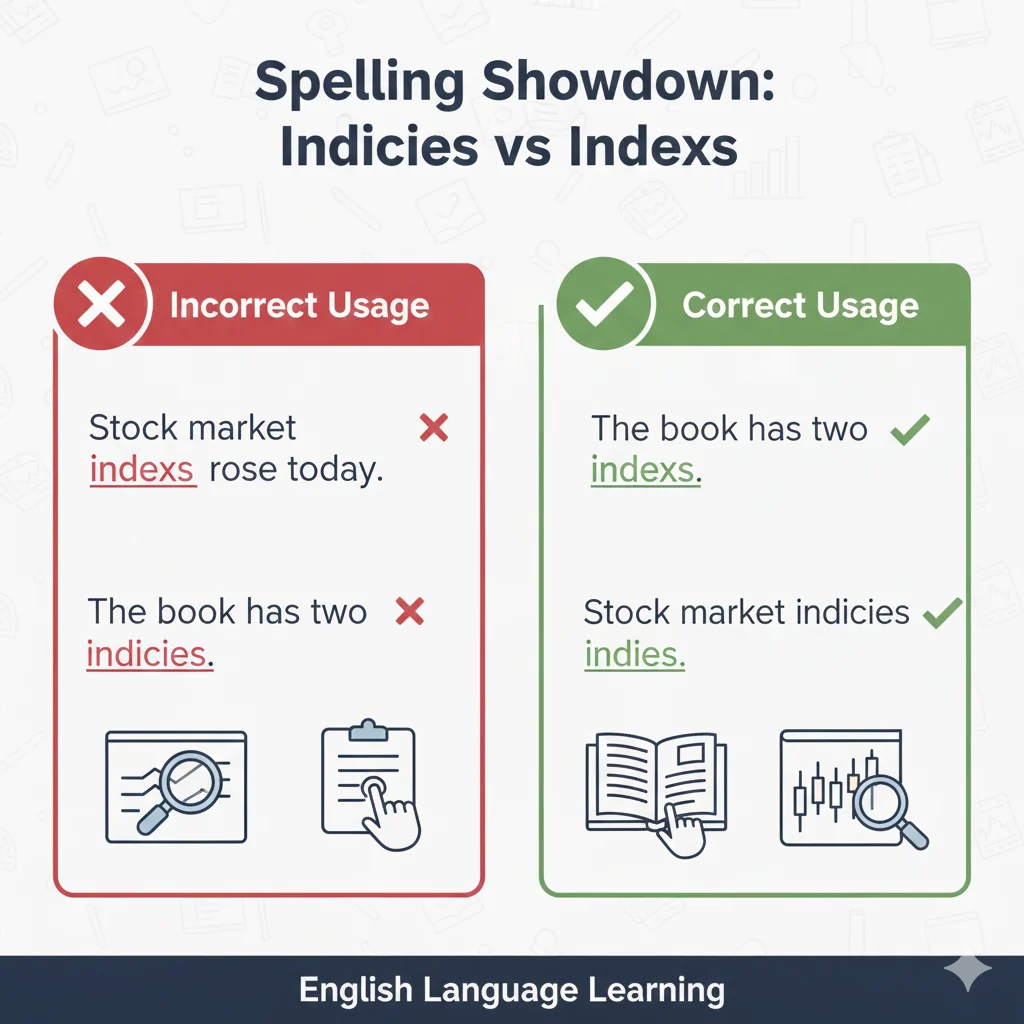
- Incorrect: The report lists all book indices.
Correct: The report lists all book indexes.
Why: “Indices” sounds too formal for a simple book list. - Incorrect: Investors track stock market indexes carefully.
Correct: Investors track stock market indices carefully.
Why: Stock market tracking is technical; indices is more accurate. - Incorrect: The library has many indices online.
Correct: The library has many indexes online.
Why: General lists in libraries are everyday use, not technical.
When to Use Indexes
Usage Situations:
- School textbooks or novels
- Library catalogs
- Website search or table of contents
- Casual conversation or general writing
Examples:
- I checked the indexes at the back of my history book.
- The website’s search indexes help find articles quickly.
- The recipe book has an indexes section for ingredients.
- Students use indexes to locate chapters easily.
Memory Trick:
Think “indexes = everyday lists”. If it’s not technical, just use indexes.
When to Use Indices
Usage Situations:
- Mathematics (exponents or powers)
- Science research (chemical or biological data)
- Finance and economics (stock market, inflation, etc.)
- Academic or formal writing
Examples:
- The engineer calculated the indices of refraction.
- Inflation indices show how prices have changed over time.
- The biologist studied biodiversity indices in the rainforest.
- The math book explains the rules for exponents and indices.
Memory Hack:
Think “indices = technical or formal numbers”. If it’s science, math, or finance, use indices.
Quick Recap: Indexes vs Indices
- Indexes
- Everyday plural of index
- Used in books, websites, casual lists
- Example: Book indexes, library indexes
- Indices
- Formal, technical plural of index
- Used in math, science, finance
- Example: Stock market indices, mathematical indices
- Tip: For casual writing, choose indexes. For technical writing, choose indices.
Advanced Tips
- Origin: Both words come from the Latin word index, meaning “sign” or “pointer.”
- Formal Writing: Academic papers and scientific journals prefer indices.
- Online Writing: Using the wrong form (e.g., indices in a blog post) can confuse readers.
- Exams & Tests: Remember the context: general list → indexes, technical → indices.
Mini Quiz
Fill in the blanks with indexes or indices:
- The textbook has multiple __________ at the end to help students.
- The mathematician explained powers using __________.
- The financial report shows inflation __________ for the last year.
- The library maintains online __________ of all the books.
- Scientists calculated biodiversity __________ in the forest.
Answers: 1. indexes, 2. indices, 3. indices, 4. indexes, 5. indices
FAQs
1. Are indexes and indices interchangeable?
Sometimes, but indices is more formal or technical. Indexes is common in daily writing.
2. Which is correct in a book?
Use indexes for books, libraries, and casual lists.
3. Which is correct for finance?
Use indices for stock markets, economic data, or technical reports.
4. Can I use indices in casual writing?
It’s better to use indexes; using indices may sound overly formal.
5. How to remember the difference?
Think indexes = everyday lists, indices = technical or formal numbers.
Conclusion
Understanding the difference between indexes and indices is simpler than it seems. Indexes are everyday lists found in books, libraries, or websites, while indices are reserved for technical, mathematical, or scientific contexts. By learning the meanings, examples, and usage rules, you can confidently write sentences without confusion.
Practice using both words in real-life situations, like reading books or checking stock reports. Over time, choosing the correct plural form will become second nature. Remember, context is the key: casual → indexes, technical → indices. Every small step in learning correct word usage helps improve your English. Keep practicing, and soon you’ll master these tricky plurals with ease!

Caribbean-born novelist Jean Rhys (1890–1979) explored alienation, identity, and female psychology with lyrical, haunting, and emotionally rich prose.