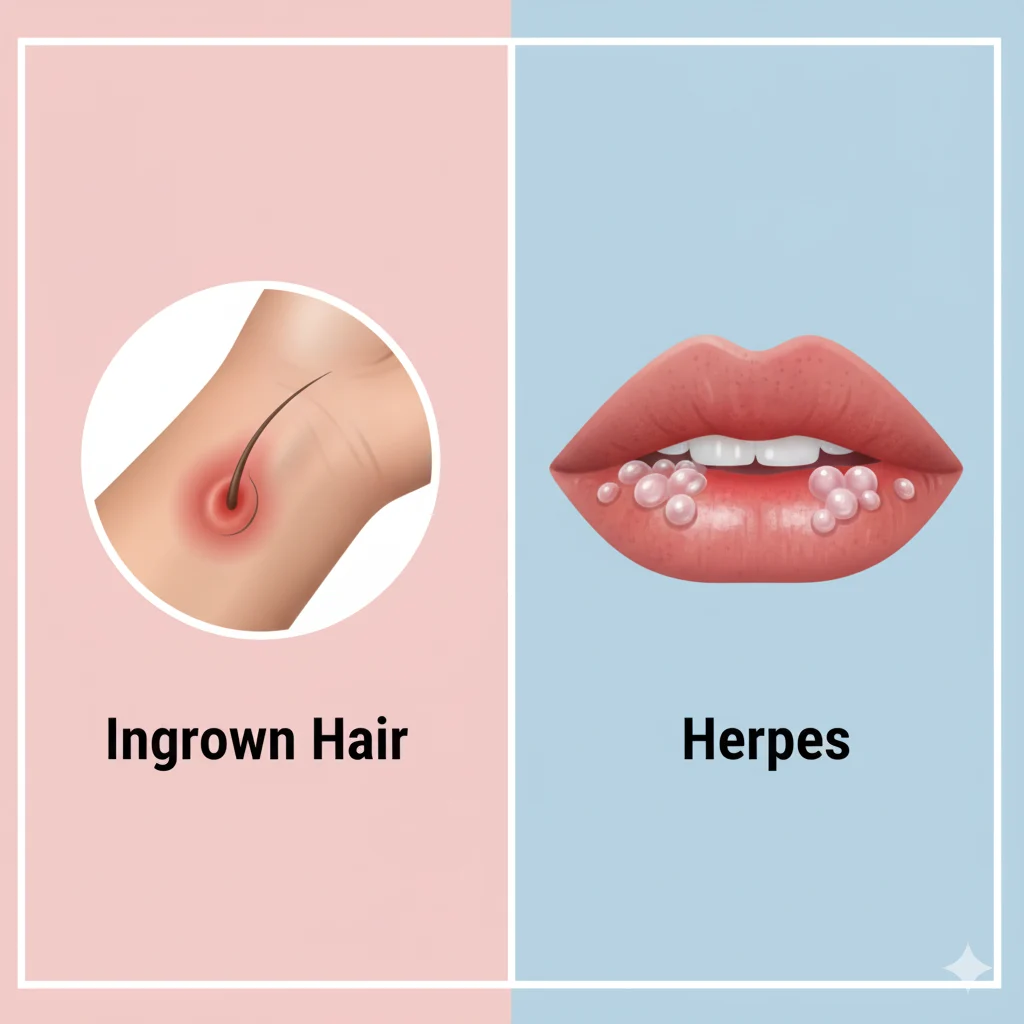
Many people often confuse ingrown hair or herpes, especially when noticing skin bumps, irritation, or redness. Both terms refer to conditions that affect the skin, but they are entirely different in cause, appearance, and treatment. Misunderstanding them can lead to unnecessary worry or incorrect self-care.
In this guide, we will break down ingrown hair vs herpes in simple terms. You will learn the meaning of each, their key differences, common mistakes people make, and practical examples of when to use each term correctly. By the end, even beginners will easily understand how to identify, describe, and talk about these conditions accurately. This guide also includes memory hacks, easy comparisons, and a mini quiz to test your knowledge.
What Does Each Word Mean?
Ingrown Hair
Meaning: An ingrown hair happens when a hair grows back into the skin instead of rising up from it. This can cause a red bump, itchiness, or mild pain.
Part of Speech: Noun
Simple Examples:
- I have an ingrown hair on my leg that hurts when I touch it.
- Shaving too closely can cause an ingrown hair.
- Applying warm compresses helps treat an ingrown hair.
Think of it like a plant seedling that accidentally grows sideways under the soil—it’s still hair, but it’s trapped.
Herpes
Meaning: Herpes is a viral infection caused by the herpes simplex virus (HSV). It appears as painful blisters or sores, usually on the mouth or genital area.
Part of Speech: Noun
Simple Examples:
- Cold sores are a common type of herpes.
- He was diagnosed with herpes after noticing small, painful blisters.
- Herpes can flare up during times of stress or illness.
Think of herpes as a virus that “lives” in your body and can reactivate, unlike an ingrown hair which is a one-time skin issue.
The Key Difference Between Ingrown Hair and Herpes
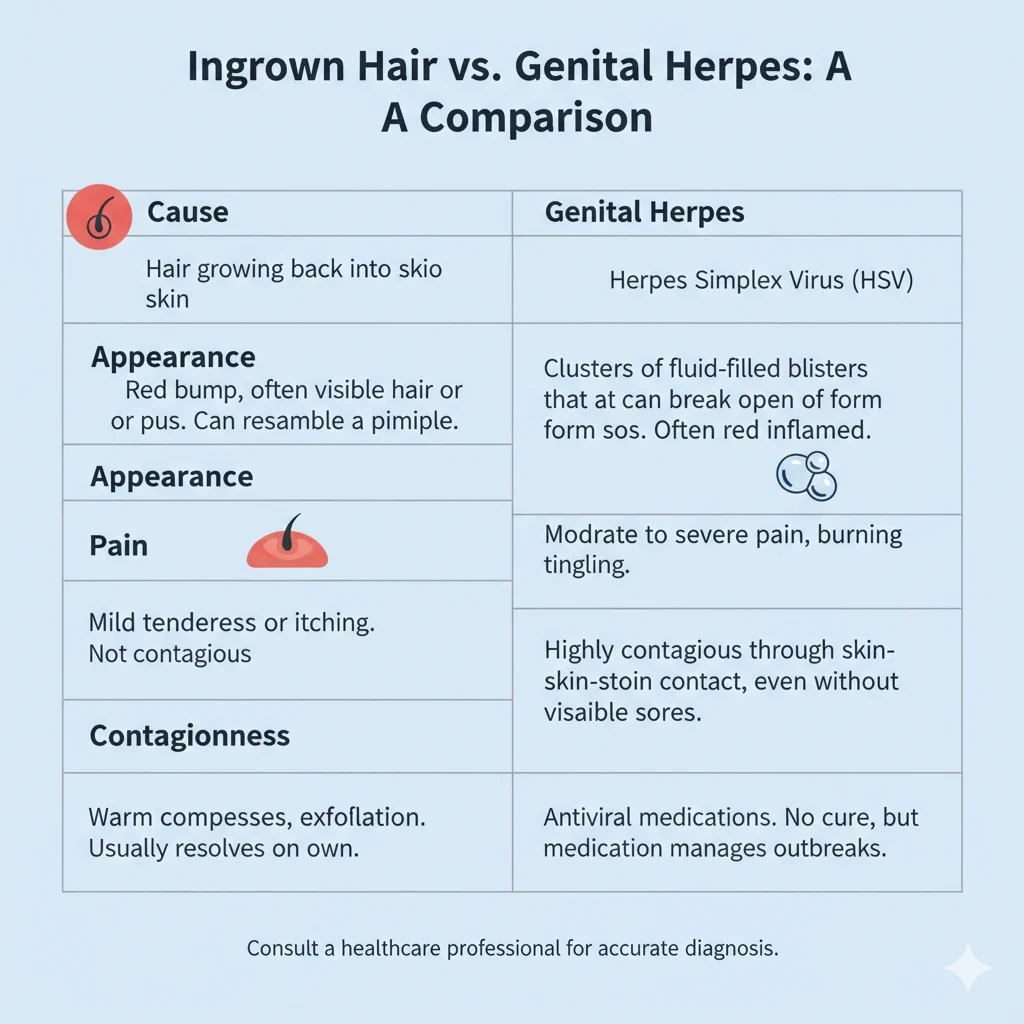
| Feature | Ingrown Hair | Herpes |
|---|---|---|
| Cause | Hair growing back into the skin | Viral infection (HSV) |
| Appearance | Small, red bump, sometimes with pus | Blisters or sores filled with fluid |
| Pain/Itch | Mild pain or itch | Tingling, burning, and painful sores |
| Contagious? | No | Yes, highly contagious |
| Treatment | Exfoliation, warm compress, sometimes removal | Antiviral medication, doctor consultation |
| Quick Tip | Usually occurs after shaving or waxing | Appears anywhere HSV virus affects skin |
Quick Tip to Remember: If it’s just a red bump after shaving, it’s likely an ingrown hair. If it’s a fluid-filled blister or recurring sore, think herpes.
Common Mistakes and How to Avoid Them
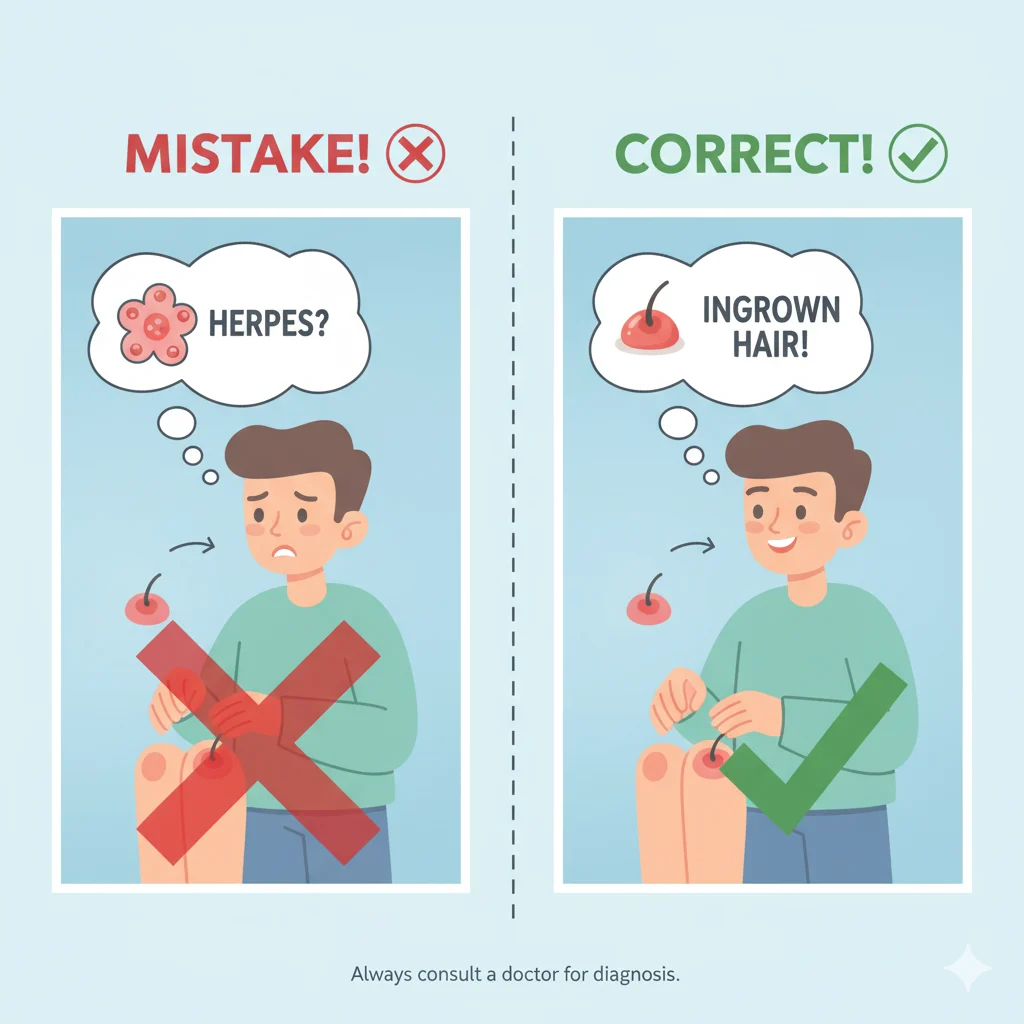
Incorrect: “I think I have herpes because of a red bump on my arm.”
Correct: “I think I have an ingrown hair on my arm.”
Why Mistake Happens: People often assume all skin bumps are infections. Always check the characteristics—blister vs hair bump.
Incorrect: “Ingrown hairs are contagious like herpes.”
Correct: “Ingrown hairs are not contagious; herpes can spread to others.”
Why Mistake Happens: Misunderstanding the nature of each condition. Remember: one is viral, the other is mechanical.
When to Use Ingrown Hair
Use in situations involving hair growth problems:
Examples:
- After shaving, I noticed an ingrown hair on my chin.
- My legs have a few ingrown hairs from waxing.
- Exfoliating the skin helps prevent ingrown hairs.
- Don’t pick at an ingrown hair, or it may get infected.
Memory Hack: Think “hair trapped under the skin”—ingrown hair.
When to Use Herpes
Use when talking about viral infections:
Examples:
- He visited a doctor for herpes sores around his mouth.
- Stress can trigger a herpes outbreak.
- Avoid close contact with someone who has active herpes.
- Herpes can’t be cured, but medication helps control symptoms.
Visual Trick: Imagine little fluid-filled balloons on the skin—this is a herpes sore.
Quick Recap: Ingrown Hair vs Herpes
- Ingrown Hair: Hair grows under skin → red bump → not contagious → caused by shaving/waxing.
- Herpes: Viral infection → fluid-filled blisters → contagious → caused by HSV virus.
- Tip: Check appearance, pain type, and whether it spreads to others.
Advanced Tips
- Origins: “Ingrown” comes from the idea of hair growing inward. “Herpes” comes from Greek herpein, meaning “to creep,” describing the virus spreading along nerves.
- Formal Writing: Use “herpes simplex virus” in medical papers; use “ingrown hair” in personal care or dermatology contexts.
- Online Writing: Don’t label every red bump as herpes—it can spread misinformation.
Mini Quiz
Fill in the blanks:
- A small red bump caused by shaving is an ________.
- Fluid-filled sores on lips are usually ________.
- ________ is contagious; ________ is not.
- Warm compresses help treat ________.
- Stress can trigger ________ outbreaks.
- ________ grows under the skin, while ________ is caused by a virus.
- Exfoliating prevents ________ but does not affect ________.
Answers: 1. Ingrown hair 2. Herpes 3. Herpes, ingrown hair 4. Ingrown hair 5. Herpes 6. Ingrown hair, herpes 7. Ingrown hair, herpes
5 FAQs
1. Can ingrown hair turn into herpes?
No. Ingrown hair is mechanical, herpes is viral. They are unrelated.
2. How can I tell the difference quickly?
Check for blisters (herpes) vs red bumps (ingrown hair).
3. Are ingrown hairs contagious?
No. Only herpes is contagious.
4. Can I treat herpes at home?
No. See a doctor; antiviral medication is needed.
5. Does shaving cause herpes?
No. Shaving may cause ingrown hairs, not herpes.
Conclusion
Understanding ingrown hair or herpes is easier than it seems. Ingrown hairs are red bumps caused by hair growing under the skin, while herpes is a viral infection causing painful blisters. By recognizing the appearance, cause, and contagiousness, you can use these words accurately in daily conversations, writing, and even medical discussions. Avoid common mistakes by observing symptoms carefully and remembering the key differences. Practice using the examples in this guide, take the mini quiz, and soon you’ll confidently distinguish between the two. Learning small yet important grammar and usage distinctions like this improves your English every day.

English playwright and novelist Patrick Hamilton (1904–1962) captured psychological tension, social decay, and dark humor in gripping, unforgettable stories.