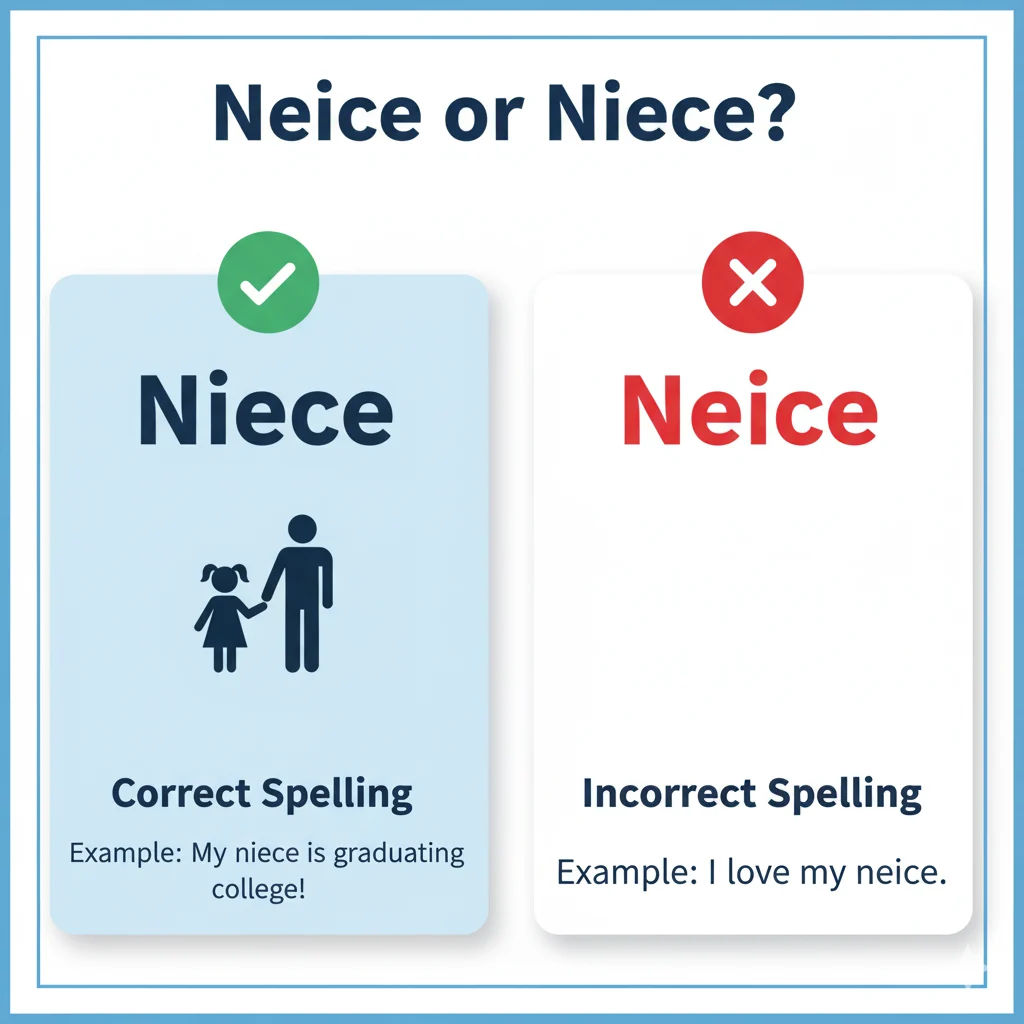
Many people get confused between “neice” or “niece” because both look correct at first glance. The truth is simple: only one of them is correct English, but the incorrect version is used so often that learners start doubting themselves. If you’ve ever stopped while typing and wondered, “Is it neice or niece?”, this guide will help you forever.
In this article, you’ll learn the correct spelling, the meaning, the difference, and how to use the correct word in real-life sentences. Every explanation is written in easy, clear English, suitable for complete beginners—even a 4th-grade student can understand it. By the end, you will remember the correct spelling instantly and avoid this common grammar mistake in everyday writing.
Let’s make this confusing pair super simple!
What Does Each Word Mean?
1. “Niece” — Correct Word
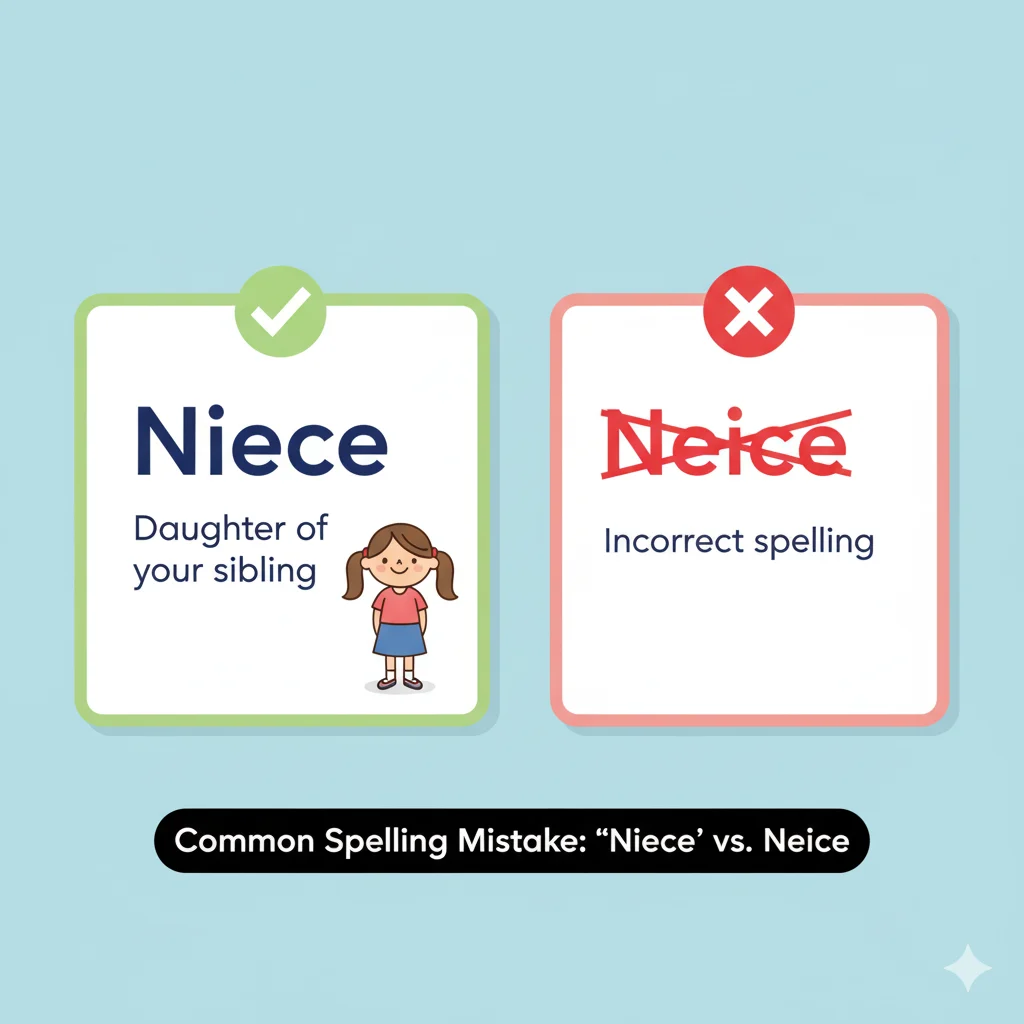
Meaning: A niece is the daughter of your brother or sister.
Part of speech: Noun (a naming word)
Easy examples:
- My niece loves drawing.
- I bought a birthday gift for my niece.
- Her niece visits every weekend.
You can think of a niece as “a younger girl in your family,” but specifically the child of your siblings.
2. “Neice” — Incorrect Word
Meaning: Neice has no meaning in English.
It is simply a spelling mistake.
People often write “neice” by accident because the English “ie/ei” pattern is confusing.
Incorrect examples:
❌ She is my neice.
❌ I will call my neice today.
These sentences are wrong. Always replace neice with niece.
PleadED or Pled: What’s the Difference & Which One Is Correct?
The Key Difference Between “Neice” and “Niece”
The difference is extremely simple:
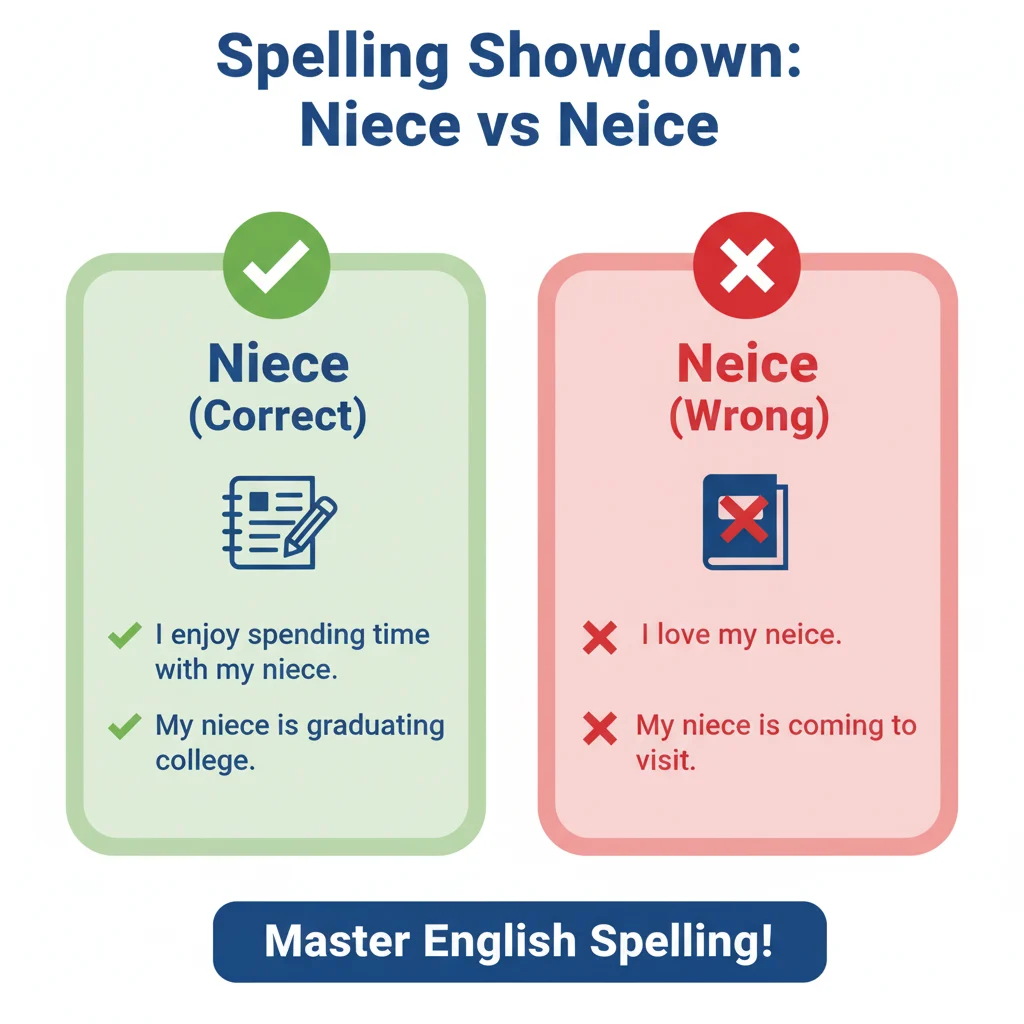
- Niece = ✔️ correct spelling
- Neice = ❌ incorrect spelling
That’s it!
Comparison Table (Easy Visual Guide)
| Feature | Niece (Correct) | Neice (Incorrect) |
|---|---|---|
| Meaning | Daughter of your brother/sister | No meaning |
| Part of speech | Noun | — |
| Accepted in English? | ✔️ Yes | ❌ No |
| Example sentence | “My niece is in 5th grade.” | “My neice is in 5th grade.” (wrong) |
Quick Tip to Remember
💡 The word “niece” contains “ice.”
Imagine your niece eating ice cream.
If you remember ICE, you will always spell NIECE correctly.
Common Mistakes and How to Avoid Them
1. Mixing up “ie” and “ei”
English has many confusing spellings like “friend,” “believe,” “receive.”
People think the same rule applies to niece, so they wrongly type neice.
2. Relying on pronunciation
Both neice and niece sound the same, so people rely on hearing instead of spelling.
3. Spell-check errors
Fast typing often causes the “i” and “e” to switch places.
Incorrect vs Correct Examples
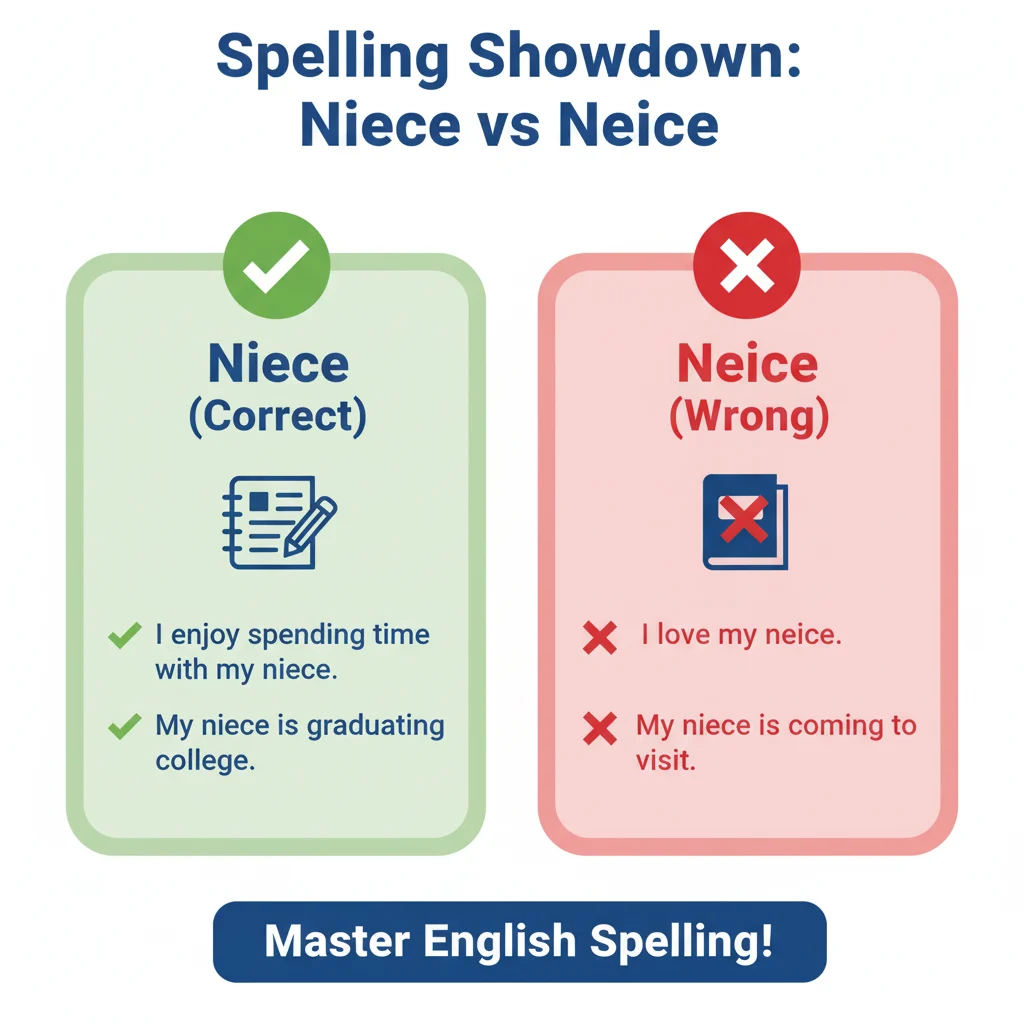
❌ I love spending time with my neice.
✔️ I love spending time with my niece.
❌ My neice starts school tomorrow.
✔️ My niece starts school tomorrow.
How to fix it:
Always slow down when typing words with ie/ei.
Use the ICE trick: your niece loves ice cream!
When to Use “Niece” (Correct Word)
You should always use niece when talking about:
- Your brother’s daughter
- Your sister’s daughter
- Your spouse’s sibling’s daughter
- Your adopted sibling’s daughter
Basically, whenever you describe a girl in the family one generation below you.
Easy Example Sentences
- My niece won a gold medal in school.
- We invited my niece to the picnic.
- Her niece baked cookies on Sunday.
- I read a bedtime story to my niece yesterday.
- His niece likes to collect stickers.
These simple examples help you see how the word is used in everyday situations (school, family, events, celebrations).
When to Use “Neice”
Never.
Neice is always wrong.
It should not be used in any sentence, school essay, online post, or message.
Memory Hack to Avoid “Neice” Forever
Think of the word:
N + ICE → N-ICE → NIECE
If you see the letters “E I” together, pause!
The correct word has I E (just like “piece” or “friend”).
Quick Recap: Niece vs Neice
- Niece = ✔️ correct spelling
- Neice = ❌ incorrect spelling
- Meaning: Daughter of your brother or sister
- Use “NIECE” in all writing
- Remember: Your niece likes ICE cream → NIECE (ICE)
Advanced Tips
1. Word Origin
The word “niece” comes from the Old French word “niece”, meaning “granddaughter” or “female relative.”
This old spelling helps explain why the letters “ie” appear together.
2. Use in Formal Writing
In essays, applications, and emails, always double-check the spelling because one small mistake (writing neice) can look unprofessional.
3. Usage in Exams
English tests often ask students to choose the correct spelling.
Always select niece.
4. Online & Texting Habits
Many texting errors come from fast typing.
If you often type “neice,” consider adding “niece” to your personal autocorrect dictionary.
Mini Quiz (Test Yourself!)
Fill in the blanks with niece:
- My _______ loves pink dresses.
- We are taking my _______ to the zoo.
- His _______ is learning to swim.
- I bought my _______ a storybook.
- Her _______ starts school next week.
- They celebrated their _______’s birthday yesterday.
- I enjoy talking to my _______ after school.
(Answers: niece for all)
5 Helpful FAQs
1. What is the correct spelling: neice or niece?
The correct spelling is niece. “Neice” is always wrong.
2. What does “niece” mean in English?
It means the daughter of your brother or sister.
3. Why do people write “neice”?
Because “ie/ei” spellings in English are confusing, and both versions sound the same.
4. How can I remember the spelling?
Think: NIECE contains ICE → your niece loves ice cream.
5. Is “neice” ever accepted in any country?
No. “Neice” is not accepted in American, British, Canadian, or Australian English.
Conclusion
The confusion between “neice or niece” is extremely common, but now you know the simple truth: only niece is correct. It’s a name used for your sibling’s daughter and should be spelled with I E, never E I. Using the ICE memory trick, the examples, and the tips in this guide, you can confidently choose the right spelling every time. Keep practicing, keep reading, and keep improving—good spelling becomes easier when you understand the meaning behind the words.
You’re now one step closer to writing clear, accurate English every day!

English playwright and novelist Patrick Hamilton (1904–1962) captured psychological tension, social decay, and dark humor in gripping, unforgettable stories.