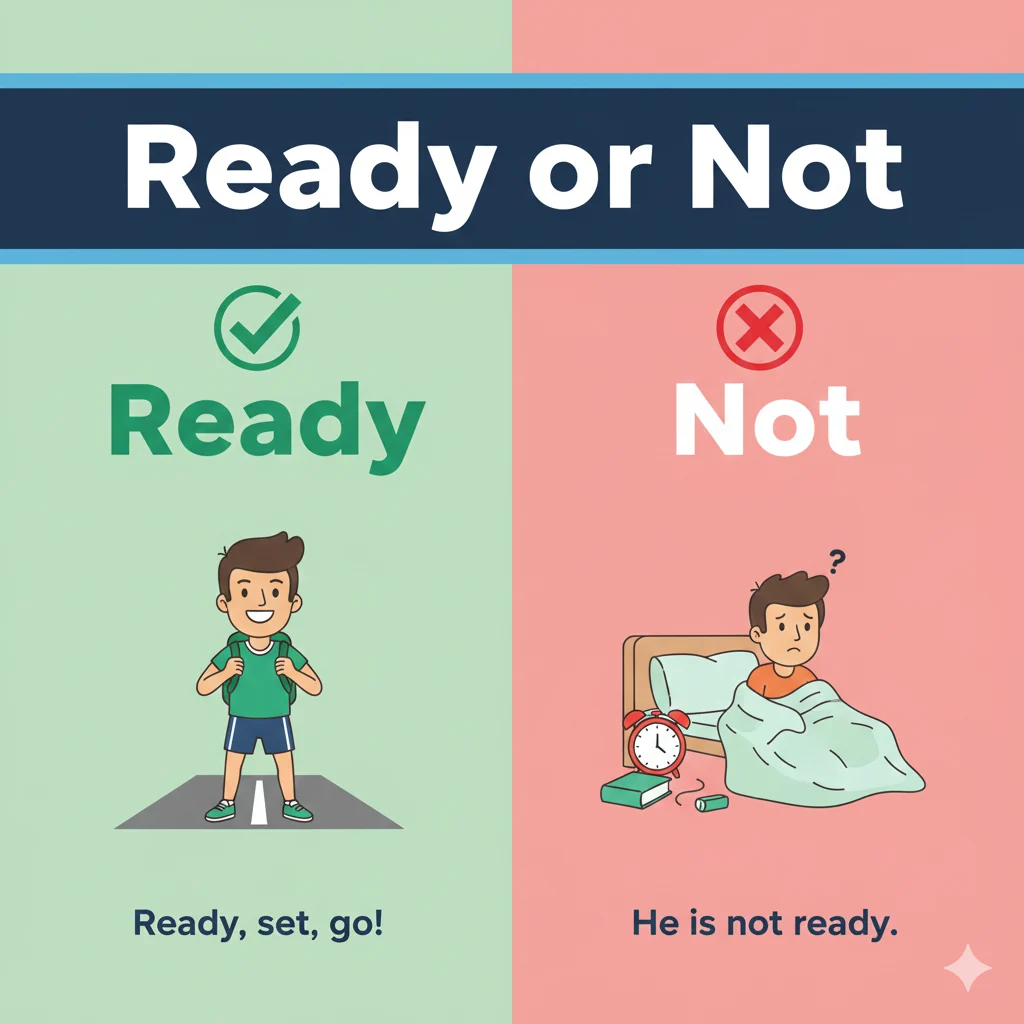
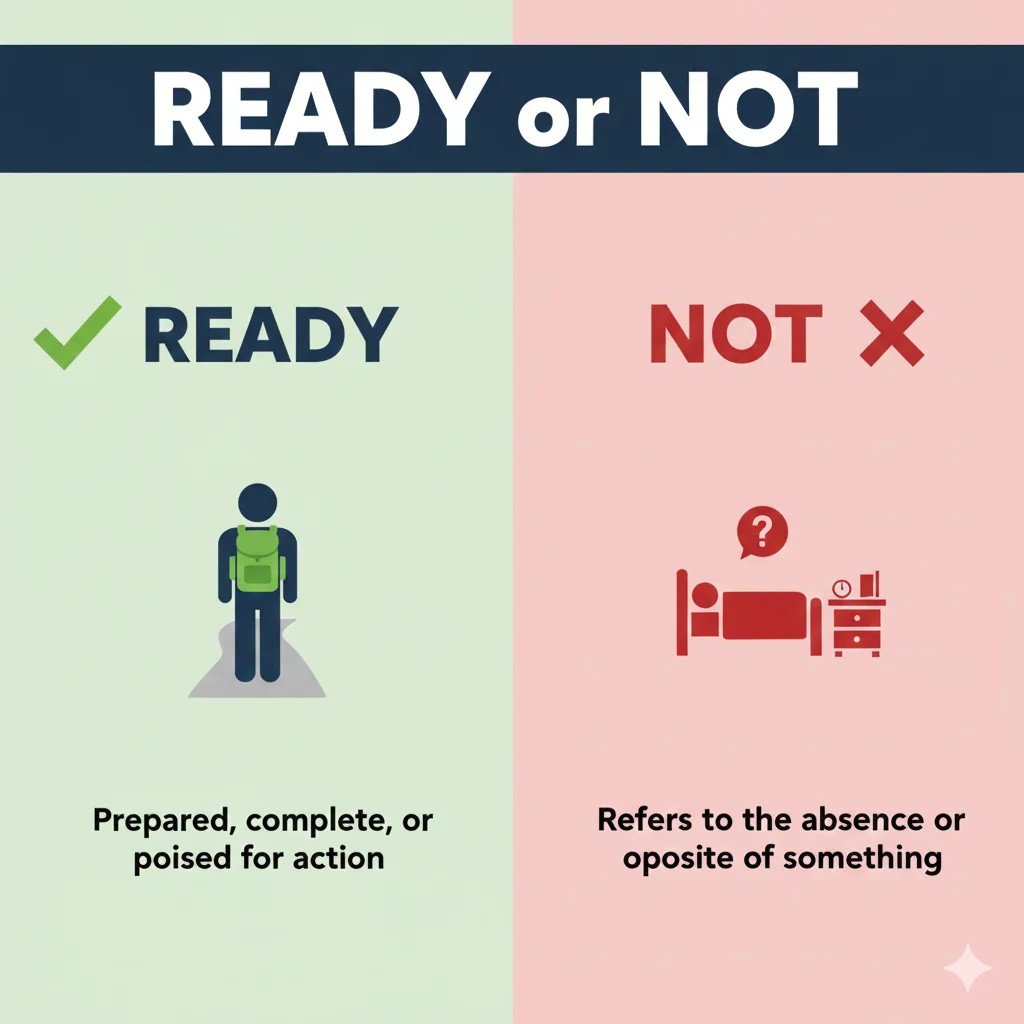
- “Ready” means prepared.
- “Not” means no / negative / opposite.
- “Ready or not” is a phrase used to say something will happen whether you are prepared or not.
The phrase “ready or not” is one of the most commonly used expressions in English. People hear it in games, movies, classrooms, and daily conversations. Even though it looks simple, many learners are confused about what it really means, how to use it correctly, and why both words together change the meaning of a sentence.
In this complete guide, we will explain the meaning of “ready”, the meaning of “not,” and how the combined phrase “ready or not” works in English. You will also learn the difference, correct usage, easy examples, common mistakes, and memory tricks. Each section is written in simple English, so even a 4th-grade student can understand it without difficulty.
By the end of this article, you will be able to use ready or not confidently in conversations, writing, texting, and school work.
What Does Each Word Mean?
1. Meaning of “Ready”
Part of Speech: adjective
Simple Meaning: prepared, set, all done, or about to start something.
Examples of “ready”
- I am ready for school.
- The food is ready to eat.
- She is ready to start her exam.
Memory Tip:
Ready = prepared.
If you can begin something, you are “ready.”
2. Meaning of “Not”
Part of Speech: adverb
Simple Meaning: no, negative, does not, opposite.
Examples of “not”
- I am not going outside.
- This is not my book.
- He is not happy today.
Memory Tip:
Not = opposite or negative.
If something is “not” true, it means the opposite is true.
What Happens When We Join Them? – “Ready or Not”
When “ready” and “not” come together as “ready or not,” the meaning becomes:
👉 Something will start even if you are not prepared.
It is often used:
- before starting a game,
- when someone must begin without waiting,
- when time is up,
- when a situation cannot be delayed,
- in movies and books to build suspense.
Example Sentences
- Ready or not, the test begins now.
- We are leaving in five minutes, ready or not.
- Ready or not, here I come! (used in games like hide-and-seek)
The Key Difference Between “Ready” and “Not”
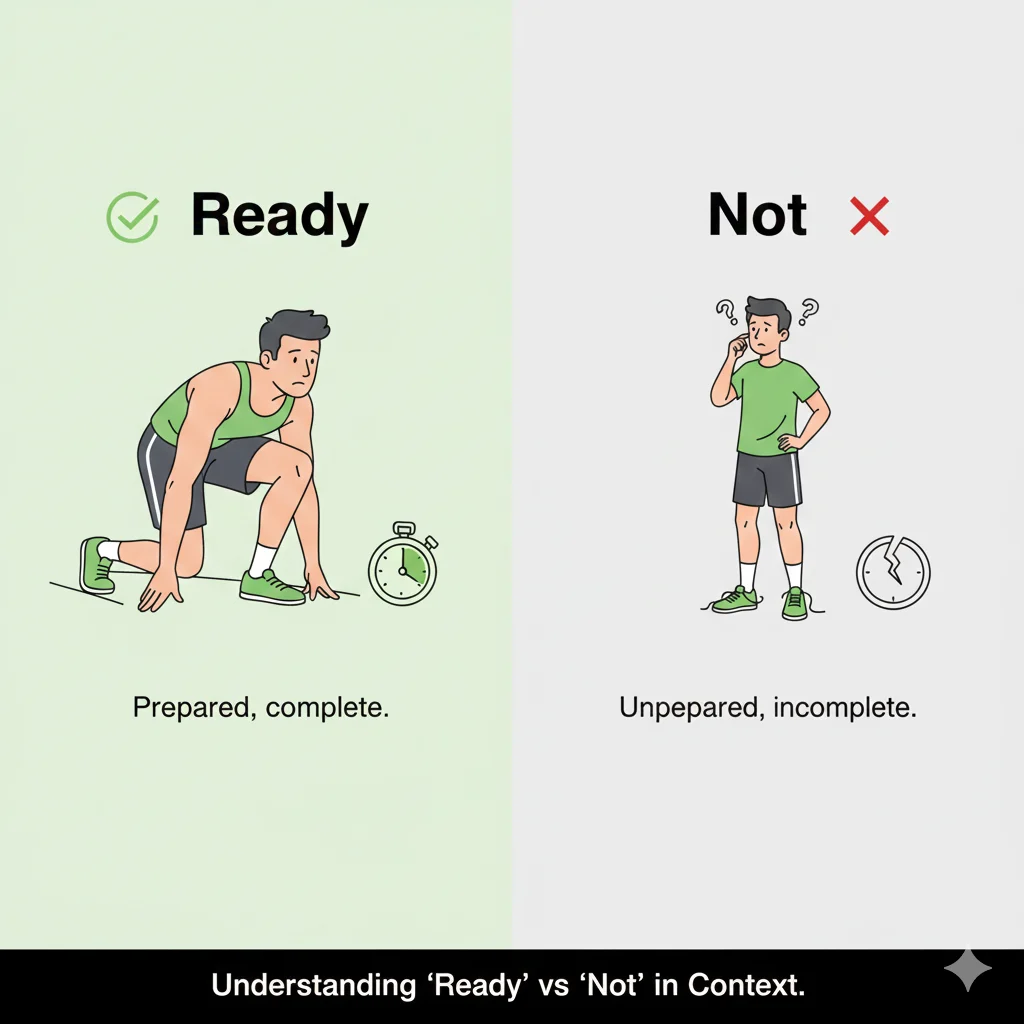
Even though they appear together in the phrase, the two words are completely different.
Comparison Table: “Ready” vs “Not”
| Feature | Ready | Not |
|---|---|---|
| Meaning | Prepared | Opposite / Negative |
| Part of Speech | Adjective | Adverb |
| Usage | Describes a state (being prepared) | Changes a sentence to negative |
| Example | I am ready to go. | I am not ready to go. |
| Memory Trick | Ready = set | Not = no / opposite |
Quick Tip to Remember
- If you want to say someone is prepared, use ready.
- If you want to say someone is the opposite of ready, use not ready.
- If you want to say something will happen anyway, use ready or not.
Common Mistakes and How to Avoid Them
Mistake 1: Using only “ready” when the meaning is negative
❌ I am ready going to school.
✔️ I am not ready to go to school.
Why the mistake happens: The speaker forgets that “ready” means prepared.
Mistake 2: Using “not ready” instead of “ready or not”
❌ Not ready, here I come!
✔️ Ready or not, here I come!
Why the mistake happens: Learners think “not ready” is the same as the phrase “ready or not,” but the phrase has a special meaning.
Mistake 3: Using “ready or not” in situations where nothing is starting
❌ I am doing homework, ready or not.
✔️ Use “ready or not” when something must begin.
Correct Use: Ready or not, the class is starting.
When to Use “Ready”
Use ready when someone or something is prepared.
Examples of “ready”
- The students are ready for the test.
- Dinner is ready.
- She is ready to present her project.
- The car is ready to drive.
- I am ready when you are.
Real-Life Situations
- When starting school
- Before a match or game
- Before meals
- When a task is completed
- When a person is prepared mentally or physically
When to Use “Not”
Use not to show the negative form of any word, action, or condition.
Examples of “not”
- I am not tired.
- This is not correct.
- She is not coming today.
- We do not have time.
- The answer is not simple.
Memory Hack
Think of not as a stop sign in English.
It stops the sentence from being positive.
Are Blueberries Blue or Purple? Understanding the True Color
When to Use the Phrase “Ready or Not”
Use ready or not when something must start, cannot be delayed, or will happen either way.
Examples
- Ready or not, the new year is coming.
- Ready or not, the bell is about to ring.
- Ready or not, the teacher will check your homework.
- Ready or not, the race begins now.
- Ready or not, life keeps moving.
Where It Is Commonly Used
- Hide-and-seek
- Announcing a deadline
- Telling someone time is up
- Motivational speeches
- Books and movies
Quick Recap: Ready vs Not vs Ready or Not
- Ready = prepared
- Not = negative/no/opposite
- Ready or not = something will happen even if you’re not prepared
Advanced Tips
1. Word Origin
- Ready comes from Old English “ræde,” meaning “prepared.”
- Not comes from Old English “naught” or “no whit,” meaning “nothing.”
2. In Formal Writing
- “Ready” is common in essays.
- “Not” is used to create negative sentences.
- “Ready or not” is usually informal and fits better in stories or dialogue.
3. In Online Writing or Texting
People often use “ready or not” to show:
- urgency
- pressure
- surprise
- excitement
Example:
“Ready or not, the update is coming today!”
Mini Quiz: Test Yourself
Fill in the blanks with ready, not, or ready or not.
- I am ________ for my presentation.
- ________, here comes the final round!
- She is ________ answering your call.
- We are ________ leaving in five minutes.
- The food is ________ yet.
- ________ you try your best, you can improve.
- He is ________ happy with the results.
(Answers: 1. ready, 2. Ready or not, 3. not, 4. ready or not, 5. not, 6. If, 7. not)
FAQs
1. What does “ready or not” mean?
It means something will begin whether you are prepared or not.
2. Is “ready or not” formal or informal?
It is mostly informal and used in conversations, games, and storytelling.
3. Can I use “ready” alone?
Yes. Use “ready” when someone or something is prepared.
4. Can “not ready” replace “ready or not”?
No. “Not ready” means unprepared. “Ready or not” means something will happen anyway.
5. How do children use “ready or not”?
Children commonly say “Ready or not, here I come!” while playing hide-and-seek.
Conclusion
The phrase “ready or not” may look simple, but it has a powerful meaning. “Ready” shows preparation, “not” shows the opposite, and the phrase “ready or not” tells us something will begin even without waiting. With the explanations, examples, and memory tricks in this guide, you can now use all three forms correctly in daily English.
Practice these words in real conversations, writing, and schoolwork. The more you use them, the easier English becomes.
Keep learning—your language skills get better every day!

English novelist and poet Thomas Hardy (1840–1928) explored human struggles, social constraints, and tragic love with deep realism and vivid storytelling.