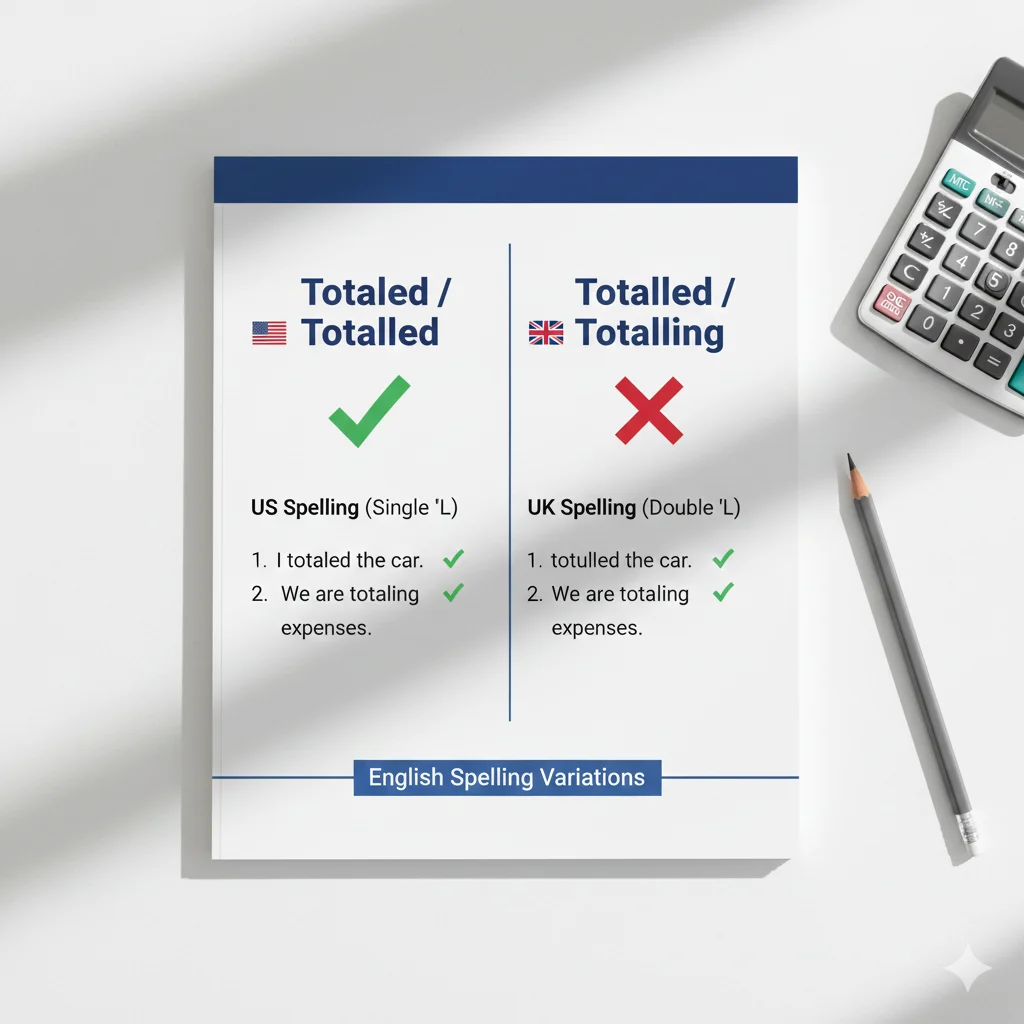
English can sometimes feel tricky, especially when the same word appears in different spellings. “Totalled,” “totaling,” and “totalling” are perfect examples. These words confuse many learners because they sound the same, mean nearly the same thing, and only differ by one letter — the extra “l.”
Why does British English use “totalled” and “totalling,” while American English prefers “totaled” and “totaling”? When should you pick one spelling over the other? And what does “totalled” even mean in a sentence?
In this simple guide, you’ll learn the meaning of each word, how they’re used, their grammar role, and the exact difference between them. You’ll also see clear examples, common mistakes, fun memory tricks, and a quick recap. Everything is explained in easy, plain English so even a 4th-grade student can understand it confidently.
What Does Each Word Mean? (Simple Meanings + Examples)
Before learning the differences, let’s understand the basic meaning of all forms.
1. Totaled / Totalled – Meaning
These two spellings mean the same thing.
They are the past tense of the verb “to total.”
Meaning: to add up numbers or to completely destroy something (often in accidents).
- American English → totaled
- British English → totalled
Easy Examples
- The bill totaled $25. (US spelling)
- Her expenses totalled £90. (UK spelling)
- The car was totaled/totalled after the crash.
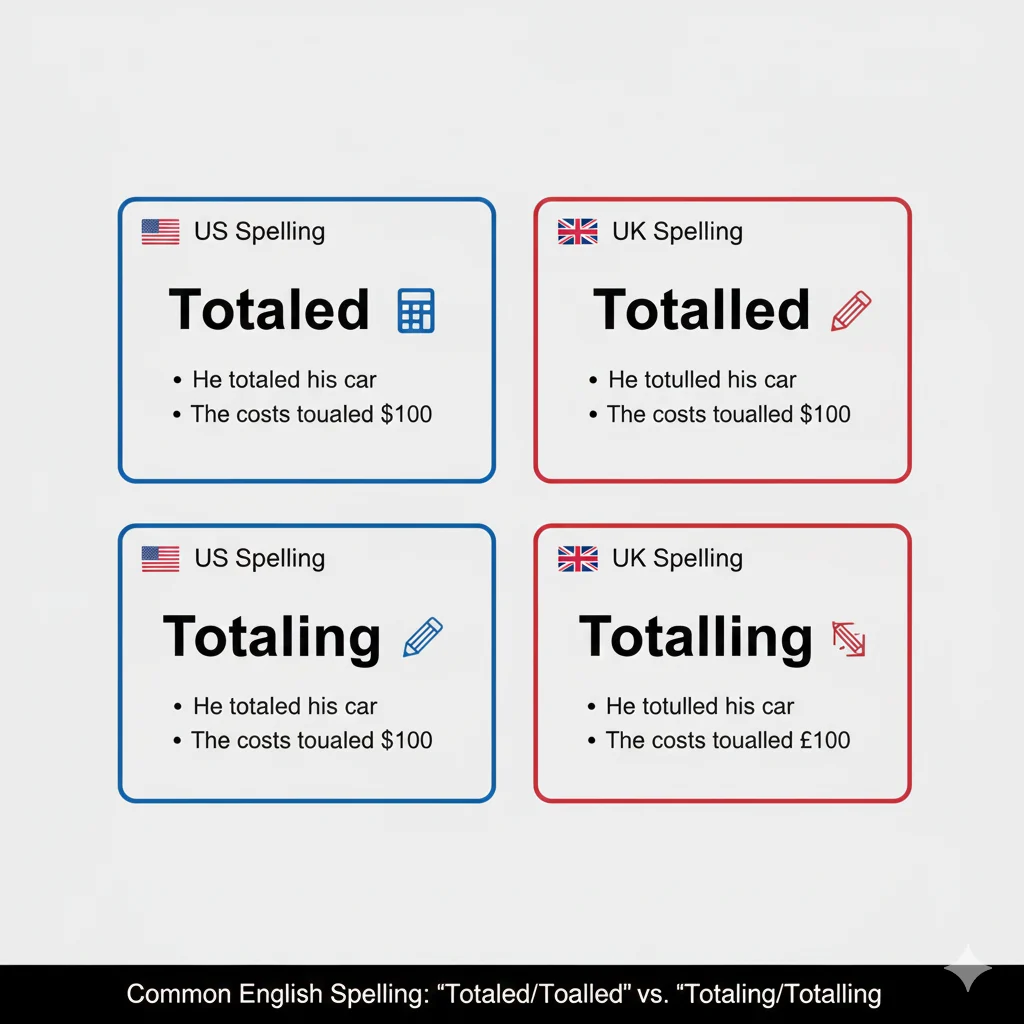
2. Totaling / Totalling – Meaning
These are the present participle or continuous tense forms of “to total.”
Meaning: adding up numbers or causing complete damage, depending on the context.
- American English → totaling
- British English → totalling
Easy Examples
- We are totaling the marks. (US)
- The accountant is totalling the sales. (UK)
- The damage is totaling/totalling thousands of dollars.
🧠 Why two spellings?
English uses different spelling rules:
- American English often keeps only one “l” in words like traveling, modeling, canceled.
- British English doubles the “l” → travelling, modelling, cancelled.
The same rule applies to totaling/totalling and totaled/totalled.
The Key Difference Between Totaled, Totalled, Totaling & Totalling
Although all four forms come from the same root verb “to total,” the differences depend on:
✔ Tense – past tense vs. continuous
✔ Spelling style – American vs. British English
Here is the simplest comparison:
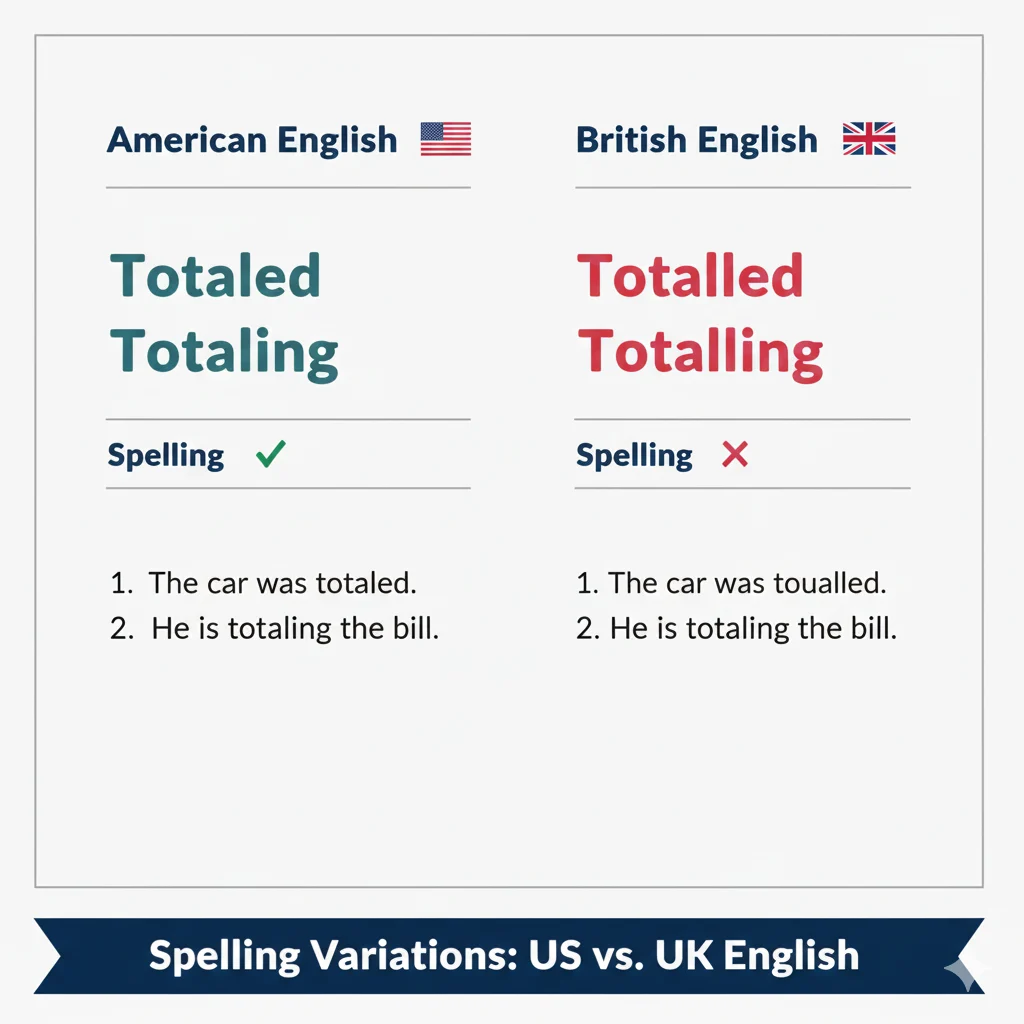
🔍 Comparison Table
| Word | Meaning | Tense | English Variety | Example Sentence |
|---|---|---|---|---|
| Totaled | Added up; destroyed | Past tense | American | The meal totaled $18. |
| Totalled | Added up; destroyed | Past tense | British | The repair costs totalled £120. |
| Totaling | Adding up; destroying | Continuous tense | American | She is totaling the marks now. |
| Totalling | Adding up; destroying | Continuous tense | British | He is totalling the budget. |
⭐ Quick Tip to Remember
- If you use American English → ONE “L”: totaled, totaling.
- If you use British English → TWO “L’s”: totalled, totalling.
Think:
🇺🇸 USA = Usually Single “L”
🇬🇧 UK = Uses “K” + “LL” (Two L’s)
Common Mistakes and How to Avoid Them
Here are the most frequent errors English learners make.
❌ Mistake 1: Mixing US & UK spelling in the same document
Wrong:
The repairs totalled $200, and now I am totaling the final bill.
Correct:
Use one style consistently.
- US style: totaled, totaling
- UK style: totalled, totalling
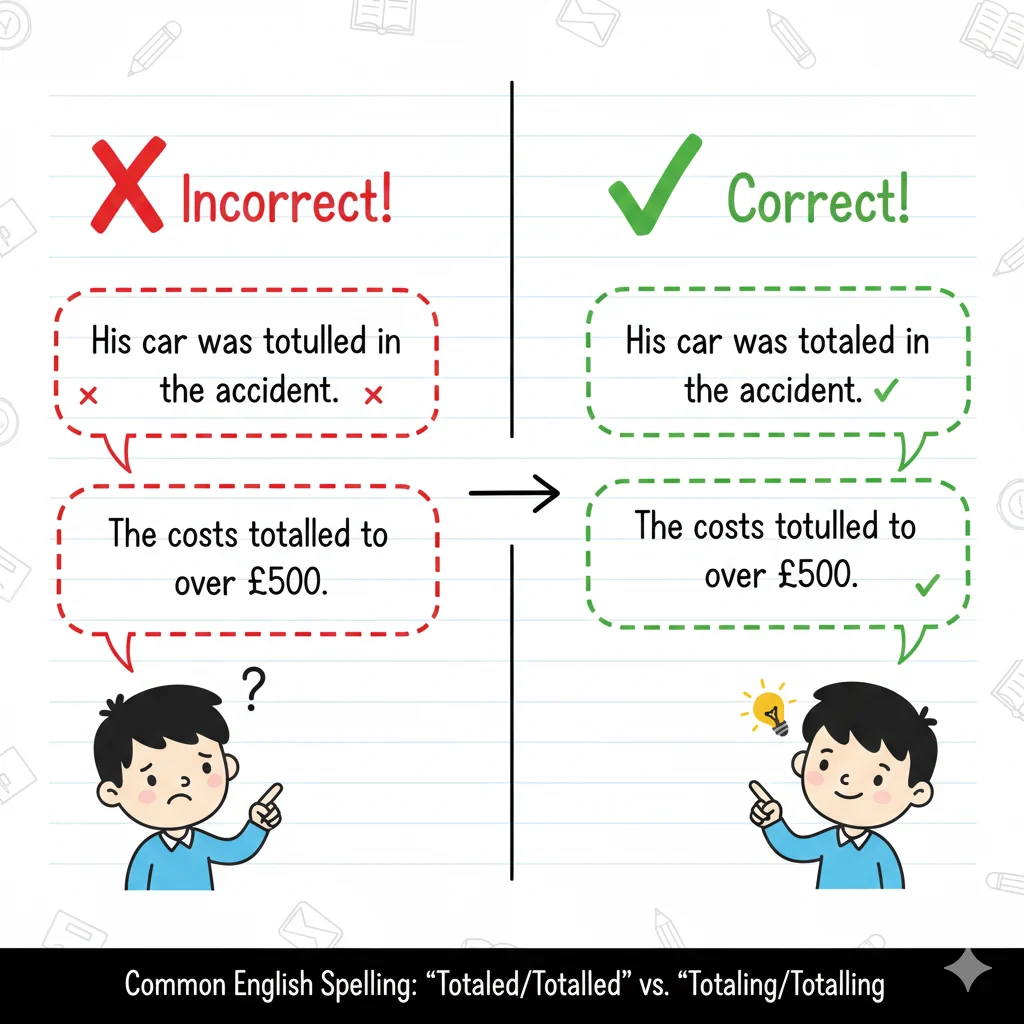
❌ Mistake 2: Using the wrong tense
Wrong:
I am totaled the numbers.
(Incorrect because “totaled” is past tense.)
Correct:
I am totaling/totalling the numbers.
❌ Mistake 3: Confusing “totaled” with “totally”
Wrong:
I am totaled tired.
(“Totaled” does NOT mean very tired.)
Correct:
I am totally tired.
When to Use “Totaled” or “Totalled” (Past Tense)
Use these when something already happened.
These forms show finished action.
Use it when:
✔ You added numbers in the past
✔ Something was destroyed or damaged beyond repair
✔ A total amount was calculated before now
✔ A final result was completed
Practical Examples
- The grocery bill totaled/totalled $40 yesterday.
- The storm totaled/totalled many houses.
- My monthly expenses totaled/totalled $900 last month.
- The game scores totaled/totalled 85 points.
- Her medical bills totaled/totalled thousands.
When to Use “Totaling” or “Totalling” (Present Continuous)
Use these when the action is happening now or is ongoing.
Use it when:
✔ Someone is currently adding numbers
✔ Damage is still increasing
✔ You are describing something that is in progress
✔ A total is being calculated at this moment
Easy Examples
- She is totaling/totalling the weekly expenses.
- We are totaling/totalling the results in class.
- The cost is totaling/totalling more than we expected.
- The accountant is totalling/totaling the profit.
- The damage is totaling/totalling thousands.
🧠 Memory Hack
If the action is happening NOW → use “-ing” form (totaling/totalling).
Think: “ING” = I Now Go (happening now).
Quick Recap: Totaled vs Totalled vs Totaling vs Totalling
- Totaled = US past tense
- Totalled = UK past tense
- Totaling = US continuous tense
- Totalling = UK continuous tense
- All forms come from the verb “to total.”
- Meaning: to add up numbers or destroy completely
- US spelling = one L
- UK spelling = double L
Simple! ✔️
Advanced Tips
1. Origin
The word “total” comes from Latin “totalis,” meaning “entire” or “whole.”
English adopted it to mean the full amount.
2. In Exams or Essays
Stick to one spelling style:
- American schools → totaled, totaling
- British/International exams → totalled, totalling
Consistency improves clarity and grammar marks.
3. In Online Writing
Mixing spellings can confuse readers and look unprofessional.
Choose one style for your website, report, or email.
Mini Quiz
Fill in the blanks with the correct word form.
- The bill ______ $75 yesterday.
- She is ______ the marks right now.
- The accident completely ______ his car.
- Our school expenses are ______ more every month.
- Last year, the donations ______ £10,000.
(Answers: 1. totaled/totalled 2. totaling/totalling 3. totaled/totalled 4. totaling/totalling 5. totaled/totalled)
FAQs
1. Is it “totaled” or “totalled”?
Both are correct. “Totaled” is American English; “totalled” is British English.
2. What does “totaled” mean?
It means added up or completely destroyed, especially in accidents.
3. When do we use “totaling” or “totalling”?
Use them when an action is in progress, like adding numbers right now.
4. Why does British English use double L?
British spelling rules keep a double “l” before adding endings like -ed and -ing.
5. Are totaled and totalling related?
Yes. They come from the same verb “to total”, but used in different tenses.
Conclusion
Understanding the difference between “totaled,” “totalled,” “totaling,” and “totalling” becomes simple once you know the spelling rules in American and British English. All four forms share the same root meaning, but their usage changes based on tense and style. If you prefer American English, use one “l.” If you follow British English, use two. With the meanings, examples, and memory tricks in this guide, you’ll now be able to choose the right form every time. Keep practicing — good English becomes easier with daily use and clear explanations.

English playwright and novelist Patrick Hamilton (1904–1962) captured psychological tension, social decay, and dark humor in gripping, unforgettable stories.