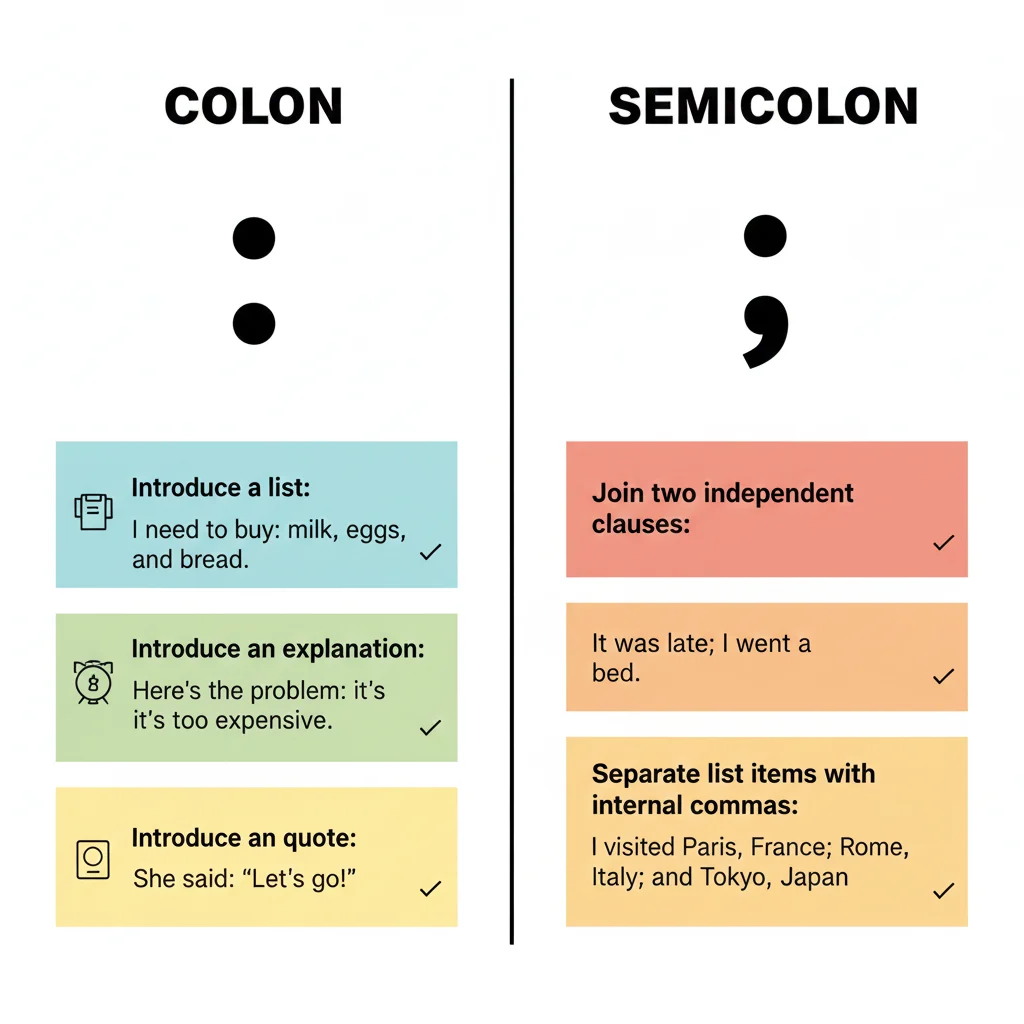
Punctuation marks may look small, but they can change the meaning of a sentence in a big way. Two of the most confusing punctuation marks in English are the colon (:) and the semicolon (;). Many people mix them up because they look similar and both are used inside sentences, not at the end like a full stop.
If you have ever wondered about the difference between a colon and a semicolon, you are not alone. Students, bloggers, and even experienced writers often make mistakes with them.
In this easy guide, you will learn the meaning of colon and semicolon, how they are different, and how to use each one correctly. Everything is explained in plain English, with short sentences and real-life examples. By the end, even a beginner or a 4th-grade student will feel confident using colons and semicolons the right way.
What Does Each Mark Mean?
Before we compare them, let’s understand each one clearly.
What Is a Colon (:)?
A colon is a punctuation mark that tells the reader,
👉 “Get ready. More information is coming.”
It is often used to introduce something new, such as a list, an explanation, or an example.
Part of speech:
A colon is not a word. It is a punctuation mark.
Simple Examples of a Colon
- I need three things from the store: milk, bread, and eggs.
- She had one dream: to become a doctor.
- The sign said: No parking here.
Easy way to remember:
A colon is like pointing a finger and saying, “Look here!”

What Is a Semicolon (;)?
A semicolon is used to join two related sentences that could stand alone but are closely connected.
It tells the reader,
👉 “These two ideas belong together.”
Part of speech:
Like the colon, a semicolon is also a punctuation mark, not a word.
Simple Examples of a Semicolon
- I like tea; my sister prefers coffee.
- He studied all night; he still felt nervous.
- It was raining; we stayed inside.
Easy way to remember:
A semicolon is like a soft stop — stronger than a comma, weaker than a full stop.
The Key Difference Between Colon and Semicolon
The main difference is what they do in a sentence.
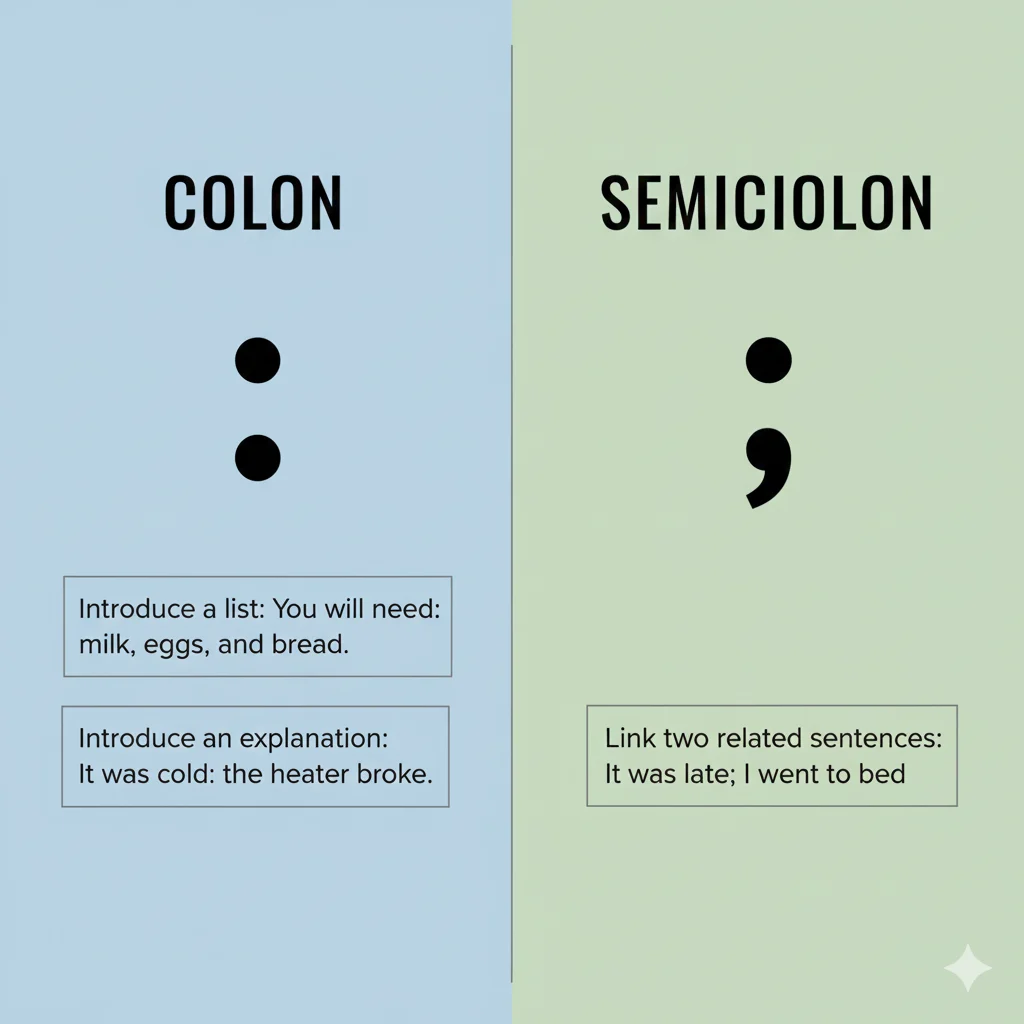
- A colon introduces or explains.
- A semicolon connects related ideas.
Colon vs Semicolon Comparison Table
| Feature | Colon (:) | Semicolon (;) |
|---|---|---|
| Main purpose | Introduces or explains | Connects related sentences |
| Common use | Before lists, examples, explanations | Between two related complete sentences |
| Can join two full sentences? | No (usually explains the first part) | Yes |
| Easy clue | “Here comes more info” | “These ideas are connected” |
| Example | She loves fruits: apples and bananas. | She loves apples; she eats them daily. |
Quick Tip:
If you can replace the punctuation with “that is”, use a colon.
If you can replace it with a full stop, use a semicolon.
Common Mistakes and How to Avoid Them
Many learners make similar mistakes with colons and semicolons. Let’s fix them.
Mistake 1: Using a Semicolon for a List ❌
Wrong:
I bought apples; bananas; and oranges.
Correct:
I bought apples, bananas, and oranges.
OR
I bought fruits: apples, bananas, and oranges.
Why it happens:
People think semicolons always mean “pause.”
Fix: Use a colon to introduce a list.
Mistake 2: Using a Colon Between Two Full Sentences ❌
Wrong:
I was tired: I went to bed early.
Correct:
I was tired; I went to bed early.
Why it happens:
Writers confuse explanation with connection.
Fix: If both parts can stand alone, use a semicolon.
Mistake 3: Using a Semicolon Instead of a Full Stop ❌
Wrong:
I like pizza; It is my favorite food.
Correct:
I like pizza. It is my favorite food.
OR
I like pizza; it is my favorite food.
Why it happens:
Capital letters after semicolons confuse learners.
Fix: After a semicolon, do not capitalize unless it’s a name.
When to Use a Colon (:)
Use a colon when you want to introduce, explain, or show something clearly.
Situations Where a Colon Is Correct
- Before a list
- She packed three items: clothes, shoes, and books.
- Before an explanation
- He had one fear: failing the exam.
- Before examples
- I enjoy outdoor games: football and cricket.
- In time and ratios
- The class starts at 9:30.
- The ratio is 2:1.
- Before a quote (in writing)
- The teacher said: “Practice makes perfect.”
Simple Daily-Life Examples
- At school:
Bring these things tomorrow: notebook, pen, and ruler. - At home:
Mom gave one rule: finish homework first. - In writing:
Remember this idea: simple is better.

When to Use a Semicolon (;)
Use a semicolon when you want to join two closely related sentences.
Situations Where a Semicolon Is Correct
- To connect related ideas
- I was hungry; I made a sandwich.
- Instead of words like “and” or “but”
- She wanted to play; it was raining.
- Before words like however, therefore, still
- He studied hard; however, the test was difficult.
- In complex lists (advanced use)
- We visited Paris, France; Rome, Italy; and Madrid, Spain.
Memory Hack
Think of a semicolon as a bridge 🌉
It connects two sentences that are friends.
Quick Recap: Colon vs Semicolon
- Colon (:)
- Introduces or explains
- Used before lists and examples
- Think: “Here it comes”
- Semicolon (;)
- Connects related sentences
- Replaces a full stop sometimes
- Think: “These ideas belong together”
Advanced Tips (For Curious Learners)
- History:
The colon and semicolon were first used in Greek and Latin texts to show pauses while reading aloud. - In exams and essays:
Using colons and semicolons correctly shows strong grammar skills. - In texting:
Many people avoid them, but misuse can confuse meaning. - Formal writing:
Semicolons are common in academic and professional writing.
Mini Quiz: Test Yourself ✏️
Fill in the blanks with colon or semicolon.
- I had one goal ___ to win the race.
- She was tired ___ she kept working.
- Bring these items ___ pencil, eraser, and ruler.
- It was late ___ we went home.
- He loves one sport ___ football.
Answers:
- Colon
- Semicolon
- Colon
- Semicolon
- Colon
FAQs: Colon vs Semicolon
1. What is the main difference between a colon and a semicolon?
A colon introduces or explains, while a semicolon connects related sentences.
2. Can I use a semicolon instead of a full stop?
Yes, but only when the sentences are closely related.
3. Is a colon used before a list?
Yes, a colon is perfect for introducing lists.
4. Are colons and semicolons used in spoken English?
Mostly in writing, not in everyday speech.
5. Which one is more formal?
Both are formal, but semicolons appear more in academic writing.
Conclusion
Understanding the difference between a colon and a semicolon does not have to be hard. A colon helps you introduce ideas, lists, and explanations. A semicolon helps you connect related thoughts smoothly. Once you remember their simple jobs, choosing the right one becomes easy.
Practice using both marks in short sentences. Read your writing aloud and check what feels right. With time, your confidence will grow. Every small grammar improvement makes your English stronger and clearer. Keep learning, keep practicing, and enjoy the journey of better writing every day.

English novelist and poet Thomas Hardy (1840–1928) explored human struggles, social constraints, and tragic love with deep realism and vivid storytelling.