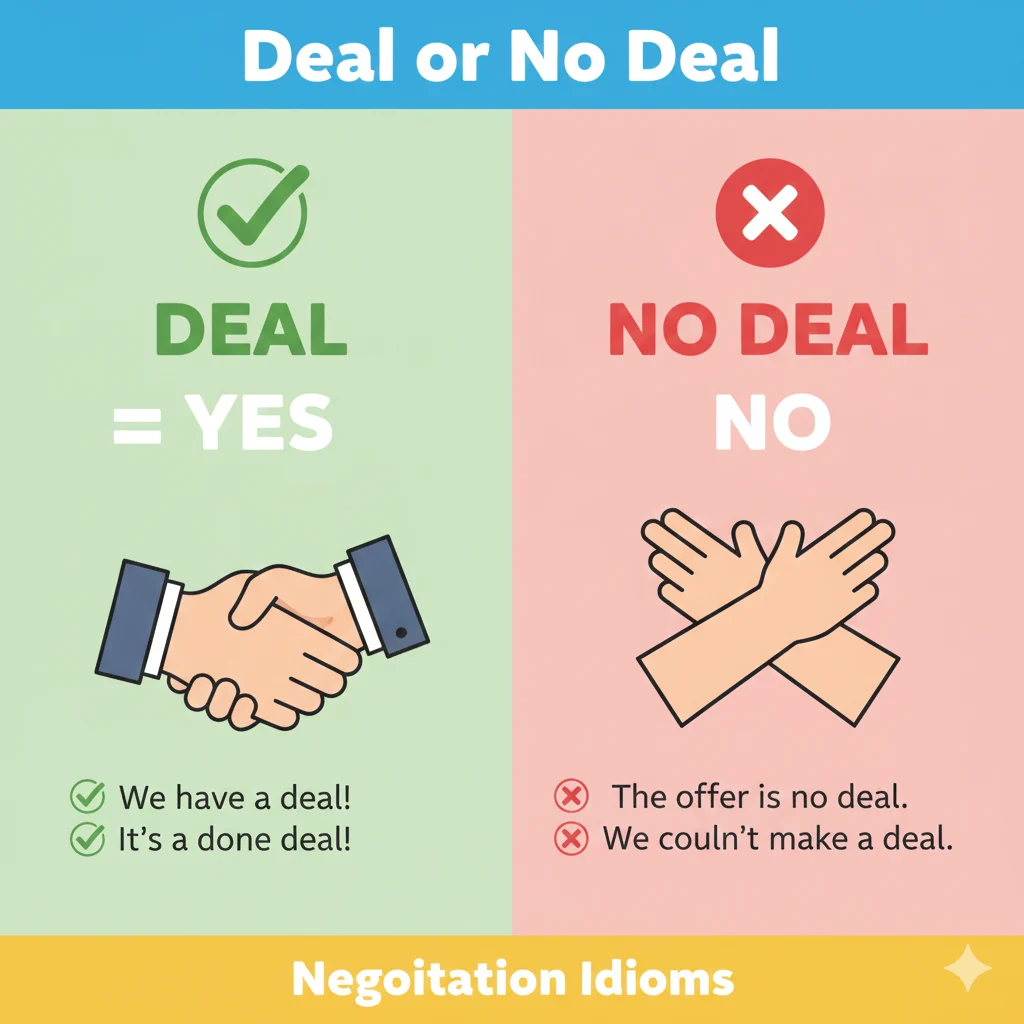
Have you ever wondered about the phrase “deal or no deal” and when to use it correctly? Many people hear it on TV or in conversations but get confused about its meaning and proper usage. Some even try to use it in writing but aren’t sure if it fits the sentence. Don’t worry — this guide will make it easy for you.
In this article, you will learn the meaning of “deal or no deal,” understand its correct usage, spot common mistakes, and see plenty of examples that make it stick in your memory. By the end, you’ll confidently know when to use this phrase in daily conversations, writing, or even fun games. Even beginners and young learners can follow along.
What Does “Deal or No Deal” Mean?
The phrase “deal or no deal” is most commonly used as a question in negotiations, games, or decisions. Let’s break it down simply:
- Deal: This means you agree to the terms offered. It is like saying “yes, I accept.”
- No Deal: This means you reject the terms. It’s like saying “no, I don’t accept.”
Part of Speech:
- Deal: Noun or verb, depending on the sentence.
- No Deal: Phrase (used as a response or choice).

Simple Examples of “Deal”:
- I think this offer is fair, so I will take the deal.
- Can we make a deal about sharing the snacks?
- He sealed the deal with a handshake.
Simple Examples of “No Deal”:
- Do you want to sell your phone for $50? — No deal!
- The game show host asked, “Deal or no deal?”
- She rejected the proposal and said, “No deal.”
Think of it like playing a simple game: someone offers you something, and you must answer deal (yes) or no deal (no).
The Key Difference Between Deal and No Deal
Here’s a quick comparison to make it crystal clear:
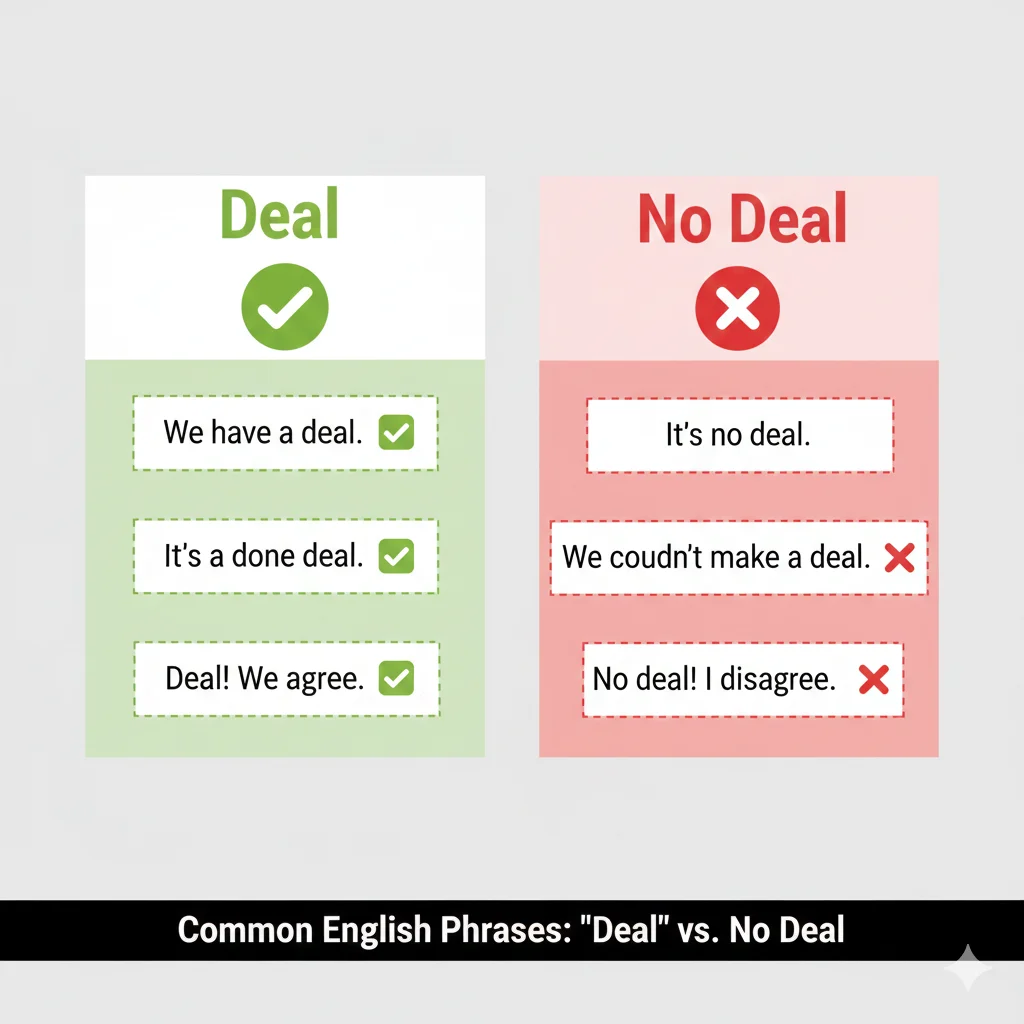
| Phrase | Meaning | Usage Example | Quick Tip |
|---|---|---|---|
| Deal | Accepting an offer or agreement | I agreed to the deal. | “Deal = yes” |
| No Deal | Rejecting an offer or agreement | He said no deal to the proposal. | “No deal = no” |
Quick Tip: If you want to accept, say deal. If you want to reject, say no deal. Simple!
Common Mistakes and How to Avoid Them
Even native speakers sometimes mix this up. Here are a few examples:
- ❌ “I said no deal, but I really meant yes.”
✅ Correct: “I said deal because I agreed.”
Reason: People confuse the response with what they feel internally. Always match words to the choice.
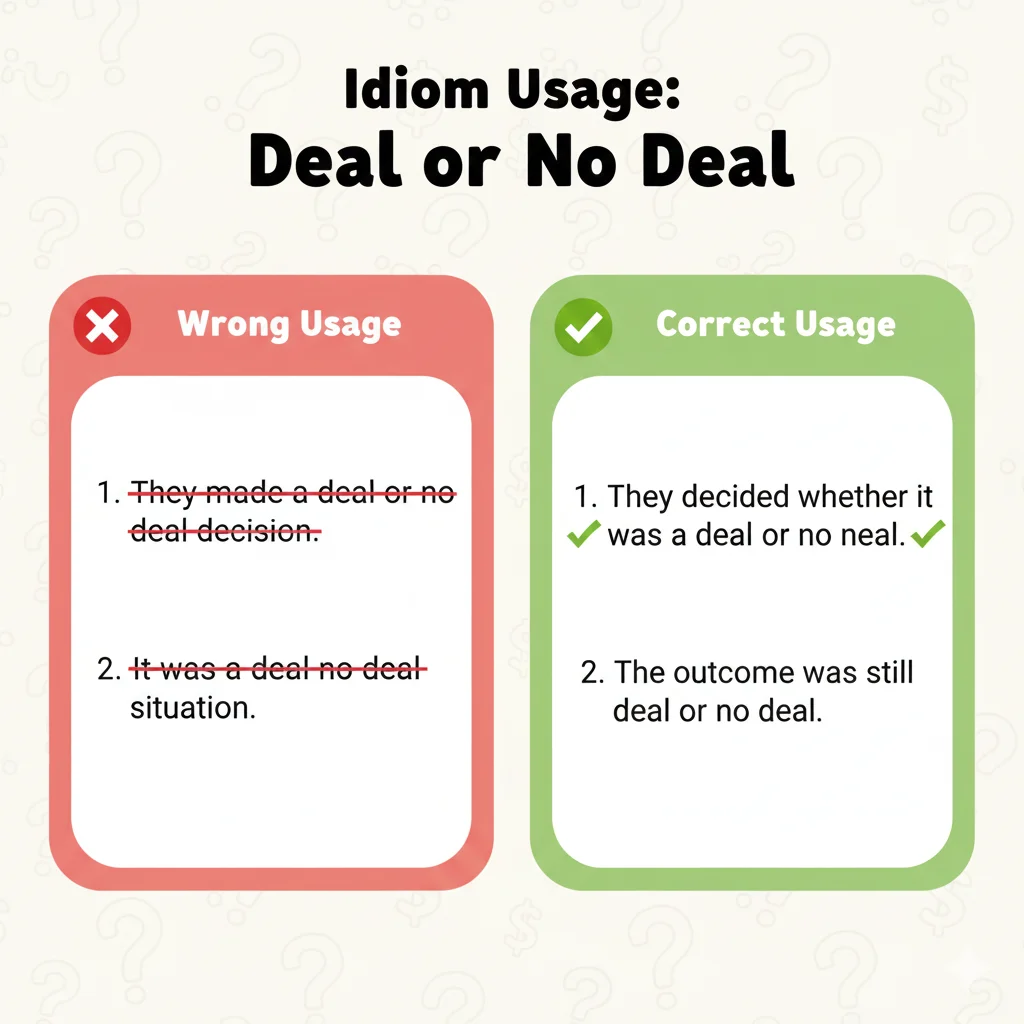
- ❌ “Deal or no deal?” asked in the middle of an irrelevant topic.
✅ Correct: Use it when an actual offer, decision, or negotiation is happening. - ❌ Using “deal or no deal” in formal writing as a verb.
✅ Correct: Keep it as a phrase or question for casual or game-like contexts.
When to Use “Deal”
Use deal when you want to accept an offer or agreement.
Examples in Daily Life:
- Mom offered to buy me a toy if I cleaned my room — deal!
- The teacher said we could leave early if we finished our homework — deal.
- I offered to help my friend with homework, and he said deal.
- We can swap snacks after school — deal?
- He accepted the game challenge — deal!
Real-life situations like school, family, or games are perfect for using this word.
When to Use “No Deal”
Use no deal when you want to reject an offer.
Examples in Daily Life:
- “Do you want to trade your cookie for my candy?” — No deal.
- She refused to lend her pencil — no deal.
- The host asked, “Deal or no deal?” He chose no deal.
- I won’t agree to finish the homework for free — no deal.
- Memory Hack: Imagine a red stop sign when saying no deal, and a green go sign for deal.
Quick Recap: Deal vs No Deal
- Deal = Yes, I agree. ✅
- No Deal = No, I don’t agree. ❌
- Use deal to accept offers, no deal to reject.
- Perfect for negotiations, games, or daily decisions.
- Always match your words with your true choice to avoid confusion.
Advanced Tips
- The phrase became famous because of the game show “Deal or No Deal.”
- In formal writing, you rarely use “deal or no deal” unless quoting the game or a conversation.
- Online, texting, or casual emails can use it for fun or negotiation.
Mini Quiz
Fill in the blanks with deal or no deal:
- Mom said I could have ice cream if I finished my homework — ______.
- He offered me $10 for my old toy — ______.
- “Do you accept the challenge?” — ______.
- I won’t swap my notebook for a pen — ______.
- They offered a trade, and I agreed — ______.
- She rejected the offer immediately — ______.
- “Do you want to join the game?” — ______.
(Answer key: 1. Deal, 2. No deal, 3. Deal, 4. No deal, 5. Deal, 6. No deal, 7. Deal)
FAQs
1. Can “deal or no deal” be used in formal writing?
Usually not. It’s more casual and used in conversations, games, or negotiations.
2. Is “deal” only for money?
No. You can use “deal” for any agreement, trade, or offer.
3. Can children use this phrase?
Yes! It’s simple and fun for kids in games or small negotiations.
4. What is the origin of “deal or no deal”?
It became widely popular from the game show, but “deal” as an agreement has been used in English for centuries.
5. How can I remember the difference?
Think: green = deal (go/yes), red = no deal (stop/no).
Conclusion
Now you know the difference between deal and no deal, how to use them correctly, and how to avoid common mistakes. Remember: deal = yes, no deal = no. Using these phrases is simple once you match your words with your choice. Practice in daily life — at school, home, or with friends — and soon it will feel natural. Even beginners can quickly master this phrase with the examples and tips in this guide.
Learning small phrases like deal or no deal builds your confidence in English step by step. Keep practicing, and soon you’ll use it correctly every time, whether in games, conversations, or fun negotiations.

Caribbean-born novelist Jean Rhys (1890–1979) explored alienation, identity, and female psychology with lyrical, haunting, and emotionally rich prose.