Many English learners often feel confused about fare or fair. These two words sound exactly the same when spoken, but they have different meanings and spellings. Words that sound alike but have different meanings are called homophones, and fair and fare homophones are a common example in English.
Because of their similar pronunciation, people sometimes write sentences like “that’s not fare” when they really mean “that’s not fair.” Even a small spelling mistake like this can change the meaning of a sentence. Understanding the fare or fair meaning helps you choose the correct word and avoid common grammar mistakes.
Many learners also ask questions such as Which is correct, fair or fare?, Is it fare or fair for food?, or How did you fare vs fair in the exam? These questions are very common because both words are used in everyday conversations.
In this guide, you will learn the difference between fare and fair, their meanings, and how to use them correctly. The explanations are simple, and the examples are easy to understand. By the end of this article, even beginners will clearly know when to use fare and when to use fair.
What Does Each Word Mean?
To understand fare or fair in English, it is important to look at each word separately.
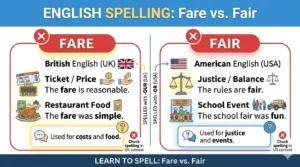
Meaning of “Fare”
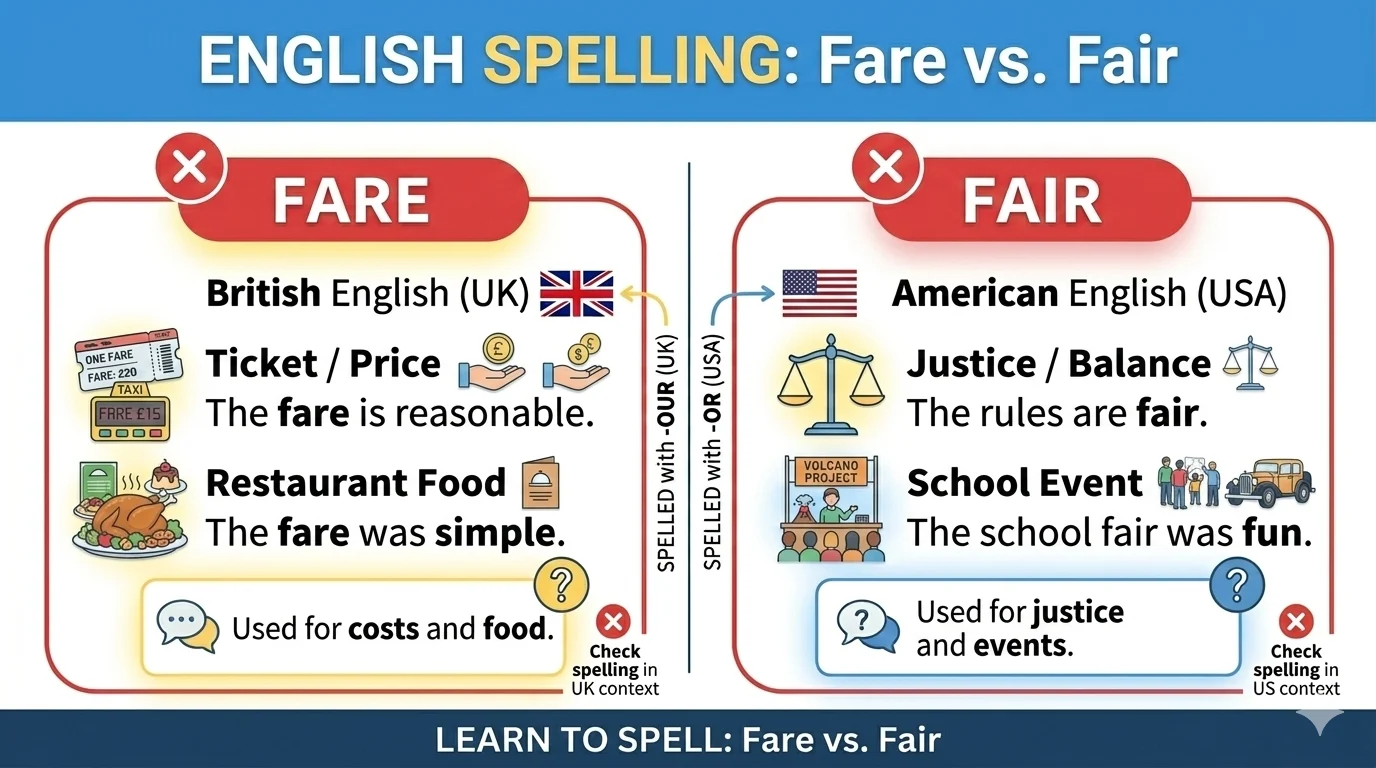
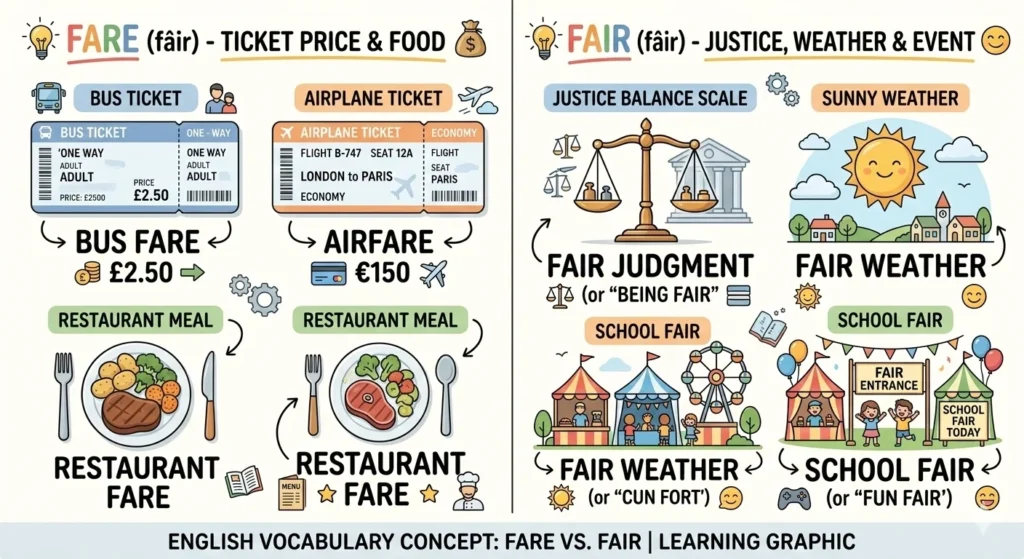
The word fare usually refers to travel cost, food served somewhere, or how someone performs in a situation. It can be used as a noun or sometimes as a verb.
Common meanings of fare
- The price paid for transportation
- Food or meals served in a place
- How someone performs in a situation
Examples of fare in sentences
- The bus fare is cheaper than the taxi.
- The airline fare increases during holiday seasons.
- The restaurant serves traditional Italian fare.
- The café offers simple homemade fare for breakfast.
- How did you fare in the competition?
Many learners ask questions like how did you fare or fair in the exam? The correct word is fare, because the sentence asks about someone’s performance.
Correct example:
✔ How did you fare in the exam?
Here are more examples showing the same idea:
- How did he fare or fair in the job interview?
- How did they fare or fair in the tournament?
- How you fare or fair in life often depends on your choices.
- How we fare or fair during challenges shows our strength.
In all these sentences, the correct word is fare because it refers to how someone performs.
Meaning of “Fair”
The word fair usually describes something that is just, equal, honest, or reasonable. It can also describe pleasant weather, light color, or public events like festivals and exhibitions.
Most often, fair is used as an adjective, but it can also be used as a noun.
Common meanings of fair
- Just or equal
- Honest or reasonable
- Light in color
- Pleasant weather
- A public event or festival
Examples of fair in sentences
- The teacher made a fair decision.
- Everyone deserves a fair opportunity.
- The weather was fair and sunny today.
- She has fair hair and blue eyes.
- We visited the school science fair yesterday.
This is why the correct sentence is:
❌ That’s not fare
✔ That’s not fair
Another example:
❌ It’s not fare or fair to blame someone without proof.
✔ It’s not fair to blame someone without proof.
In these sentences, fair is correct because the meaning relates to justice or equality.
The Key Difference Between Fare or Fair
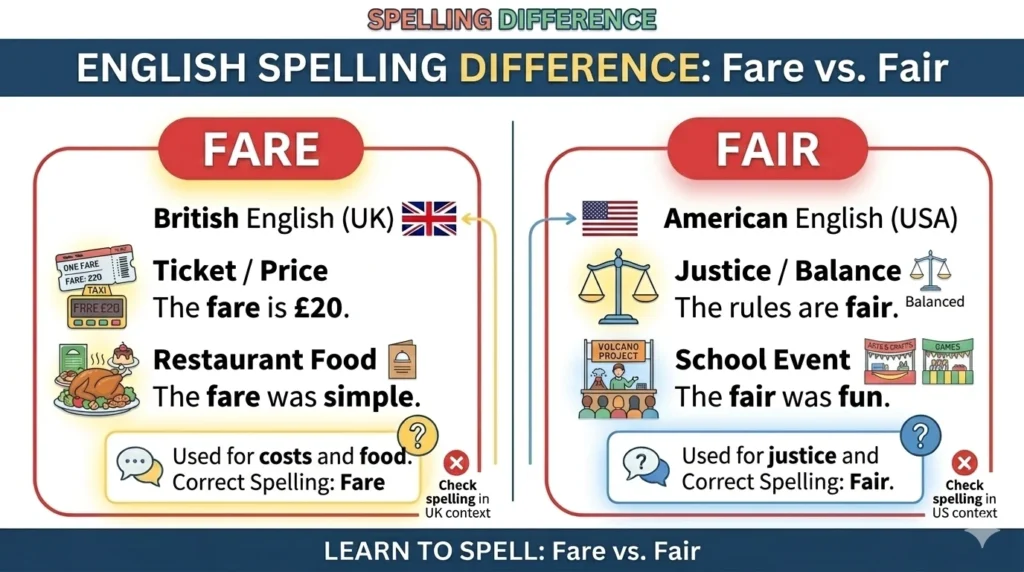
Understanding the difference between fare and fair becomes much easier when we compare them side by side.
| Word | Meaning | Part of Speech | Example Sentence |
|---|---|---|---|
| Fare | Travel cost, food, or performance | Noun / Verb | The train fare is expensive. |
| Fair | Just, equal, reasonable, or an event | Adjective / Noun | The judge made a fair decision. |
Quick Tip to Remember
A simple trick can help you remember the fare vs fair difference.
Fare → travel, food, performance
Examples:
- plane fare
- restaurant fare
- How did you fare in the exam?
Fair → justice, equality, event
Examples:
- fair decision
- science fair
- fair treatment
Sentence with Fair and Fare
Looking at examples helps learners understand fare or fair in English more clearly.
Examples:
- The taxi fare was very expensive.
- The referee made a fair decision.
- The airline fare increased this year.
- The teacher tried to be fair with every student.
- The restaurant serves delicious local fare.
- We enjoyed visiting the school book fair.
These examples clearly show the fare or fair meaning in everyday English sentences.
Common Mistakes and How to Avoid Them
Because fair and fare homophones sound the same, many writers accidentally mix them up.
Here are some common mistakes and their corrections.
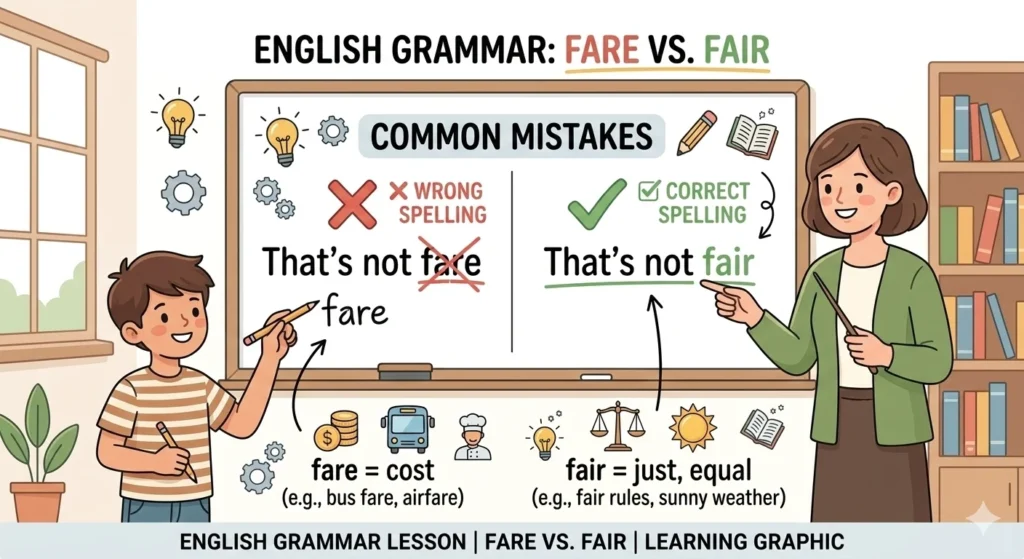
Mistake 1
❌ That’s not fare.
✔ That’s not fair.
Explanation:
Here we are talking about justice or equality, so fair is correct.
Mistake 2
❌ How did you fair in the interview?
✔ How did you fare in the interview?
Explanation:
The sentence asks about performance, so fare is correct.
Mistake 3
❌ The taxi fair was too high.
✔ The taxi fare was too high.
Explanation:
Transportation cost is always written as fare.
Mistake 4
❌ The school fare was fun.
✔ The school fair was fun.
Explanation:
A festival or event is called a fair.
When to Use “Fare”
Use fare when talking about transportation costs, food served somewhere, or how someone performs.
People often search phrases like:
- how do you fare or fair
- how would you fare or fair
- how did you fare vs fair
The correct word in these situations is fare.
Examples of fare
- The bus fare is cheaper than the taxi.
- The airline fare increased during the holidays.
- The café serves traditional homemade fare.
- How did he fare in the final interview?
- How did they fare in the championship match?
More examples:
- How you fare or fair in the exam depends on preparation.
- How I fare or fair in life depends on my decisions.
- Let’s see how you fare or fair in the next challenge.
Correct version:
✔ See how you fare.
Standard Fare Meaning
Another common phrase is standard fare.
This phrase means typical or common food, entertainment, or content.
Example:
The café serves standard fare such as sandwiches, coffee, and soup.
In movies or books, standard fare may describe common themes or typical stories.
Example:
Romantic movies are standard fare during Valentine’s season.
When to Use “Fair”
Use fair when talking about justice, equality, honesty, or public events.
Many learners ask:
Is it fare or fair for an event?
The correct word is fair.
Examples of fair
- The judge made a fair decision.
- Everyone deserves a fair chance to succeed.
- We visited the science fair at school.
- The weather remained fair and pleasant all day.
- It is important to be fair when judging others.
To Be Fair Meaning
The phrase to be fair means to speak honestly or consider both sides of a situation.
Example:
To be fair, the teacher explained the lesson clearly to everyone.
Many learners search for to be fare or fair meaning, but the correct phrase is always to be fair.
Fair Warning Meaning
Another common expression is fair warning.
Example:
Fair warning: The road ahead is dangerous.
Here the word fair means giving someone honest notice before something happens.
Fare or Fair Meaning in Urdu
Understanding the fare or fair meaning in Urdu can make the difference easier to remember.
Fare Meaning in Urdu
کرایہ، سفر کا خرچ، کھانا
Examples:
Bus fare = بس کا کرایہ
Taxi fare = ٹیکسی کا کرایہ
Fair Meaning in Urdu
انصاف، منصفانہ، میلہ
Examples:
Fair decision = منصفانہ فیصلہ
Book fair = کتابوں کا میلہ
This explanation shows the fare or fair in Urdu difference clearly.
Advanced Tips for Better English
Learning the difference between fare and fair improves both writing and speaking skills.
Word Origins
The word fare comes from an old English word meaning to travel or journey.
The word fair originally meant beautiful, pleasing, or just.
In Formal Writing
Using the correct spelling is important in essays, exams, and professional writing.
Example:
❌ How did you fair in the test?
✔ How did you fare in the test?
In Online Writing
People sometimes type quickly and make mistakes like:
❌ That’s fare
✔ That’s fair
Even a small spelling mistake can change the meaning of a sentence.
Quick Recap: Fare vs Fair
Here is a quick summary of the fare or fair meaning.
Fare
Used for:
- travel cost
- food served
- performance
Examples:
- train fare
- airline fare
- How did you fare?
Fair
Used for:
- justice or equality
- public events
- weather or appearance
Examples:
- fair decision
- science fair
- fair weather
Mini Quiz: Test Your Understanding
Fill in the blanks with fare or fair.
- The taxi ______ was expensive.
- That decision was not ______.
- How did you ______ in the competition?
- We visited the school ______ yesterday.
- The restaurant serves traditional Italian ______.
- To be ______, everyone worked very hard.
- Let’s see how you ______ in the final round.
Answers
- fare
- fair
- fare
- fair
- fare
- fair
- fare
FAQs
Which is correct, fair or fare?
Both words are correct but used in different situations. Fare refers to travel cost, food, or performance, while fair refers to justice, equality, or public events.
Is it fare or fair for an event?
The correct word is fair, such as science fair, book fair, or trade fair.
How do you use fare in a sentence?
Example:
The taxi fare was very expensive.
Another example:
How did you fare in the exam?
Is it fare or fair for food?
When talking about food served somewhere, the correct word is fare.
Example:
The restaurant serves traditional Italian fare.
What is the difference between fair and fare in English?
Fare relates to travel costs, food, or performance, while fair relates to justice, equality, beauty, or public events.
What is a simple way to remember fare vs fair?
A simple trick is to remember that fare relates to travel or food, while fair relates to justice or events.
Conclusion
Now you clearly understand the difference between fare and fair. Even though these words sound the same, their meanings are very different.
Use fare when talking about travel costs, food, or performance, such as in the sentence “How did you fare in the exam?” Use fair when talking about justice, equality, honesty, or events, such as “That’s not fair.”
Remember this easy rule:
Fare → travel, food, performance
Fair → justice, equality, event
With practice and attention to spelling, you will quickly learn how to use these words correctly. Improving your English step by step will make your writing clearer and more confident every day.

Scottish novelist Muriel Spark (1918–2006) crafted sharp, witty stories exploring human nature, morality, and society with dark humor and insight.