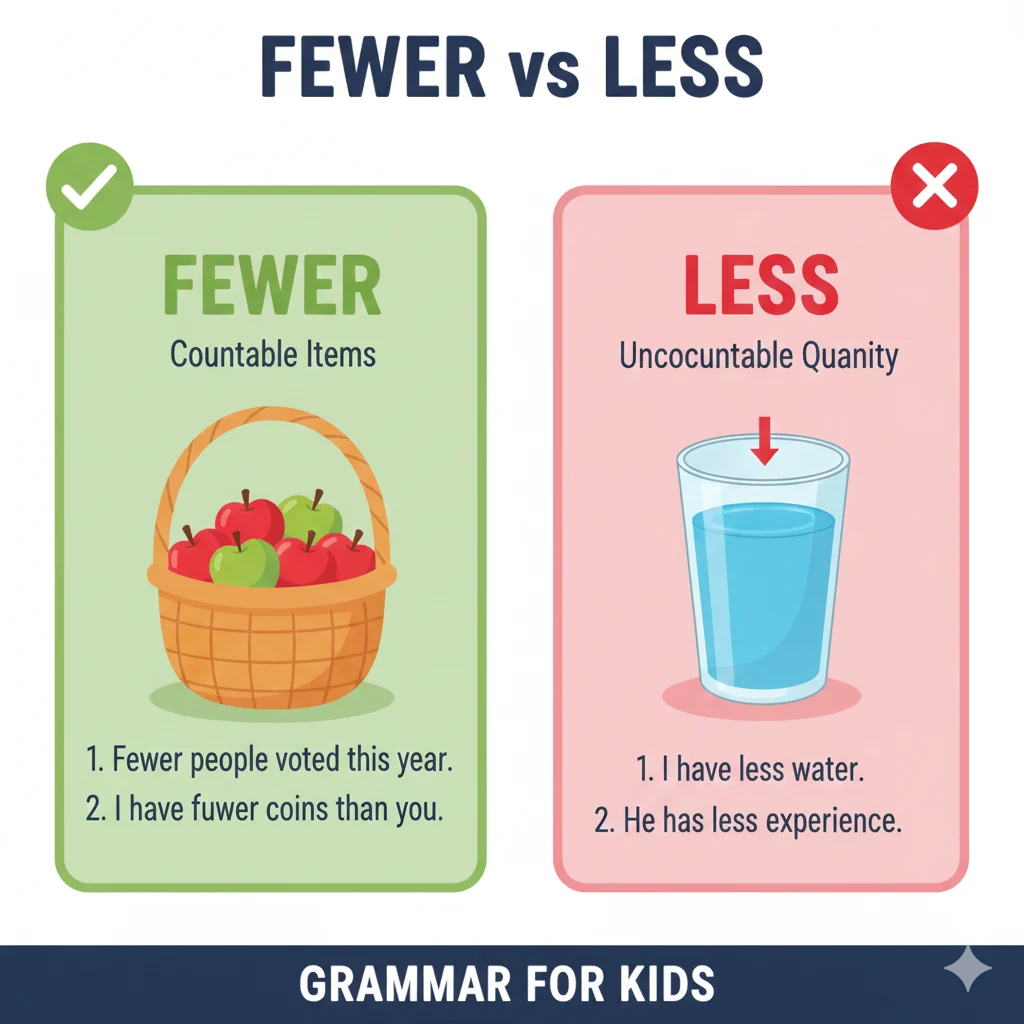
Have you ever wondered whether to say fewer apples or less apples? Many English learners — and even native speakers — often mix up fewer and less. These two words are used to talk about smaller amounts or quantities, but they are not the same. Using the wrong one can make your sentences sound awkward, confusing, or even grammatically incorrect.
In this complete guide, you will learn exactly what fewer and less mean, when to use each word, and how to avoid common mistakes. We will provide clear explanations, practical tips, fun memory hacks, and lots of real-life examples. Whether you are writing an essay, shopping, talking with friends, or posting online, this guide will help you use fewer and less correctly every time. By the end, even beginners will feel confident using these words.
What Does Each Word Mean?
Fewer
Fewer is used with countable nouns — things you can count individually. These can be objects, people, or items you can quantify one by one.
- Part of Speech: Adjective
- Meaning: A smaller number of countable items
Examples of Fewer in Daily Life:
- There are fewer apples in the basket than yesterday.
- I have fewer friends on social media than my sister.
- We need fewer chairs for this small room.
Extended Examples:
- The school has fewer students than last year.
- She bought fewer candies than her brother.
- He made fewer mistakes on his homework this time.
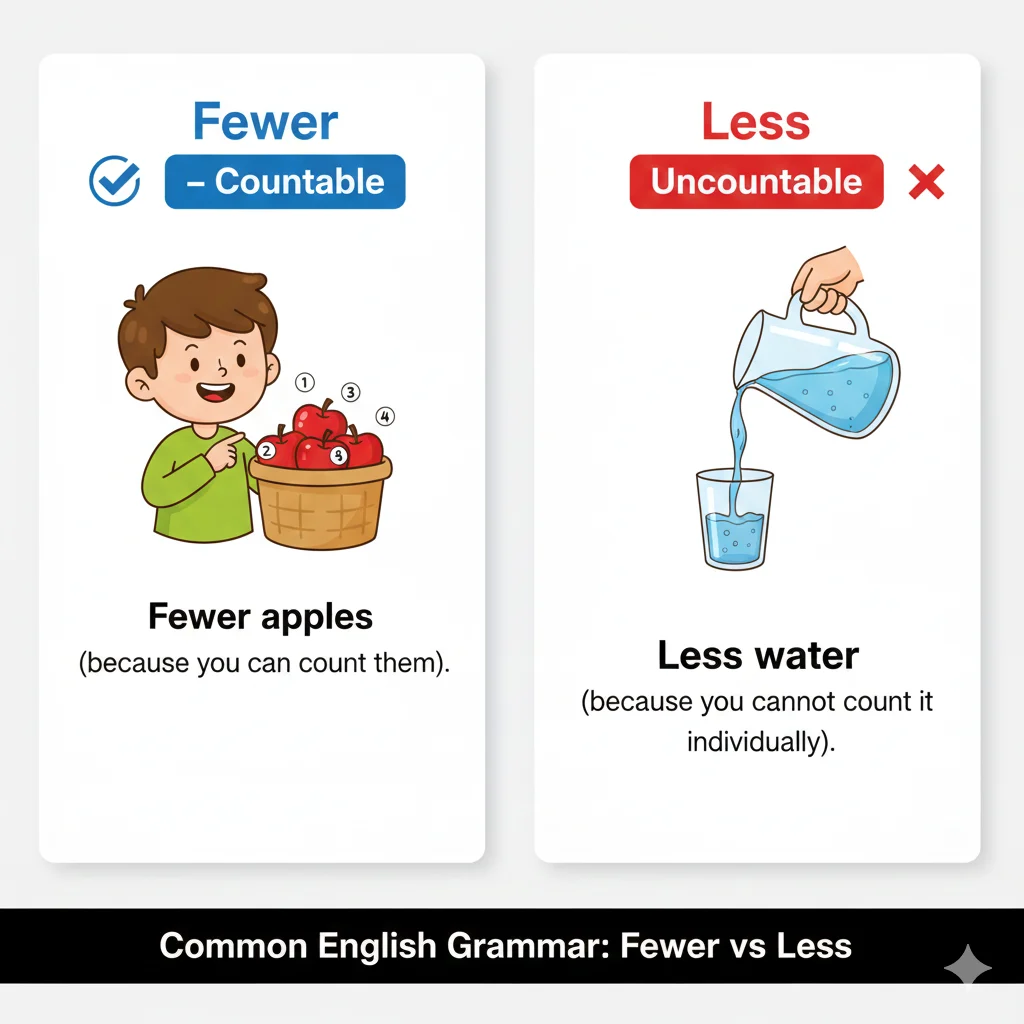
Mini Story: Imagine a basket of apples. Yesterday it had ten apples. Today it only has six. You can count each apple, so the number has decreased. That’s when you say fewer apples.
Extra Tip: Whenever you can count the items individually, fewer is usually correct. If you’re unsure, try counting in your head. If you can say “one, two, three,” it’s countable — use fewer.
Less
Less is used with uncountable nouns — things that cannot be counted individually. This includes liquids, abstract ideas, and mass nouns.
- Part of Speech: Adjective
- Meaning: A smaller amount or quantity of something uncountable
Examples of Less in Daily Life:
- I drink less water in winter than in summer.
- There is less sugar in this cake than in the last one.
- We have less time to finish the project.
Extended Examples:
- She has less patience today than yesterday.
- We spent less money on groceries this week.
- There is less noise in the library during the morning.
- He gave less information than I expected.
Mini Story: Imagine a glass of water. You cannot count water like apples. If the glass has a smaller amount, you say less. Similarly, you can’t count air, sugar, or rice grains individually in a simple way, so less is correct.
Extra Tip: If the noun refers to a general substance, idea, or mass that you can’t count as separate units, less is usually the right choice.
The Key Difference Between Fewer and Less
Here’s a simple table to help you remember the difference:
| Feature | Fewer | Less |
|---|---|---|
| Noun Type | Countable (can count individually) | Uncountable (cannot count individually) |
| Meaning | Smaller number | Smaller amount |
| Examples | Fewer books, fewer cars | Less milk, less money |
| Quick Tip | Ask: “Can I count it?” → Yes → Fewer | Ask: “Can I count it?” → No → Less |
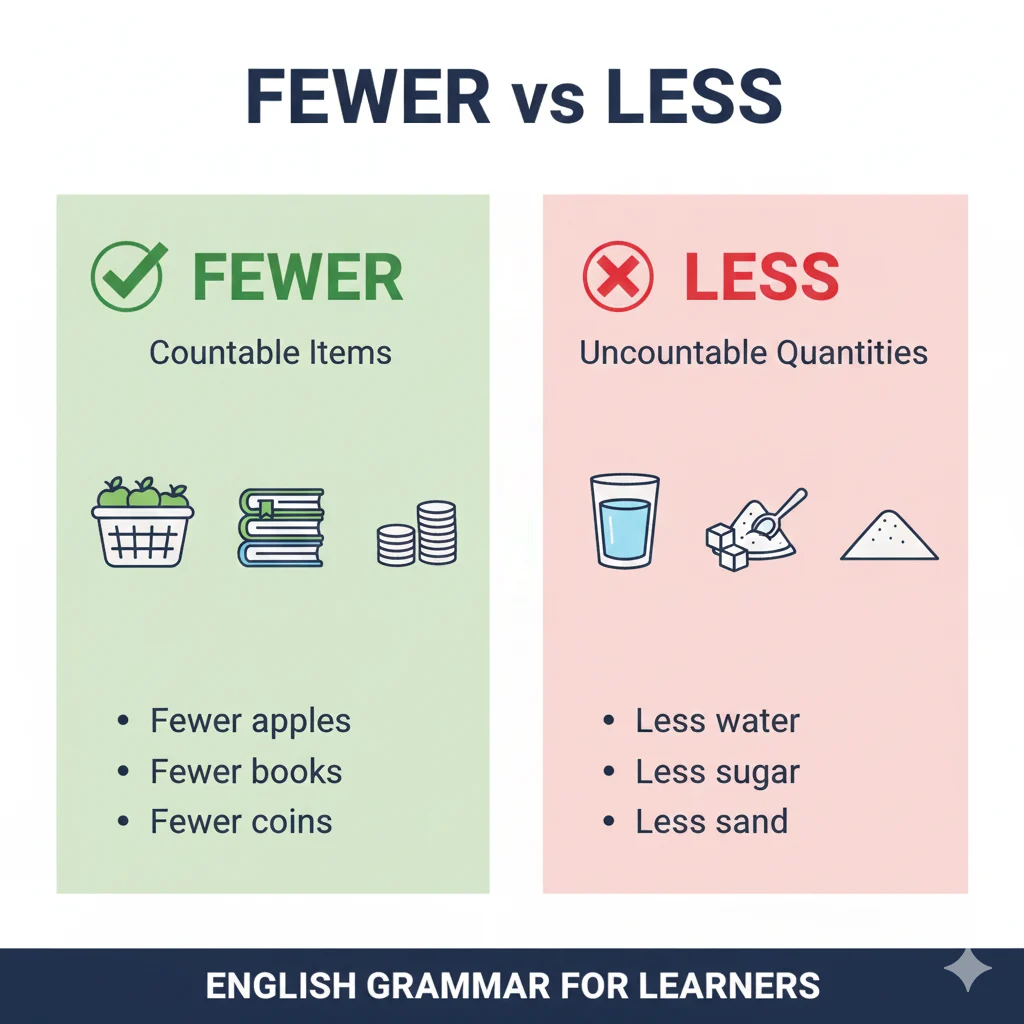
Quick Tip:
- Countable? → Fewer
- Uncountable? → Less
Think of fewer as numbers and less as quantity or mass.
Common Mistakes and How to Avoid Them
Even experienced writers sometimes confuse fewer and less. Here are some common mistakes:
- ❌ Incorrect: I have less friends than you.
✅ Correct: I have fewer friends than you.
Why: Friends are countable. - ❌ Incorrect: We need fewer water for the recipe.
✅ Correct: We need less water for the recipe.
Why: Water is uncountable. - ❌ Incorrect: He eats less cookies.
✅ Correct: He eats fewer cookies.
Why: Cookies are countable. - ❌ Incorrect: There are less cars on the road today.
✅ Correct: There are fewer cars on the road today.
Why: Cars are countable. - ❌ Incorrect: I have fewer patience than you.
✅ Correct: I have less patience than you.
Why: Patience is uncountable.
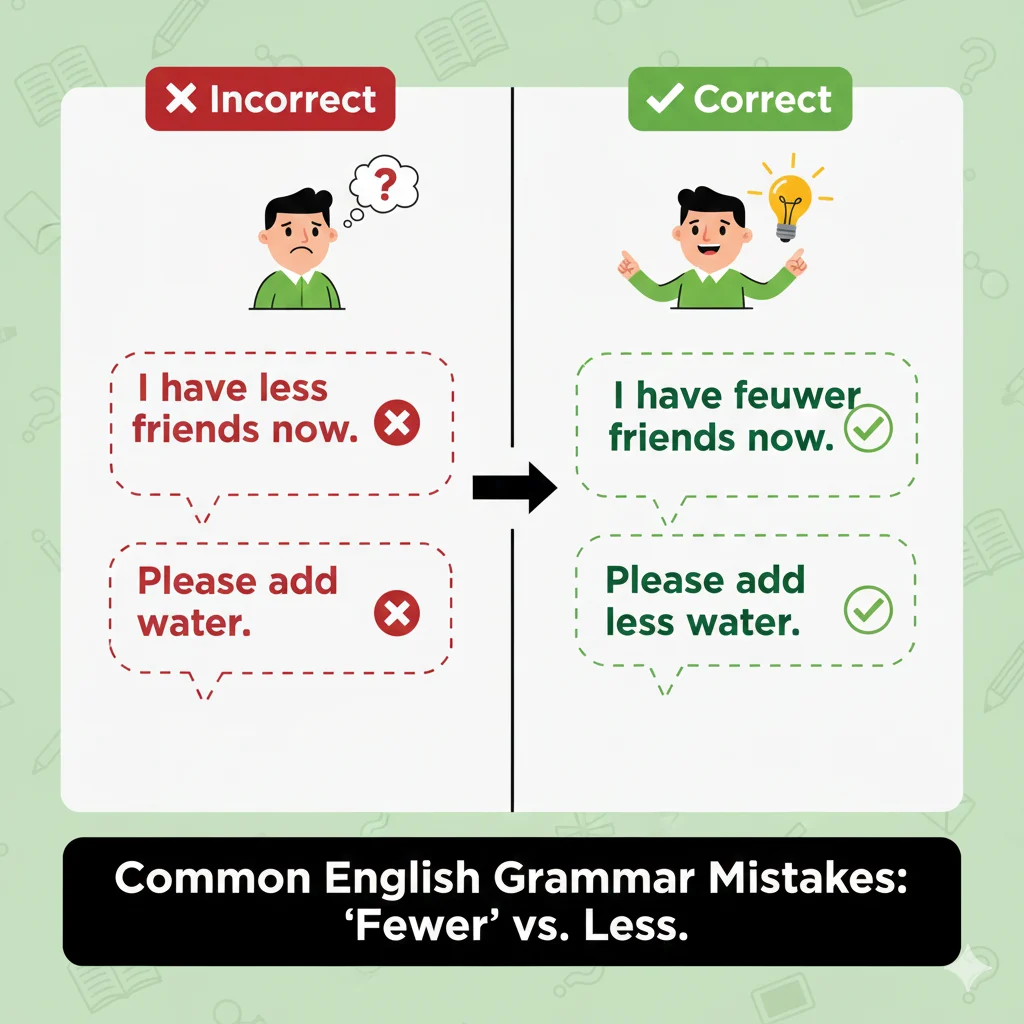
Pro Tip: Always ask yourself, “Can I count it?” If yes, use fewer. If no, use less. This simple check fixes most mistakes instantly.
When to Use Fewer
Fewer is perfect for things you can count individually. You will use it in classrooms, shops, conversations, and any situation involving countable items.
Examples in Daily Life:
- There are fewer students in class today.
- I bought fewer oranges than last week.
- My brother has fewer toys than I do.
- We ate fewer slices of pizza than we planned.
- There are fewer cars on the road during the holiday.
- The library has fewer books than the bookstore.
- We invited fewer guests to the party this year.
Practical Tip: Think about counting the items in your mind. If you can count them, fewer is almost always correct.
Memory Hack: Imagine a basket or a box of objects. Remove some items. The word to describe the smaller number is fewer.
When to Use Less
Less works with things you cannot count individually. Think liquids, time, money, abstract qualities, and mass nouns.
Examples in Daily Life:
- I have less patience today than yesterday.
- Pour less juice into the glass.
- We spent less money on groceries this week.
- She has less energy after the workout.
- He gave less information than I expected.
- There is less traffic in the morning than at night.
- I need less noise in my study room.
Practical Tip: Ask yourself, “Can I count it?” Water, sugar, time, money, or energy cannot be counted as single units easily — use less.
Visual Trick: Imagine a container or a glass. If the substance inside decreases, think less.
Advanced Tips for Using Fewer and Less
- Origin of Words:
- Fewer comes from Old English feawe, meaning “few.”
- Less comes from Old English les, meaning “smaller in quantity.”
- Formal Writing:
Using these words correctly improves clarity in essays, reports, exams, and professional emails. For example:- Correct: There are fewer errors in this report than the last one.
- Correct: We have less time to complete this project.
- Online Writing:
People often write less people on social media. While commonly understood, it is considered grammatically incorrect. Proper usage is fewer people. - Exceptions:
Some expressions use less with countable nouns for general measurements:- Less than 10 miles
- Less than 5 dollars
This is acceptable in measurements, money, and distance.
Mini Quiz: Test Yourself
Fill in the blanks with fewer or less:
- I have _______ homework today than yesterday.
- She drank _______ water than her brother.
- There are _______ chairs in this room.
- We spent _______ money on snacks this week.
- He made _______ mistakes on the test than last time.
- I ate _______ cookies than my sister.
- There is _______ sugar in this tea than I like.
- There are _______ students in the new class.
- I have _______ free time this week.
- We bought _______ oranges than last month.
Answers: 1. less, 2. less, 3. fewer, 4. less, 5. fewer, 6. fewer, 7. less, 8. fewer, 9. less, 10. fewer
FAQs
- Can I use “less” with numbers?
Only with quantities that cannot be counted individually, like time, money, or distance. - Why do people say “less people”?
It’s a common mistake. “People” is countable, so the correct word is fewer. - Is “fewer water” ever correct?
No, because water is uncountable. Always use less. - Can “fewer” be used in formal writing?
Yes, it is preferred for countable nouns in essays, reports, and exams. - Any memory trick for “fewer” and “less”?
Count objects → fewer. Think about quantities you can’t count → less.
Quick Recap: Fewer vs Less
- Fewer = countable nouns → fewer apples, fewer chairs
- Less = uncountable nouns → less milk, less time
- Count it? → Fewer | Cannot count? → Less
- Avoid common mistakes by checking the noun type
- Remember measurement exceptions (distance, money, time)
Conclusion
Now you can confidently use fewer and less. Remember: fewer is for countable nouns, and less is for uncountable nouns. Simple tips like “Can I count it?” can help you avoid mistakes instantly. By practicing these rules in everyday conversation, writing, and online communication, you’ll make your English sound natural and professional.
Using fewer and less correctly is a small change that makes a big difference in clarity and grammar. Try these words in your next sentence, essay, or casual conversation. With practice, you’ll soon notice the difference in your confidence and accuracy. Keep learning, and enjoy improving your English every day — one word at a time!

English novelist and poet Thomas Hardy (1840–1928) explored human struggles, social constraints, and tragic love with deep realism and vivid storytelling.