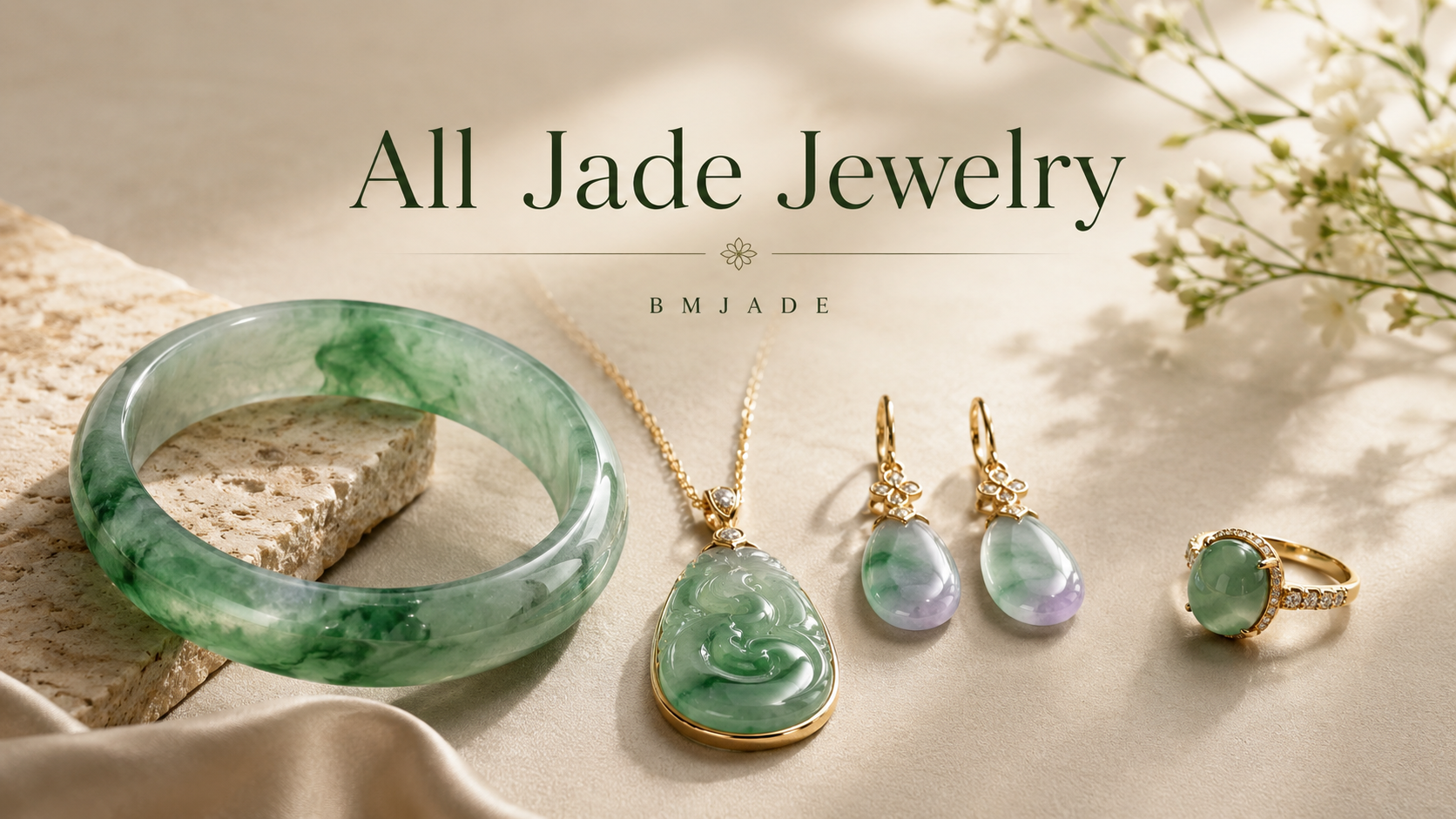
Earrings are the only jewelry that lives at eye level. A bangle gets glanced at; a pendant gets noticed; earrings sit in the same visual frame as your expression, moving when you laugh, catching light when you turn. Which is why choosing jade earrings for women involves questions no other jade format asks: not just is the stone good, but does the shape balance the face, can two natural stones actually match each other, and — the question every stone-earring buyer learns the hard way — how much does it weigh?
Those three questions organize everything below. The short version: choose the earring’s line to counter your face’s dominant line, not repeat it; understand that a matched pair is jade’s hardest supply problem and judge it honestly; and respect the physics — jade is dense, and gram budgets that don’t exist for metal earrings absolutely exist here.
One rule instead of a face-shape chart: counter the line
Every face-shape guide hands you a five-part lookup table. Here’s the single principle the whole table derives from: identify your face’s dominant line, and choose earrings that run the other way. Repetition amplifies; counterpoint balances.
- A round face is dominated by curves and width — so counter with vertical movement: slim drops, teardrops, oval dangles. (Large round studs hugging the cheek repeat the curve and add fullness.)
- A long face is dominated by the vertical — counter with width and stillness: studs, short wide drops, small hoops. (Thin straight dangles extend the very line you’re balancing.)
- A square face is dominated by angles — counter with softness: round studs, ovals, curved teardrops. (Boxy or wide-at-the-jaw designs echo the jawline.)
- A heart face narrows toward the chin — counter by weighting the bottom: teardrops and drops that widen low, filling the space beside the jaw.
- An oval face has no dominant line to counter — which is why “everything suits you” is technically true. Choose by style and occasion instead: studs for daily polish, drops for elegance, small hoops for modern ease.
That’s the entire chart, regenerated from one sentence you’ll actually remember while browsing. It’s guidance, not law — but when a pair looks inexplicably “off” on your face, the diagnosis is almost always repetition.
The two-stone problem: what “matched pair” honestly means
Here’s the supply constraint unique to this category, and the thing to inspect before anything else: earrings are the only jade format that requires two stones pretending to be one. Natural jadeite varies inch to inch within a single boulder — so cutting two pieces with the same color, tone, texture, and translucency is the bead-matching problem squared, because these two sit symmetrically beside your face, where any mismatch has a spotlight.
This has honest implications. Perfectly identical twins in natural stone are rare and priced accordingly; a well-matched pair means close, with sisterly variation — one stone a breath deeper, a cloud sitting differently — which reads as natural charm at conversational distance. What doesn’t pass: visibly different tones, one translucent stone paired with one opaque, or color drifting in the same direction on both (two “left-heavy” stones look like an error; mirror-imaged drift looks intentional).
The check is simple and non-negotiable: both earrings in one photograph, natural light, side by side. A listing showing a single earring twice — or each stone in its own separately lit shot — is managing your perception of the match. And note the quiet corollary: suspiciously perfect twins at a suspicious price usually means the matching was done in a dye vat or a mold, not at a cutting bench. In earrings, slight sisterhood is the fingerprint of the real thing.
Stone physics at the earlobe
Jade is beautiful and jade is dense — about 3.3 times the weight of water, heavier volume-for-volume than glass beads and far heavier than hollow metal. Every sizing instinct you’ve built on fashion earrings mis-calibrates here, so budget in grams:
- Studs (roughly 1–3 g per ear): the free lunch. Small cabochon studs sit weightlessly all day, which is why they’re the category’s daily-wear default and the safest gift.
- Drops (roughly 3–8 g): the sweet spot for presence with comfort — but check the listed weight, because a thick jade drop crosses the line faster than its photo suggests.
- Past ~8–10 g per ear: statement territory. Wearable for an evening, tiring by a workday’s end, and over years, heavy earrings genuinely stretch piercings. If you love the look, wear it occasionally and store it honestly.
Hardware is the other half of the physics. Friction push-backs are fine for studs; heavier drops deserve lever-backs, hooks with closures, or screw backs that won’t surrender to a sweater. And the post metal matters medically, not just aesthetically: S925 sterling, 14K, or 18K posts are the hypoallergenic standard — mystery-alloy posts are how “my ears can’t wear earrings” stories start. A listing that specs the closure and the post metal is a listing written by someone who’s worn earrings.
Color at zero distance
Every jade format interacts with your coloring; earrings do it at point-blank range, an inch from your complexion. So the undertone logic matters most here: check your wrist veins in daylight — greenish veins mean warm undertones (flattered by green, honey, and richer tones, usually in gold settings), blue-purple means cool (icy, white, lavender, and pale green sing, usually in silver or white gold), can’t-tell means neutral and lucky.
Two earring-specific color effects worth knowing. Icy jade brightens: a pale translucent stud works like a tiny reflector beside the skin, which is why icy studs read “fresh-faced” in a way no other jewelry quite does. And dark jade concentrates: near the face, black-green reads serious and sculptural — better in small, clean shapes than large ones, where the visual weight starts to pull downward.
Movement is jade’s earring superpower
A stud is a fixed point of color; a drop is an animation. Jadeite’s translucency — the watery, lit-from-within quality — only fully performs when light moves through the stone at changing angles, which is exactly what a drop earring does with every turn of the head. This is the honest argument for drops over studs when the stone has real water: you’re buying an optical property, so buy the format that exercises it. Opaque, richly colored jade inverts the logic — its beauty is surface color, which a stud presents perfectly well without the weight tax.
Hair and neckline are the logistics layer, quickly: short hair and updos amplify everything (small studs gain presence; this is the drop’s moment); long worn-down hair swallows small earrings, so scale up or tie back; and with high-neck sweaters, earrings inherit the lead-jewelry role a hidden necklace vacates — the one outfit where a slightly bolder pair is the balanced choice.
The floor, as always
Small stones deserve the same paper as large ones, and mostly don’t get it — earrings are where sellers quietly skip certification because the per-piece lab fee stings at low prices. The standard to hold: species named (jadeite or nephrite), Type A stated, NGTC certificate included and serial-verifiable at ngtc.com.cn, hypoallergenic post metal specified, and a 30-day window plus a no-expiry authenticity guarantee behind it all. That’s the configuration across BMjade’s earring range, entry pieces included — which is precisely the tier where it’s rarest, and the reason a small pair there can be gifted without a single asterisk.
FAQ
How heavy is too heavy for jade earrings? As a budget: studs at 1–3 g per ear wear invisibly; drops at 3–8 g balance presence and comfort; past 8–10 g you’re in occasion-wear territory that tires the lobe by day’s end and stretches piercings over years. Check the listed gram weight — jade’s density means photos systematically under-signal it.
Should the two stones in a pair match exactly? Closely, not identically. Natural jadeite varies, so an honest matched pair shows sisterly differences invisible at conversational distance; demand a photo of both earrings together in natural light. Perfect twins at a low price usually means dye or molds did the matching.
Which earring style suits a round face? Counter the curve with vertical line: slim drops, teardrops, and oval dangles add gentle length, while large round studs close to the cheek repeat the roundness. The general rule for every face: don’t repeat your dominant line — balance it.
Are jade studs safe for sensitive ears? The stone is irrelevant to sensitivity — the post is everything. Look for S925 sterling silver, 14K, or 18K gold posts stated explicitly in the listing; unspecified alloy posts are the usual culprit behind irritated ears.
Good jade earrings do a quiet double job: the shape balances the face’s geometry while the stone brings living color to the one place jewelry and expression share a frame. Counter your line, insist on seeing both stones together, respect the gram budget, and let translucent stones move while opaque ones sit still — four decisions, and the pair chooses itself. Start choosing at BMjade jade earrings.

