Have you ever wondered: “Is it man or men?” If yes, you are not alone. English learners often get confused between these two words because they look similar but mean different things. Choosing the wrong word can make a sentence grammatically incorrect, and sometimes even change its meaning.
Simply put, “man” refers to one adult male, while “men” refers to two or more adult males. Yet, beginners often stumble over phrases like “two man or men,” “every man or men,” or “one of the greatest man or men.”
In this complete guide, you’ll learn:
- The man or men meaning
- The difference between man and men
- How to use each word in real-life examples
- Common mistakes and how to avoid them
- Pronunciation tips
- Advanced grammar insights
- And a mini quiz to test your understanding
By the end, even beginners will confidently know which word to use — man or men — in any sentence, whether you are speaking, writing, or texting.
What Does Each Word Mean?
Meaning of Man
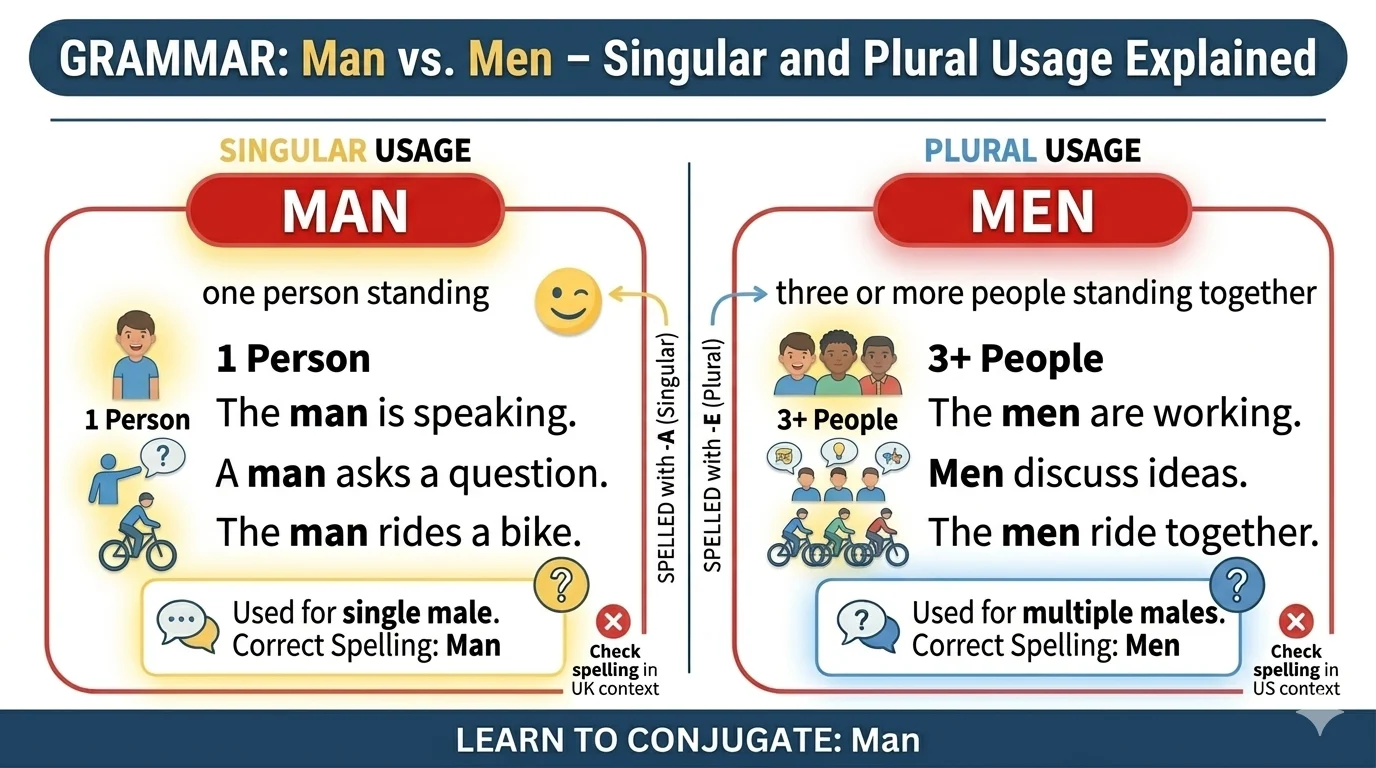
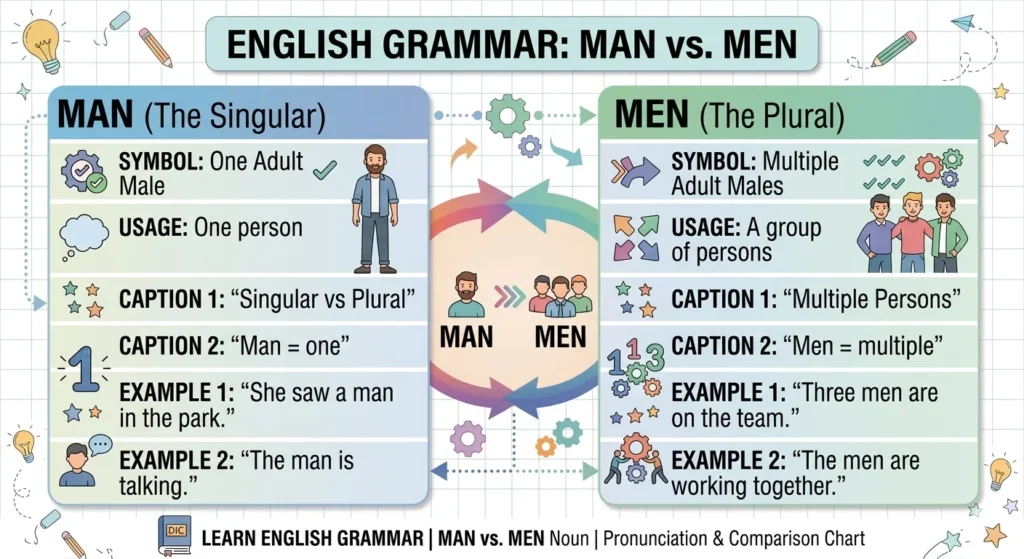
The word man is used to refer to one adult male person. It is a singular noun, and its plural form is men.
When people ask “man singular or plural?”, the answer is clear: man is singular.
Examples of Man:
- A man is waiting outside the shop.
- The man helped the child cross the street.
- My father is a hardworking man.
- The gingerbread man ran away from the baker.
- That man is very kind and polite.
Mini Story Example:
Imagine a village where only one man tends the garden. You would say: “The man waters the plants every morning.” Using men here would be wrong because there is only one person.
Usage Tip:
- Words like a, one, every, the before a noun usually indicate the singular form man.
- Examples: a man, every man, the man, one man.
Meaning of Men
The word men is the plural form of man. It refers to two or more adult males.
When learners ask “man or men plural?”, the correct answer is men.
Examples of Men:
- Two men are fixing the road.
- The men are working in the factory.
- Three men helped carry the heavy table.
- Several men attended the village meeting.
- The brave men rescued the cat from the tree.
Quick Tip:
If the sentence has a number greater than one or words like several, many, some, use men.
Example Mistake:
- ❌ Two man are standing outside.
- ✔ Two men are standing outside.
Part of Speech
| Word | Part of Speech | Notes |
|---|---|---|
| Man | Noun (singular) | Refers to one adult male. |
| Men | Noun (plural) | Refers to two or more adult males. |
Semantic Note:
This is an irregular plural. Most English nouns simply add “s” for plural (e.g., cat → cats). But man → men is irregular, like woman → women.
The Key Difference Between Man and Men
Understanding the man or men difference is simple once you know these rules:
| Feature | Man | Men |
|---|---|---|
| Meaning | One adult male person | Two or more adult male people |
| Grammar | Singular noun | Plural noun |
| Examples | A man is walking in the park. | Two men are talking outside. |
| Use With Numbers | One, a, every | Two, three, many, several |
| Common Mistake | ❌ Two man | ❌ Every men |
Quick Memory Tip:
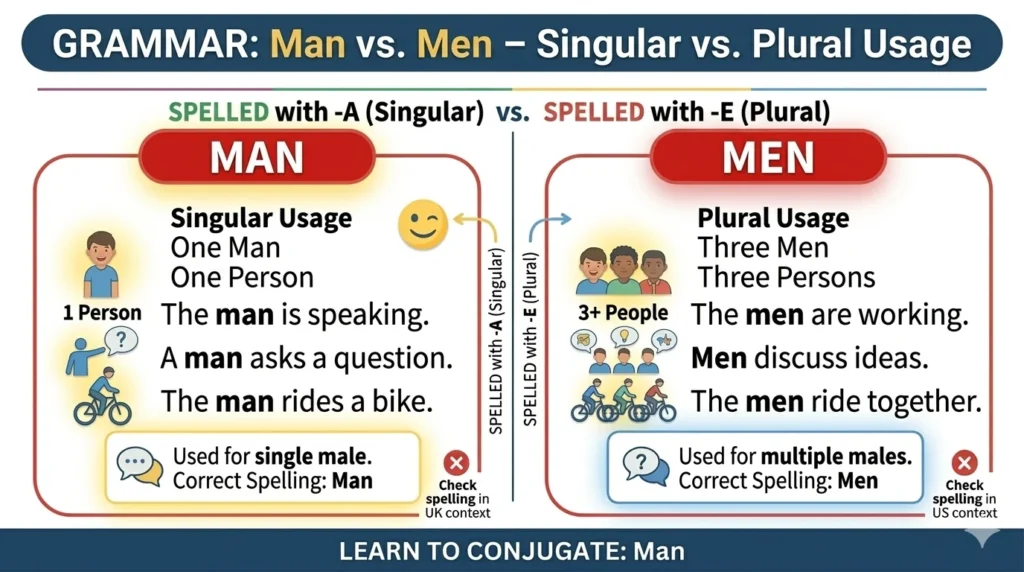
- Man = One person
- Men = Many people
Think: “If it’s one, use man; if it’s more than one, use men.”
Common Mistakes and How to Avoid Them
English learners often make mistakes with man or men which is correct. Let’s fix them.
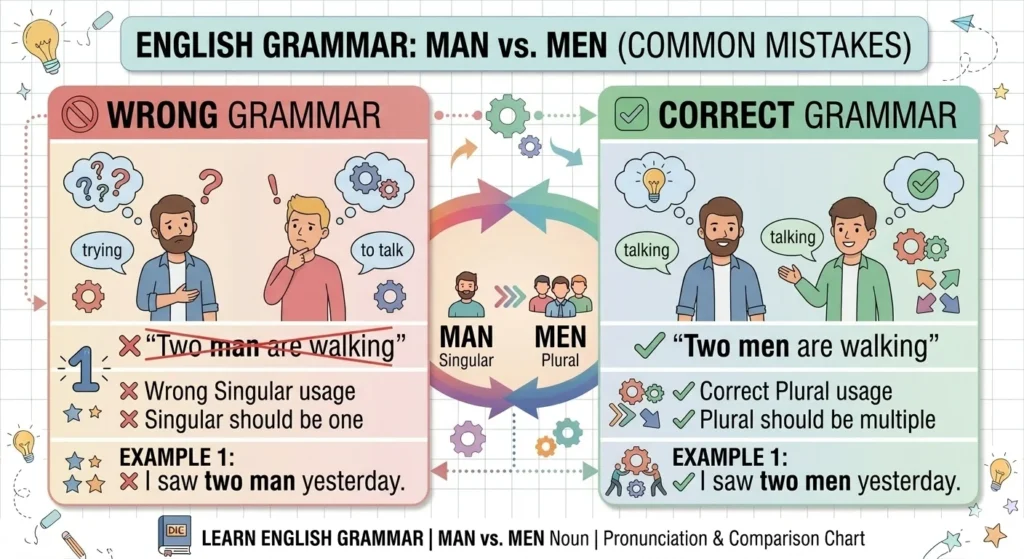
Mistake 1: Number Confusion
❌ Two man are standing outside.
✔ Two men are standing outside.
- Why: “Two” is plural. Always use men.
Mistake 2: Every + Noun
❌ Every men must follow the rule.
✔ Every man must follow the rule.
- Why: The word every takes a singular noun.
Mistake 3: One of the Greatest
❌ One of the greatest man in history
✔ One of the greatest men in history
- Why: “One of the greatest” refers to a group, so the noun must be plural.
Mistake 4: Gingerbread Example
❌ Gingerbread men ran from the baker. (if talking about the story’s original character)
✔ Gingerbread man ran from the baker.
- Why: The story refers to one character.
Mistake 5: Bible Example
❌ “God created men.” (if referring to a single human)
✔ “God created man.”
- Tip: Pay attention to context: singular or plural.
When to Use Man
Use man in the following situations:
- When talking about one adult male.
- With a, one, every, the before the noun.
- In stories or anecdotes featuring one person.
- Describing singular roles or professions.
Examples:
- A man knocked on the door.
- The man at the counter is my uncle.
- I saw a man riding a bicycle.
- Every man should learn basic life skills.
- The man who called yesterday is my neighbor.
Memory Hack:
If you can replace the noun with “he,” it’s likely man.
- Example: The man is tall → He is tall.
When to Use Men
Use men in these situations:
- When talking about two or more males.
- With numbers or quantifiers: two, three, many, several.
- In stories or examples with groups of men.
- Formal contexts: army, workplace, or community references.
Examples:
- Two men are painting the house.
- The men are playing football.
- Many men work in this company.
- Several men attended the meeting.
- The brave men rescued the trapped animal.
Memory Hack:
Think of men = multiple people. If you can replace it with “they,” it is likely men.
Man and Men Pronunciation
Pronunciation often confuses learners:
- Man → /mæn/ (rhymes with can)
- Men → /mɛn/ (rhymes with pen)
Example:
- A man is here.
- Three men are here.
Pro tip: Practice saying man and men aloud in sentences to hear the difference.
Singular vs Plural Usage in Phrases
Here are some common phrases:
| Phrase | Correct Form |
|---|---|
| One ___ is here | man |
| Two ___ are here | men |
| Every ___ must try | man |
| Many ___ helped | men |
| One of the greatest ___ | men |
| Gingerbread ___ | man |
| Boys vs ___ | men |
Tips for Clarity:
- ❌ Two man or men? → ✔ Two men
- ❌ Every men → ✔ Every man
- ❌ One man or men → ✔ One man (unless referring to group context)
Advanced Tips
Historical Origin
- Man → Men is irregular; from Old English mann → men, while most nouns add s.
- Similar pattern: woman → women.
Formal Writing
Correct usage improves essays, reports, and exams.
- Example:
- ✔ The men of the company are dedicated.
- ✔ Every man deserves respect.
Difference Between Man and Male
- Man = adult male person (noun)
- Male = gender category, can describe animals or humans
Examples:
- The man is my neighbor.
- The male cat is sleeping.
Difference Between Man and Boy
- Boy = young male
- Man = adult male
Example:
- The boy is playing outside.
- The man is working in the garden.
Fun Examples with Real-Life Situations
- School:
- A man teaches math.
- Several men are coaching football.
- Family:
- Every man in the family helps with chores.
- The men in my uncle’s house built a treehouse.
- Workplace:
- The man at reception is helpful.
- Three men repaired the office computers.
- Stories:
- The gingerbread man runs fast.
- The brave men of the village saved the harvest.
Quick Recap: Man vs Men
- Man = singular noun (one person)
- Men = plural noun (more than one person)
- Use man with a, one, every, the
- Use men with numbers or quantifiers like two, three, many, several
- Memory trick: Replace with he = man, they = men
- Common phrases: every man, two men, one of the greatest men, gingerbread man
Mini Quiz: Test Yourself
Fill in the blanks with man or men:
- A ___ is reading a book.
- Two ___ are walking in the park.
- Every ___ must be honest.
- One of the greatest ___ in history.
- The ___ at the bakery is friendly.
- Several ___ helped carry the furniture.
- The gingerbread ___ ran away.
- Many ___ attended the festival.
- One ___ called to ask directions.
- Three ___ are fixing the car.
Answers:
- man
- men
- man
- men
- man
- men
- man
- men
- man
- men
Meta Description
FAQs
1. What is the difference between man and men?
Man refers to one adult male person, while men is the plural form for two or more males.
2. Is it two man or two men?
The correct phrase is two men. Numbers greater than one require the plural.
3. Is it every man or every men?
Every man is correct. The word every takes a singular noun.
4. How do you pronounce man and men?
- Man → /mæn/ (rhymes with can)
- Men → /mɛn/ (rhymes with pen)
5. When to use man and male?
- Man = adult male person
- Male = gender category (human or animal)
Conclusion
Learning man or men is easier than it seems. Remember: man = one person, men = more than one. By practicing examples from daily life, school, work, or stories, you will never hesitate when choosing the correct word.
Correct usage improves writing, speaking, and confidence in English. Keep practicing, pay attention to numbers and context, and soon using man or men will become automatic. Every step counts in mastering English, so start using your knowledge today.

English novelist and poet Thomas Hardy (1840–1928) explored human struggles, social constraints, and tragic love with deep realism and vivid storytelling.