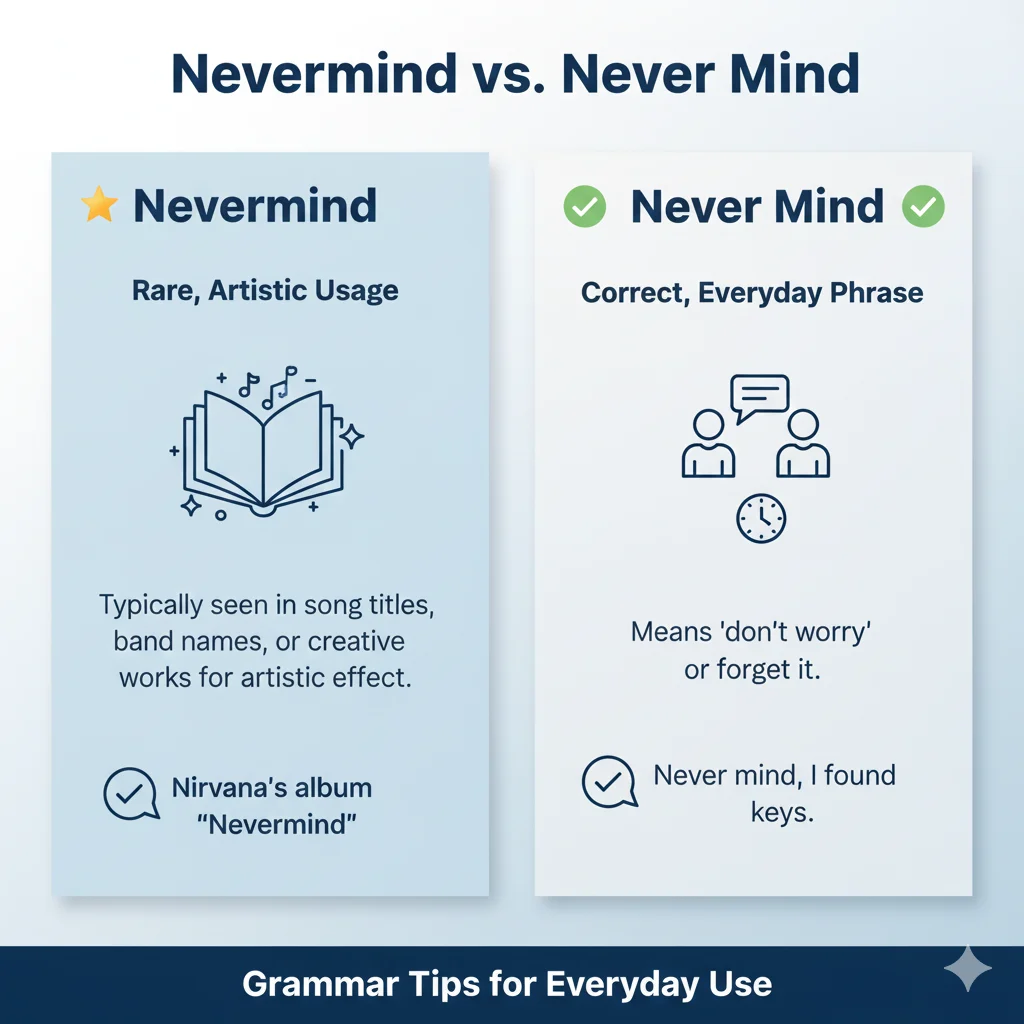
People often get confused between “nevermind” and “never mind.” These two look very similar, but they do not have the same meaning or usage. One is used in everyday English to tell someone to ignore something, and the other is mostly used in creative writing or old-style texts. Because they sound the same, many learners mix them up.
In this easy guide, you’ll learn:
- What “never mind” means
- What “nevermind” means
- The difference between nevermind and never mind
- Which one you should use in school, essays, messages, and daily life
- Common mistakes and how to fix them
- Simple examples even a 4th-grade student can understand
By the end, you’ll be able to confidently choose the right word every time.
What Does Each Word Mean?
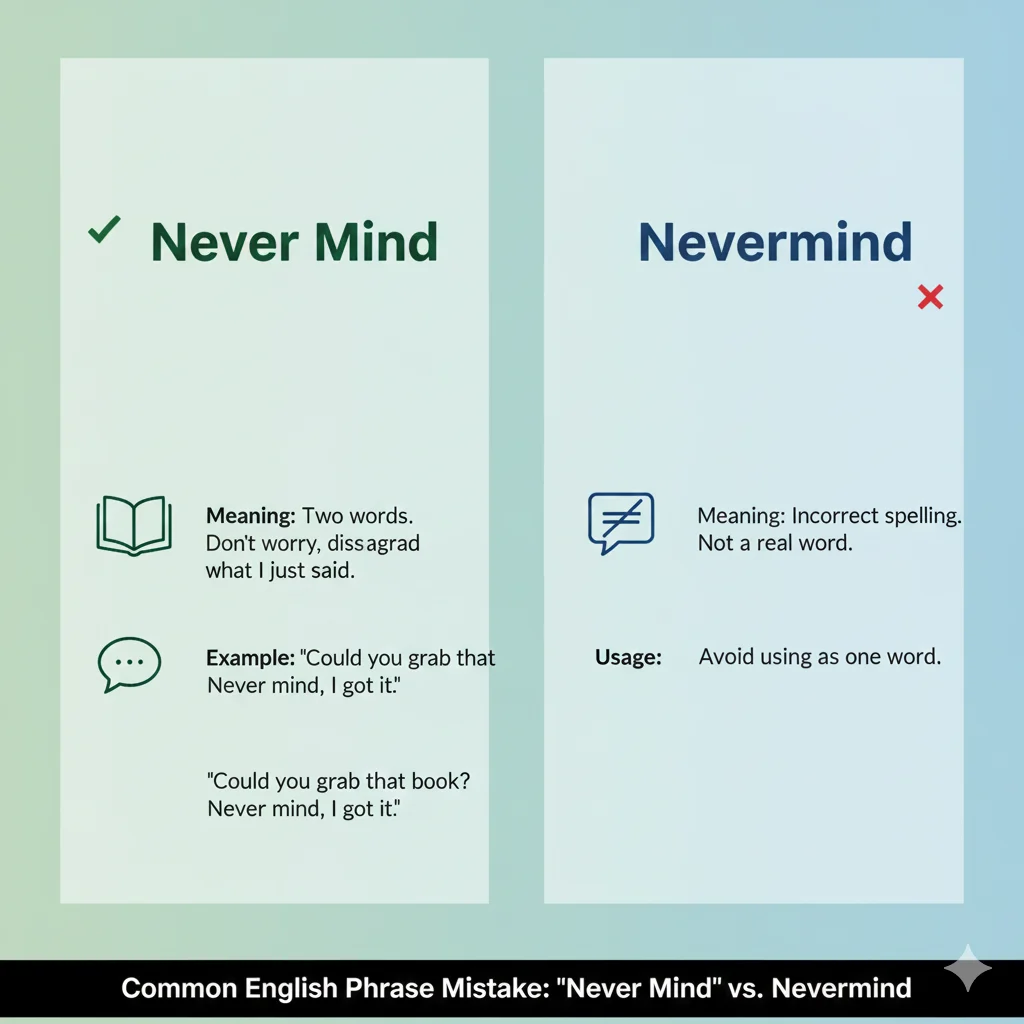
Meaning of “Never Mind”
“Never mind” (with a space) is the correct and standard form in modern English.
You use it when you want someone to forget something, ignore something, or stop worrying about it.
Part of Speech: Phrase (informal command)
Easy Examples:
- “Never mind, I found my pencil.”
- “Never mind what he said.”
- “Never mind, I can do it myself.”
You can think of it like saying: “It’s okay, forget it.”
Meaning of “Nevermind”
“Nevermind” (one word) is not used in everyday modern English.
It appears mostly in:
- Song titles
- Book titles
- Names
- Older or stylistic writing
Part of Speech: Noun (rare)
Easy Examples (mostly from titles):
- He listened to the album “Nevermind.”
- The poem used the word “nevermind” as a creative style.
- In some old books, you might see “nevermind,” but it’s uncommon today.
A simple way to remember:
✔ “Never mind” = everyday English
✖ “Nevermind” = title, name, or creative choice
The Key Difference Between Nevermind and Never Mind
Below is a quick, beginner-friendly comparison table.
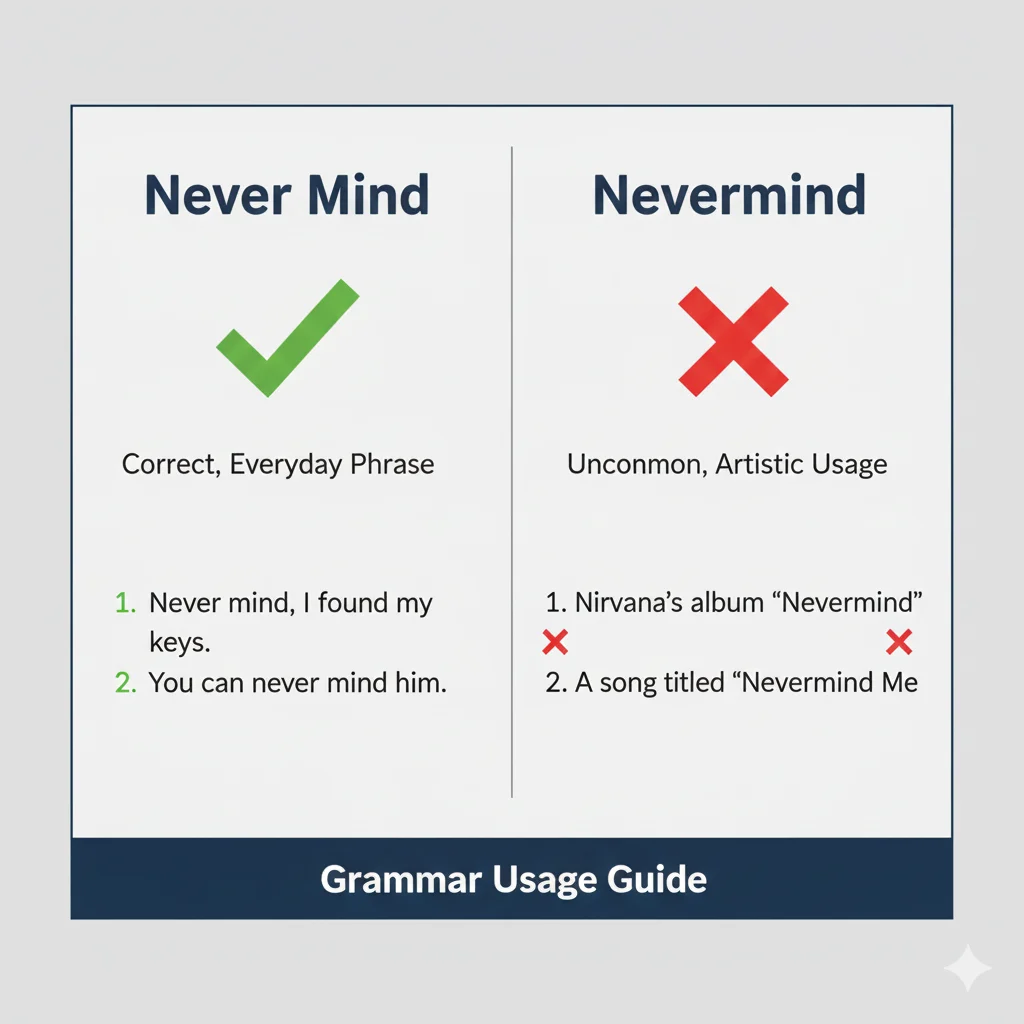
Comparison Table
| Feature | Never Mind | Nevermind |
|---|---|---|
| Correct in modern English? | ✔ Yes | ✖ Mostly no |
| Used in daily conversation? | ✔ Yes | ✖ Rarely |
| Meaning | Ignore it / Forget it | A noun (creative or stylistic use) |
| Example | “Never mind, it’s fine.” | “I love the band’s album ‘Nevermind.’” |
| Formal writing? | ✔ Accepted | ✖ Not recommended |
Quick Tip to Remember
👉 If you want to tell someone to ignore something, always use “never mind.”
Common Mistakes and How to Avoid Them
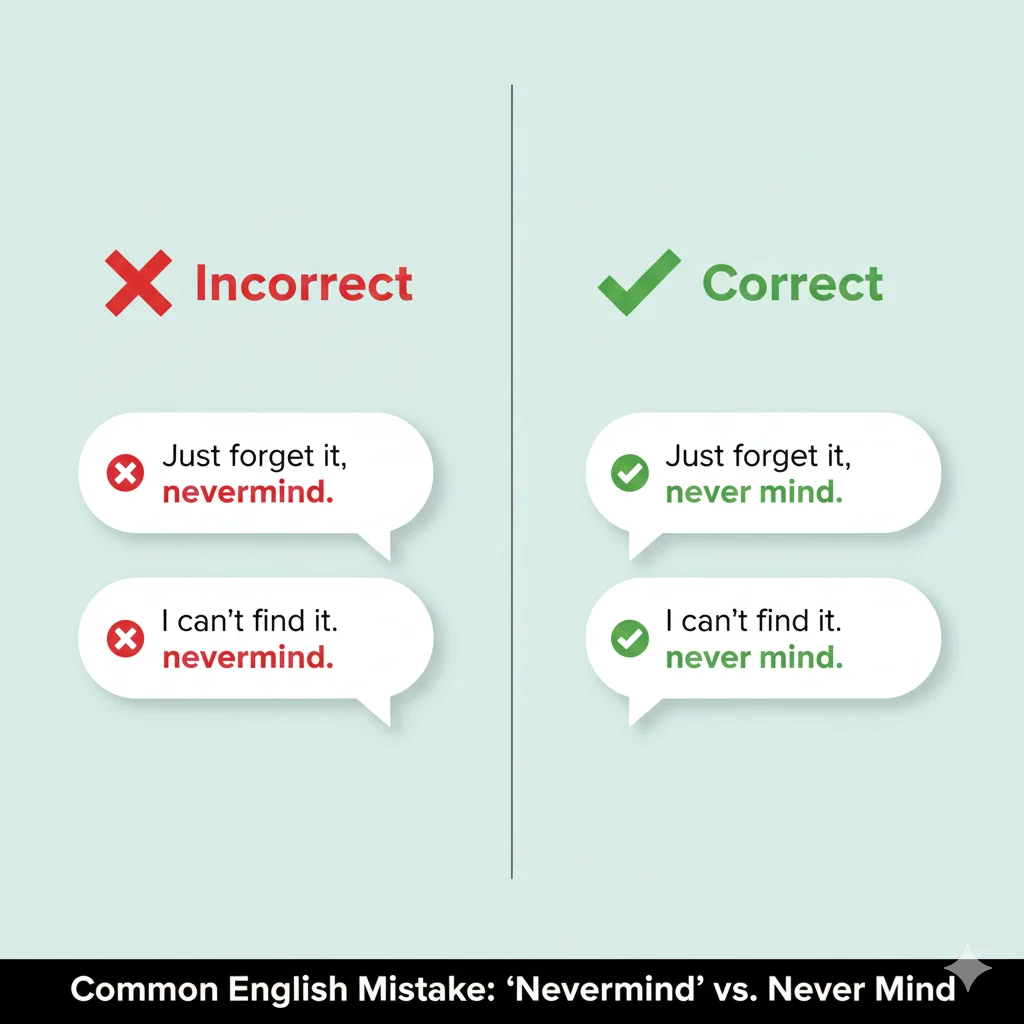
❌ Mistake 1: Using “nevermind” instead of “never mind”
Wrong: “Nevermind, I’ll do it later.”
Right: “Never mind, I’ll do it later.”
Why it happens:
People assume combining the words is correct because it sounds like one word. But in real English usage, the two-word phrase is standard.
❌ Mistake 2: Thinking both words mean the same thing
Wrong: “The teacher said nevermind the homework.”
Right: “The teacher said never mind the homework.”
Why it happens:
Learners see “never mind” and think “never + mind = nevermind,” but the meaning does not work that way.
❌ Mistake 3: Using “nevermind” in essays
Wrong: “Nevermind the earlier points…”
Right: “Never mind the earlier points…”
Why it happens:
“Nevermind” may appear in music or creative works, so students think it’s acceptable in formal writing — but it isn’t.
When to Use “Never Mind” (Correct Everyday Phrase)
Use “never mind” when you want to:
✓ Tell someone not to worry
“Never mind, everything is okay now.”
✓ Cancel something you said
“Never mind what I told you earlier.”
✓ Stop someone from doing something unnecessary
“Never mind, I already cleaned the room.”
✓ Change your mind
“Never mind, let’s stay home instead.”
✓ End a conversation politely
“Never mind, we’ll talk tomorrow.”
When to Use “Nevermind” (Rare)
You should use “nevermind” only when:
✓ It is part of a title or name
“‘Nevermind’ is a famous music album.”
✓ The writer intentionally uses it for style
“The poem used nevermind as a theme.”
✓ You see it in older books
Some authors used it in the past, but not anymore.
Memory Hack
📌 If it’s not a title or name — don’t use “nevermind.”
Quick Recap: Nevermind vs Never Mind
- Never mind
- Means “ignore it” or “forget it.”
- Correct in modern English.
- Use in school, essays, texts, conversations.
- Nevermind
- Mostly incorrect in daily use.
- Appears in song titles, book names, creative works.
💡 Best choice for students and writers:
👉 Always use “never mind.”
Advanced Tips
1. Origin
“Never mind” is the older and original phrase. “Nevermind” developed later in artistic writing.
2. Use in Formal Writing
Always choose “never mind” in essays, reports, emails, and academic answers.
3. In Texting
People sometimes write “nevermind” casually, but it’s still not correct.
If you care about proper English — stick to “never mind.”
4. In Exams
English grammar tests often check this pair because many students assume “nevermind” is okay.
Remember: two words = correct.
Mini Quiz: Test Yourself
Fill in the blanks with never mind or nevermind:
- ______, I figured it out myself.
- Did you listen to the album “______”?
- ______ what I said earlier, I changed my mind.
- ______, it’s not important anymore.
- That book is called “______,” right?
- ______ the noise, keep working.
- I told him to ______ and relax.
(Answers: 1-never mind, 2-Nevermind, 3-never mind, 4-never mind, 5-Nevermind, 6-never mind, 7-never mind)
FAQs
1. Is “nevermind” one word or two?
The correct everyday form is two words: never mind.
2. Do native speakers use “nevermind”?
Only in titles or creative works — not in regular sentences.
3. Which one should I use in school essays?
Always use “never mind.”
4. Are “ignore it” and “never mind” the same?
Yes, in many situations “never mind” means “ignore it.”
5. Why does “nevermind” appear in songs?
Artists use it for style or creativity, not grammar correctness.
Conclusion
You now understand the simple difference between “nevermind” and “never mind.”
Remember: “Never mind” is the correct and standard form you should use in everyday English, conversations, school work, and writing. “Nevermind” appears mainly in titles or artistic works.
Practice using both correctly whenever you write or speak. The more you use them, the more confident you’ll become.
Keep learning — every small step makes your English stronger and easier.

Scottish novelist Muriel Spark (1918–2006) crafted sharp, witty stories exploring human nature, morality, and society with dark humor and insight.