Some English phrases look very simple, yet many learners struggle to understand their true meaning and how to use them correctly. One of these commonly confusing expressions is “now or never.” You may have heard it in movies, songs, or even in everyday conversations, but what does it really mean? And how do we use it in English sentences?
In this easy, beginner-friendly guide, you will learn the meaning of “now or never,” how it is used, why it is powerful, and how to remember it without memorizing complicated grammar. We will also look at examples, common mistakes, comparison tables, and everyday situations so even a 4th-grade student can understand everything clearly.
By the end of this article, you will feel confident using “now or never” in writing, speaking, and even in your school essays or daily conversations.
What Does “Now or Never” Mean?
The phrase “now or never” is an expression, not a single word. It is used to show urgency. It means:
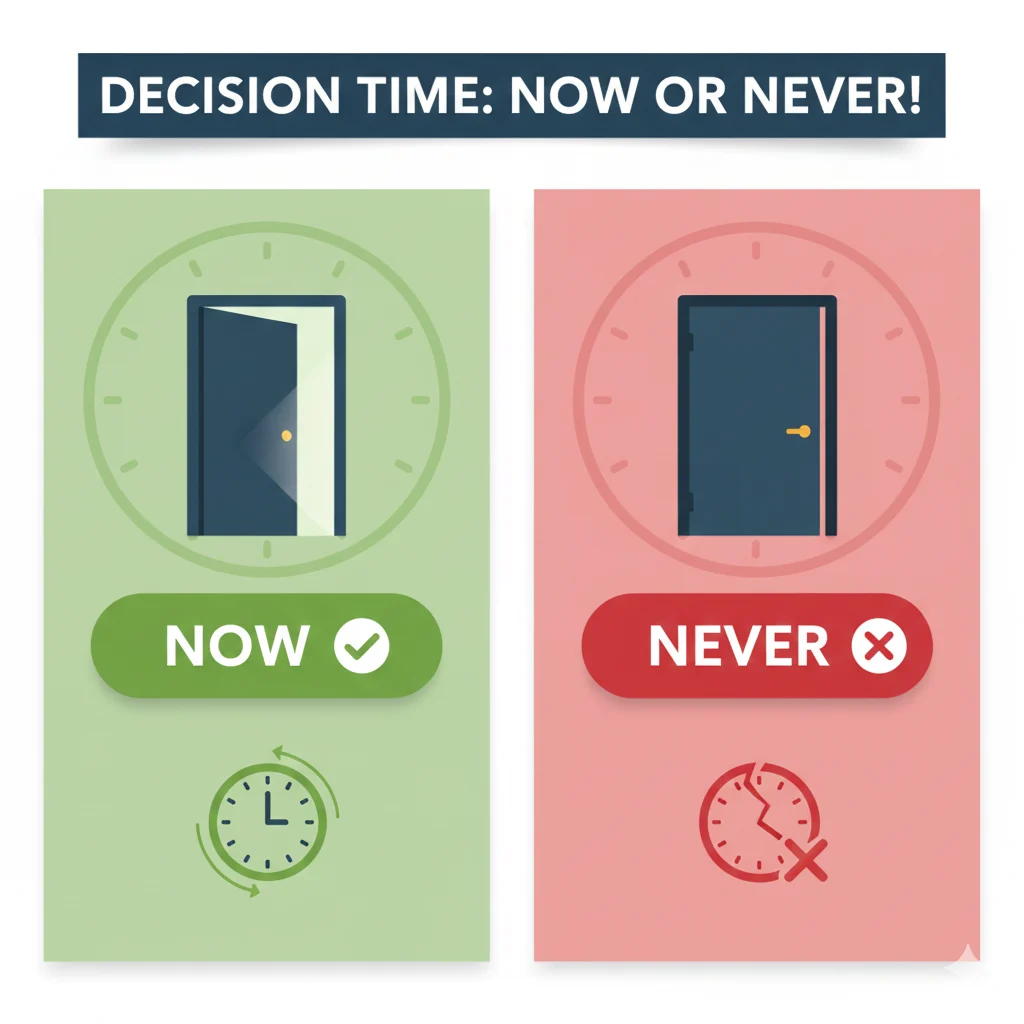
Do it right now, or you may never get another chance.
It shows that the moment is important, and waiting could make you lose the opportunity forever.
Part of Speech:
“Now or never” is an idiomatic expression. It behaves like a phrase used to express strong feelings or decisions.
Here is the simple breakdown:
- “Now” = at this moment
- “Never” = at no time; not ever
- Together → You must choose this moment or lose the chance completely.

Easy Examples:
- “It’s now or never—take the job before someone else gets it.”
- “If you want to apologize, it’s now or never.”
- “Let’s start studying. It’s now or never before the exam.”
Mini Story to Remember
Imagine you are standing outside an ice cream truck. It’s the last ice cream of your favorite flavor. If you wait even one minute, someone else may buy it.
Your friend says:
“Come on! It’s now or never!”
That means you must decide right this moment.
This small story helps you understand and remember the phrase quickly.
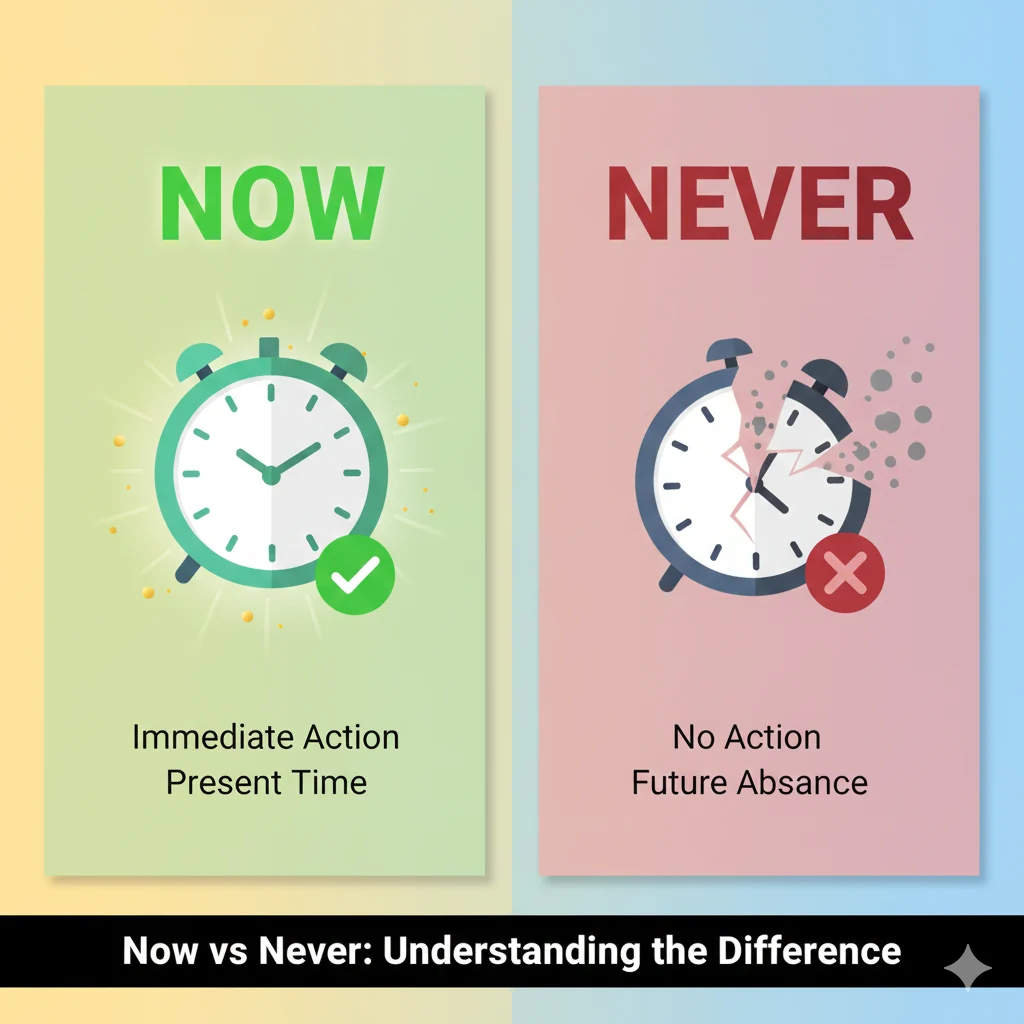
The Key Difference Explained: “Now” vs “Never” (Inside the Phrase)
Even though “now or never” is a single expression, understanding the two parts separately helps you use it correctly.
Below is a simple comparison:
| Word/Phrase | Meaning | Usage | Example Sentence |
|---|---|---|---|
| Now | At this moment; immediately | Used to show urgency or present time | “Start now if you want to finish early.” |
| Never | Not at any time; zero chance | Shows impossibility or refusal | “I never eat food late at night.” |
| Now or Never | Do it right away or you may lose your chance forever | Used for strong decisions or important moments | “Join the contest—it’s now or never.” |
Quick Tip to Remember
Think of “now or never” as a power button:
If you don’t press it now, the chance disappears forever.
Common Mistakes and How to Avoid Them
Even advanced learners make mistakes with this phrase. Here are the most common errors and the easy corrections:
❌ Mistake 1: Writing “now nor never”
Wrong: Now nor never is the right time.
Right: It’s now or never.
Why:
“Or” is used to offer a choice. “Nor” is used only after “neither.”
❌ Mistake 2: Using it for normal situations
Wrong: It’s now or never to drink water.
Right: Drink water whenever you need—it’s not urgent.
Why:
The phrase is used only for important, once-in-a-lifetime moments.
❌ Mistake 3: Using it without urgency
Wrong: It’s now or never to do your homework sometime.
Right: It’s now or never—finish your homework before the teacher comes!
Why:
The phrase must clearly show pressure, urgency, or a closing opportunity.
When to Use “Now or Never”
You should use “now or never” when:
✔ You have only one chance
✔ You must decide immediately
✔ The moment will not come back
✔ There is a risk of losing something important
Here are clear, real-life examples:
- “The train is leaving in one minute—it’s now or never!”
- “Tell her how you feel. It’s now or never.”
- “Buy the tickets before they sell out. It’s now or never.”
- “Start saving money today. It’s now or never for a better future.”
- “Submit the form—it’s now or never, the deadline is today.”
Memory Hack
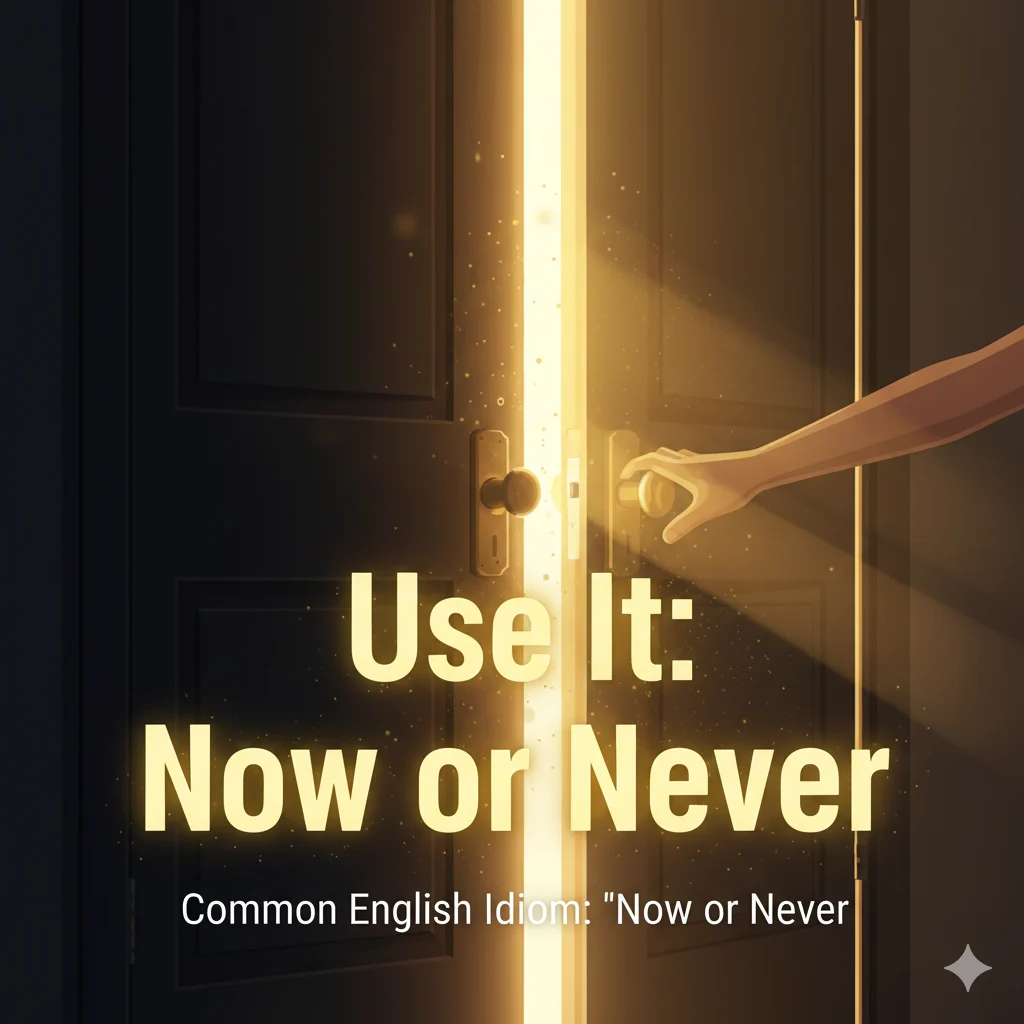
Imagine a door slowly closing. If you don’t jump in now, the door will shut forever. That’s exactly what “now or never” expresses.
When Not to Use “Now or Never”
Since many learners overuse the phrase, here’s when NOT to use it:
❌ When the action can be done anytime
Example: “It’s now or never to eat breakfast.”
(Breakfast is not a once-in-a-lifetime moment.)
❌ When the situation is not urgent
Example: “It’s now or never to clean your room.”
(You can clean later; it’s not a final chance.)
❌ When the opportunity will return
Example: “It’s now or never to watch TV.”
(TV is always available.)
Quick Recap: “Now or Never”
Here are the key points in simple bullet form:
- It means do it right now or the chance will be gone forever.
- It is used for big decisions or urgent moments.
- It adds emotion and pressure to a situation.
- It should not be used for everyday routine tasks.
- It is easy to remember with the closing door or last ice cream example.
Advanced Tips
Even though the phrase is simple, here are a few deeper points for advanced students or exam writers:
1. Origin
The phrase has been used for centuries in English to express urgency and strong decisions. It appears in old literature, motivational speeches, and famous songs.
2. Use in Essays and Exams
In formal writing, it can be used to show strong opinion:
- “The government must act now or never to protect the environment.”
- “Students should start preparing early; it is now or never to build confidence.”
3. Use in Motivation
It is often used to inspire someone:
- “Take the first step. It’s now or never.”
4. Use in Text Messages
Teenagers and young adults use it to express excitement:
- “Let’s go for the road trip! It’s now or never ✨”
Deal or No Deal: Meaning, Difference, and Correct Usage Explained
Mini Quiz (Test Yourself!)
Fill in the blanks with “now or never.”
- If you want to join the team, it’s ________.
- The sale ends in one hour. It’s ________ to buy the jacket.
- Tell him the truth. It’s ________.
- The bus is leaving! It’s ________.
- If we don’t start studying today, it’s ________ before exams.
(Answers: now or never for all questions.)
5 FAQs About “Now or Never”
1. What does “now or never” mean in simple words?
It means you must act immediately, or you will lose the chance forever.
2. Is “now or never” formal or informal?
It is mostly informal but can be used in speeches or motivational writing.
3. Can I use “now or never” for everyday tasks?
No. Use it only for urgent or important moments.
4. Is “now or never” an idiom?
Yes. It is an idiomatic expression showing urgency and decision.
5. Can I write “now nor never”?
No. The correct phrase is always “now or never.”
Conclusion
The phrase “now or never” is simple but very powerful. It tells us to take action immediately before the chance disappears forever. In this guide, you learned its meaning, correct usage, examples, common mistakes, and easy ways to remember it. With daily practice, you will start using it naturally in conversations and writing. Keep learning step by step — improving your English is also a “now or never” moment!

English playwright and novelist Patrick Hamilton (1904–1962) captured psychological tension, social decay, and dark humor in gripping, unforgettable stories.