“Pleaded or pled” is one of the most confusing word pairs in English. Many people—even native speakers—often wonder which form is correct, which one sounds more formal, and when each should be used. Both words come from the verb “plead,” but their usage changes depending on the country, writing style, and type of English.
In this simple, friendly guide, you’ll learn the meaning, correct usage, and the difference between pleaded and pled. You’ll also see easy examples, memory tricks, grammar tips, and a comparison table anyone can understand—even a 4th-grade student. By the end, you’ll know exactly which word to use in school assignments, essays, messages, legal writing, and daily conversations.
Let’s make English easy, clear, and fun—one confusing pair at a time!
What Does Each Word Mean?
1. What Does “Pleaded” Mean?
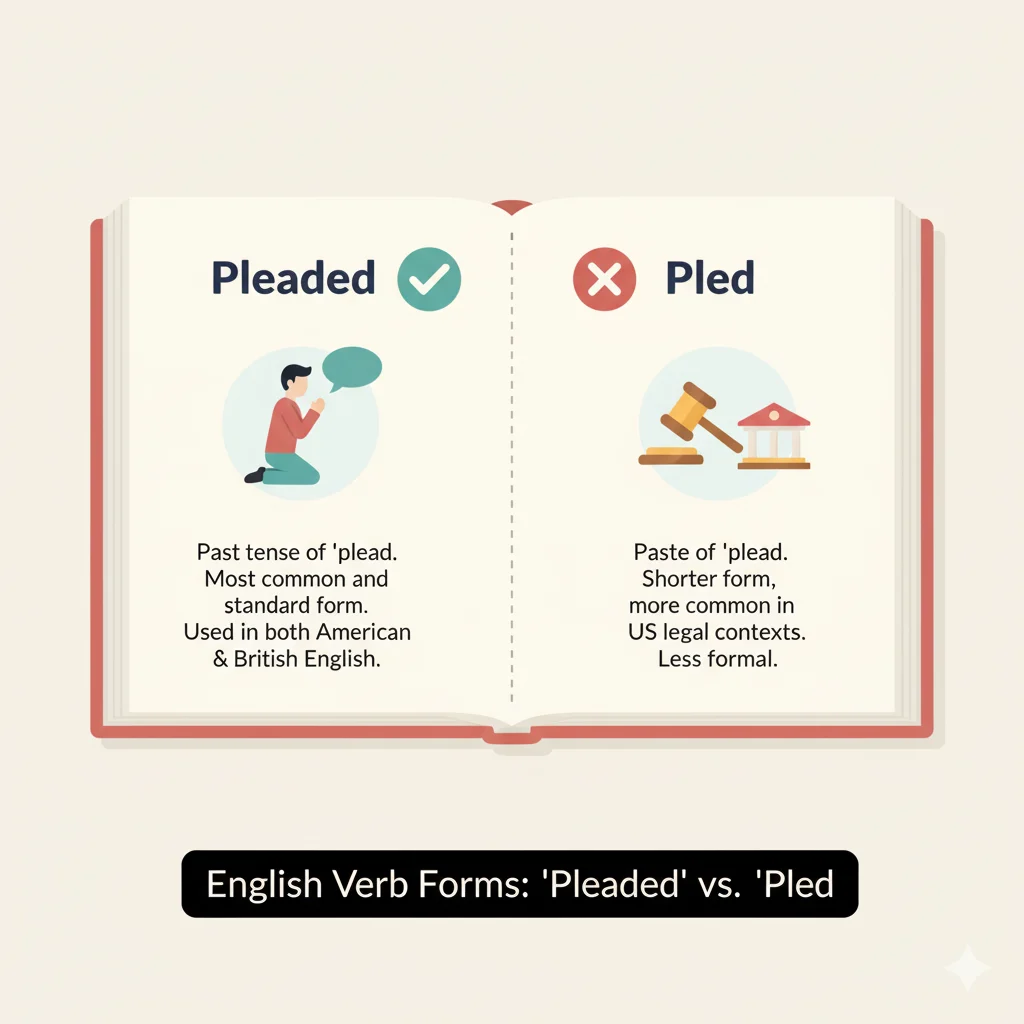
Pleaded is the past tense and past participle of plead.
It is the most standard, most accepted form in modern English—especially in writing.
Simple Meaning:
Pleaded = asked strongly, begged, or made a statement in court.
Easy Examples:
- She pleaded for help when she lost her wallet.
- The student pleaded with the teacher to give extra time.
- The lawyer pleaded not guilty in court.
2. What Does “Pled” Mean?
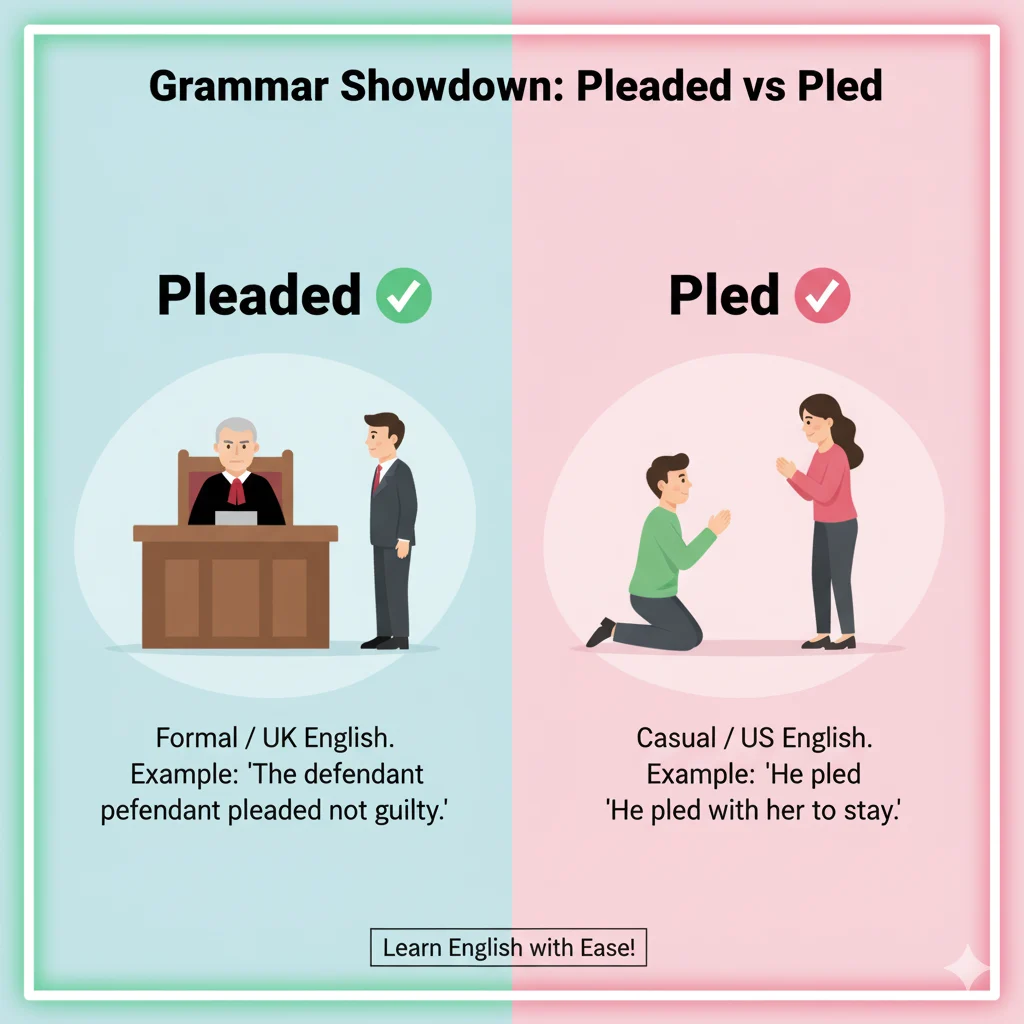
Pled is also a past tense of plead, but it is more common in American English, especially in legal settings and informal speech.
Simple Meaning:
Pled = said something in court OR begged (informally).
It is shorter and sounds more casual.
Easy Examples:
- He pled for leniency.
- The driver pled guilty to speeding.
- She pled with her parents to stay up late.
The Key Difference Between “Pleaded” and “Pled”
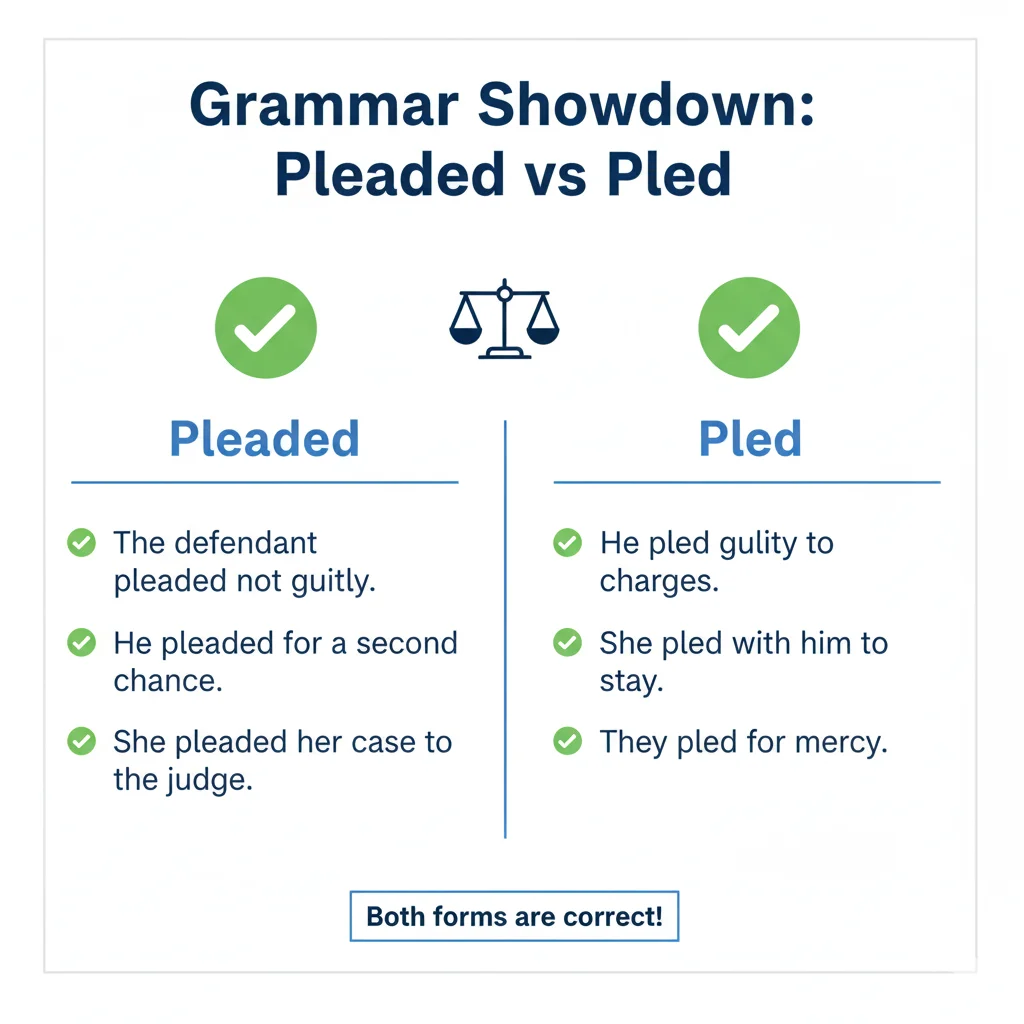
Both words mean the same thing, but their usage depends on style, country, and formality.
- Pleaded = widely accepted everywhere (US, UK, exams, school, formal writing).
- Pled = common in US speech, newspapers, and legal writing; rare in UK.
✔️ Comparison Table: Pleaded vs Pled
| Feature | Pleaded | Pled |
|---|---|---|
| Meaning | Past tense of “plead” | Past tense of “plead” |
| Formality | More formal & standard | More informal |
| Usage | Worldwide | Mostly American |
| Common In | Schools, essays, legal writing, news | Daily speech, US law, journalism |
| Exam-Safe? | ✔ Yes | ❌ Not always |
| Example | She pleaded for help. | She pled for help. |
Quick Tip to Remember:
👉 If you want to be 100% safe, always use “pleaded.”
It works everywhere.
Common Mistakes and How to Avoid Them
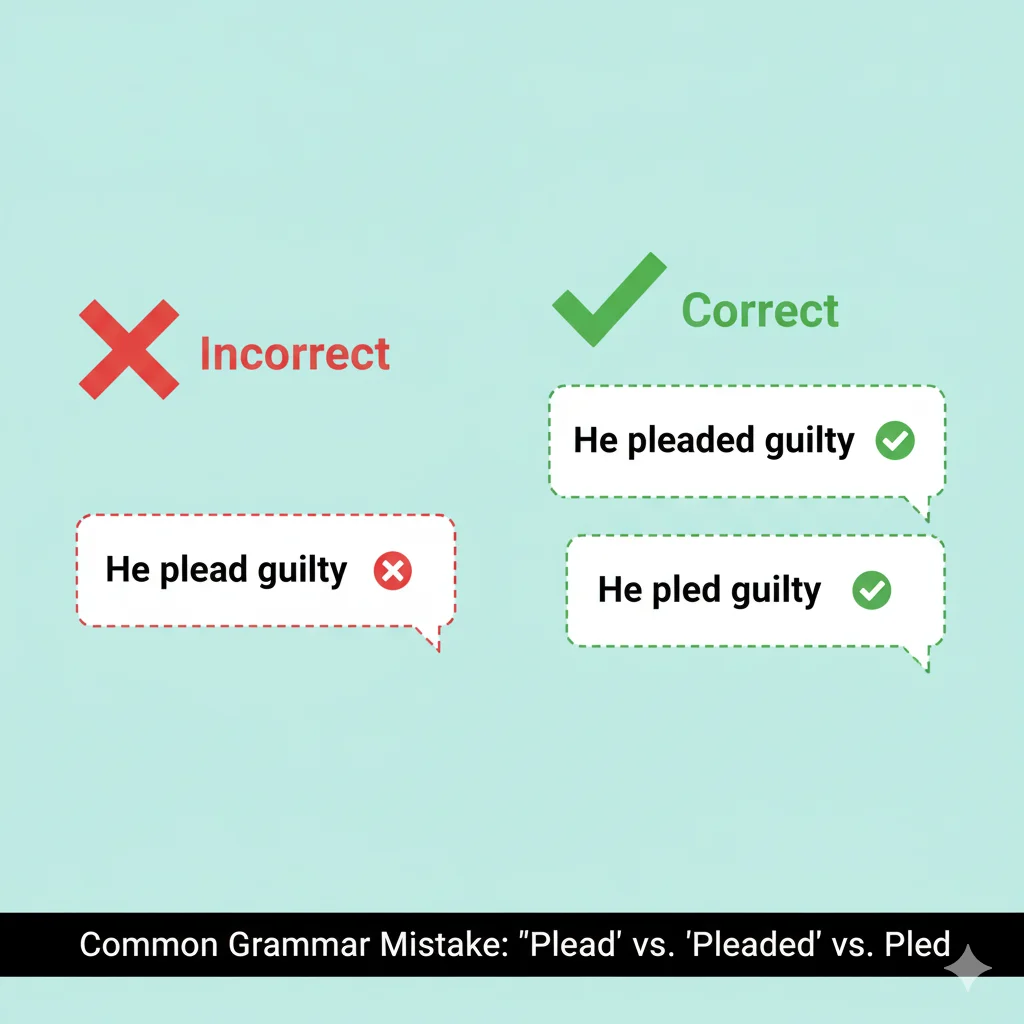
❌ Mistake 1:
Incorrect: He plead guilty yesterday.
Correct: He pleaded/pled guilty yesterday.
Why?
“Plead” (present) cannot be used as past tense.
❌ Mistake 2:
Incorrect: She has pled for help many times in the past.
Correct: She has pleaded for help many times.
Why?
In most formal writing, “pleaded” is preferred for past participle.
❌ Mistake 3:
Incorrect: The lawyer pleaded or pled not guilty?
Correct: The lawyer pleaded not guilty. (Safest form)
Why?
Formal writing favors “pleaded,” especially in legal contexts outside the US.
When to Use “Pleaded”
Use pleaded when you want a word that is:
✔ accepted everywhere
✔ used in exams
✔ preferred in essays
✔ common in British & American English
✔ standard in dictionaries
Use “pleaded” when:
- someone is begging
- someone is making a request
- someone is giving a response in court
- the sentence is formal
- you want to be grammatically safe
Example Sentences:
- She pleaded with her friend not to leave.
- The boy pleaded for another chance.
- They pleaded guilty after the accident.
- The victim pleaded for justice.
- The teacher said the student pleaded too much about homework.
When to Use “Pled”
Use pled when you want a word that is:
✔ short
✔ commonly used in the US
✔ used in legal writing
✔ used in conversational English
Use “pled” when:
- writing informal dialogue
- writing American-style legal stories
- the tone is casual
- people are speaking out loud in conversation
Example Sentences:
- He pled guilty to the charge.
- She pled with her sister to stay home.
- The suspect pled not guilty during the hearing.
- The child pled for ice cream.
- They pled with the officer for a warning instead of a ticket.
Memory Hack (Easy Trick):
👉 “Pleaded” has more letters → more formal.
👉 “Pled” is shorter → more casual.
Quick Recap: Pleaded vs Pled
- Both are correct forms of past tense.
- Pleaded is the safest and most accepted form.
- Pled is more common in American speech and legal writing.
- Use pleaded for school, exams, essays, and official documents.
- Use pled in casual US conversation or creative writing.
Advanced Tips
1. Word Origin
- “Plead” comes from Old French “plaid,” meaning to argue in court.
- “Pleaded” developed during Middle English.
- “Pled” appeared later as a shorter American variation.
2. Formal Writing Rules
Most academic style guides (APA, MLA, Chicago) prefer pleaded.
Government reports and international newspapers also prefer pleaded.
3. Digital Writing & Texting
Many people use pled online because it’s shorter.
However, for professional emails, always choose pleaded.
Mini Quiz: Test Yourself!
Fill in the blanks with pleaded or pled.
- She ______ for her brother to stay calm.
- The suspect ______ guilty during the trial.
- The child ______ with his mom for a toy.
- They ______ for peace after the argument.
- He ______ not guilty and asked for a lawyer.
- The student ______ for more time on the test.
- The player ______ with the referee to reconsider.
Answers: pleaded, pled/pleaded, pleaded/pled, pleaded, pled/pleaded, pleaded, pled/pleaded
FAQs
1. Is “pleaded” or “pled” more correct?
Pleaded is more correct in formal English and accepted worldwide. Pled is mainly used in the US.
2. Can I use “pled” in school essays?
It’s safer to use pleaded in school or academic writing.
3. Do “pleaded” and “pled” mean the same thing?
Yes. Both are past tense forms of “plead.”
4. Which word is used in court?
Both appear in US courts, but “pleaded” is more common internationally.
5. Is “pled” informal?
Yes, it sounds more casual and is mostly used in spoken American English.
Conclusion
“Pleaded” and “pled” may look confusing at first, but now you know exactly when and how to use each one. Both forms are correct, but pleaded is the safest choice for exams, essays, and formal writing. Pled is shorter and more common in American conversations and legal language. With the examples, tips, and memory tricks in this guide, choosing the right word will now feel easy and natural. Keep practicing, keep reading, and soon your English grammar skills will grow stronger every day.

English novelist and poet Thomas Hardy (1840–1928) explored human struggles, social constraints, and tragic love with deep realism and vivid storytelling.