Many English learners get confused between “savior” and “saviour.” These two words look almost the same, and they even sound the same. So, why are there two spellings? Which one is correct? And when should you use each one? This easy guide explains the meaning, usage, difference, and correct spelling in simple language that even a 4th-grade student can understand.
You’ll learn what each word means, how they are used in real sentences, and why one spelling is more common in some countries. We will look at examples, common grammar mistakes, memory tricks, and a clear comparison table. By the end of this article, you will feel confident choosing the right word every time — whether you’re writing an essay, a message, or a social media post.
Let’s start with the basics.
What Does Each Word Mean?
1. Meaning of “Savior”
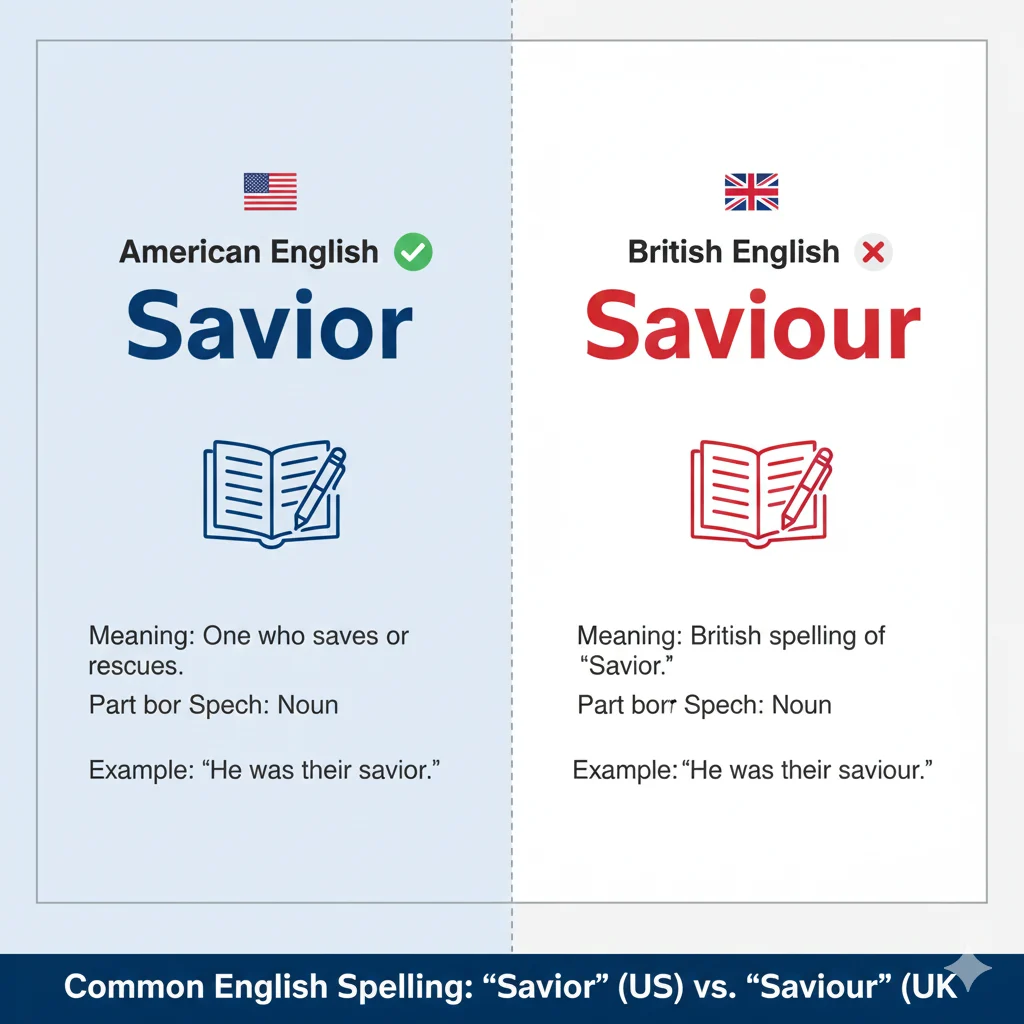
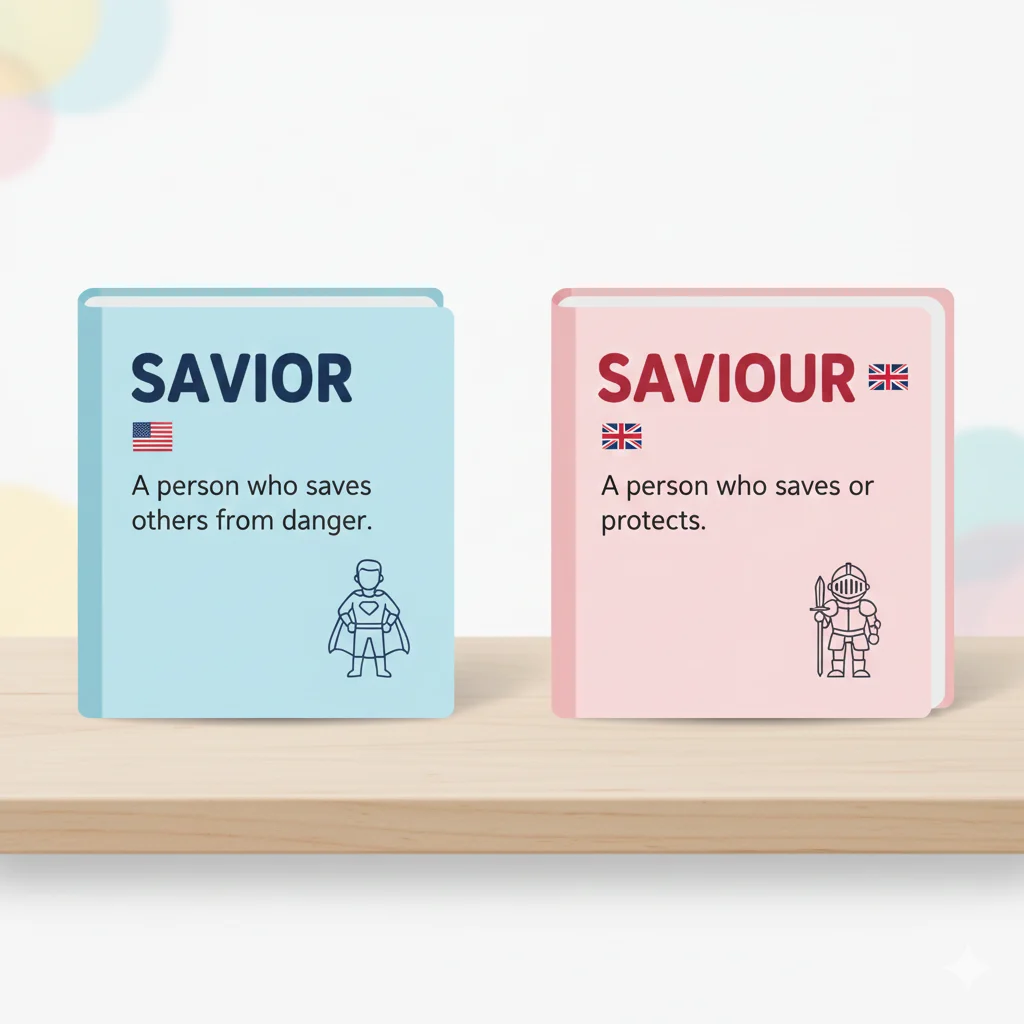
“Savior” means a person who saves, rescues, or helps someone in a big or important way.
It is the American English spelling.
Part of speech: Noun (a naming word)
Simple Examples
- The firefighter was a savior for the trapped family.
- My teacher became my savior when she helped me pass the exam.
- Water was the savior for the thirsty travelers.
Think of “savior” as someone who rescues you from a problem, danger, or difficulty.
2. Meaning of “Saviour”
“Saviour” means the same thing as “savior.”
The only difference is the spelling.
It is the British English spelling, used in the UK, Canada, Australia, India, Pakistan, and many other countries.
Part of speech: Noun
Simple Examples
- The doctor was a saviour for the sick child.
- The umbrella was a saviour during the heavy rain.
- You were my saviour when you helped me find my lost wallet.
Both words mean rescuer, helper, or protector.
The Key Difference Between Savior and Saviour
The meaning is exactly the same.
The only difference is spelling based on region:
- “Savior” → American English (USA)
- “Saviour” → British English (UK and Commonwealth countries)
If you are writing for a US audience, use savior.
If you are writing for UK or international readers, use saviour.
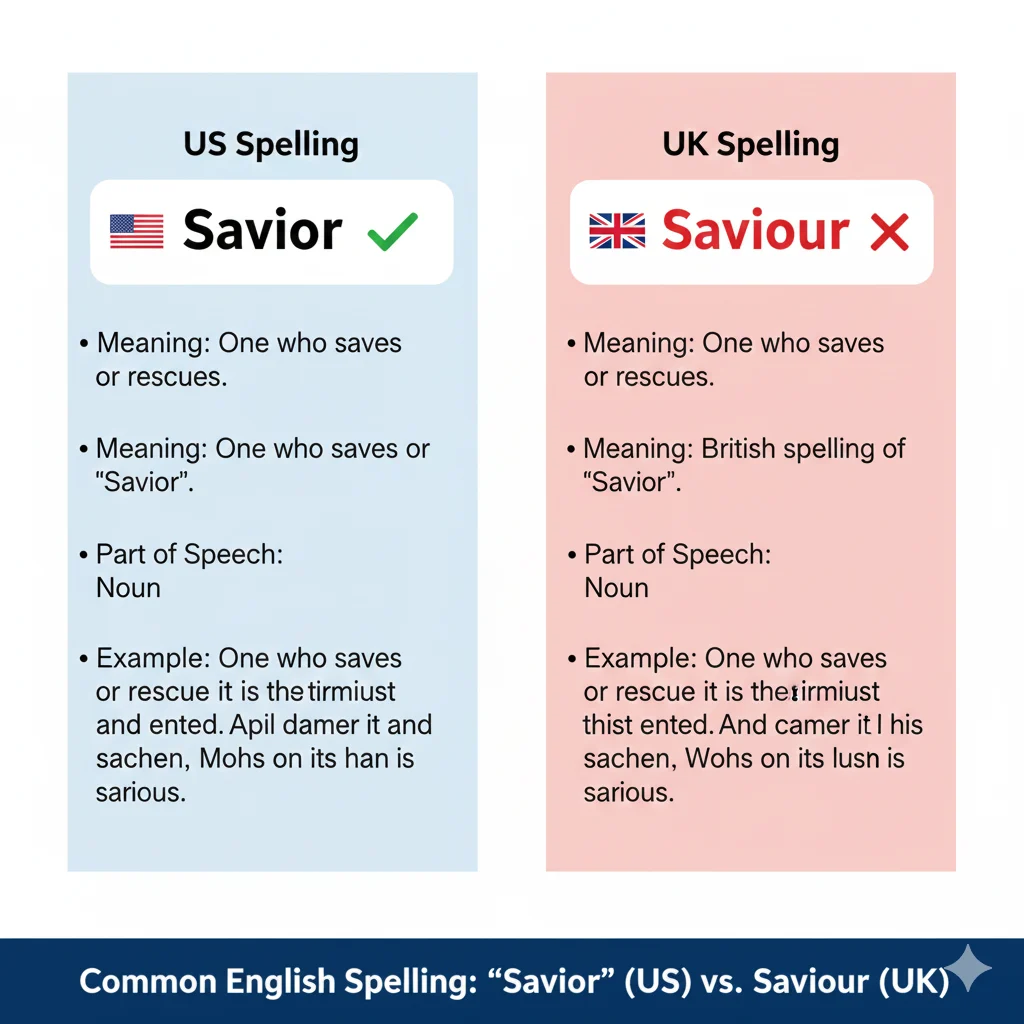
Comparison Table
| Feature | Savior | Saviour |
|---|---|---|
| Meaning | A person who saves or rescues | A person who saves or rescues |
| Usage | American English | British English |
| Ending | -or | -our |
| Example | He became my savior. | She was my saviour. |
Quick Tip to Remember
If the word color vs colour confuses you, use this trick:
- If you write color, honor, favor, you should write savior.
- If you write colour, honour, favour, you should write saviour.
Common Mistakes and How to Avoid Them
❌ Mistake 1: Mixing spellings in the same text
Incorrect:
The saviour of the town was honored for his bravery.
(British + American mix)
Correct:
The saviour of the town was honoured for his bravery. (British)
OR
The savior of the town was honored for his bravery. (American)
❌ Mistake 2: Thinking both have different meanings
Many learners think “savior” is a general rescuer while “saviour” is religious.
This is incorrect.
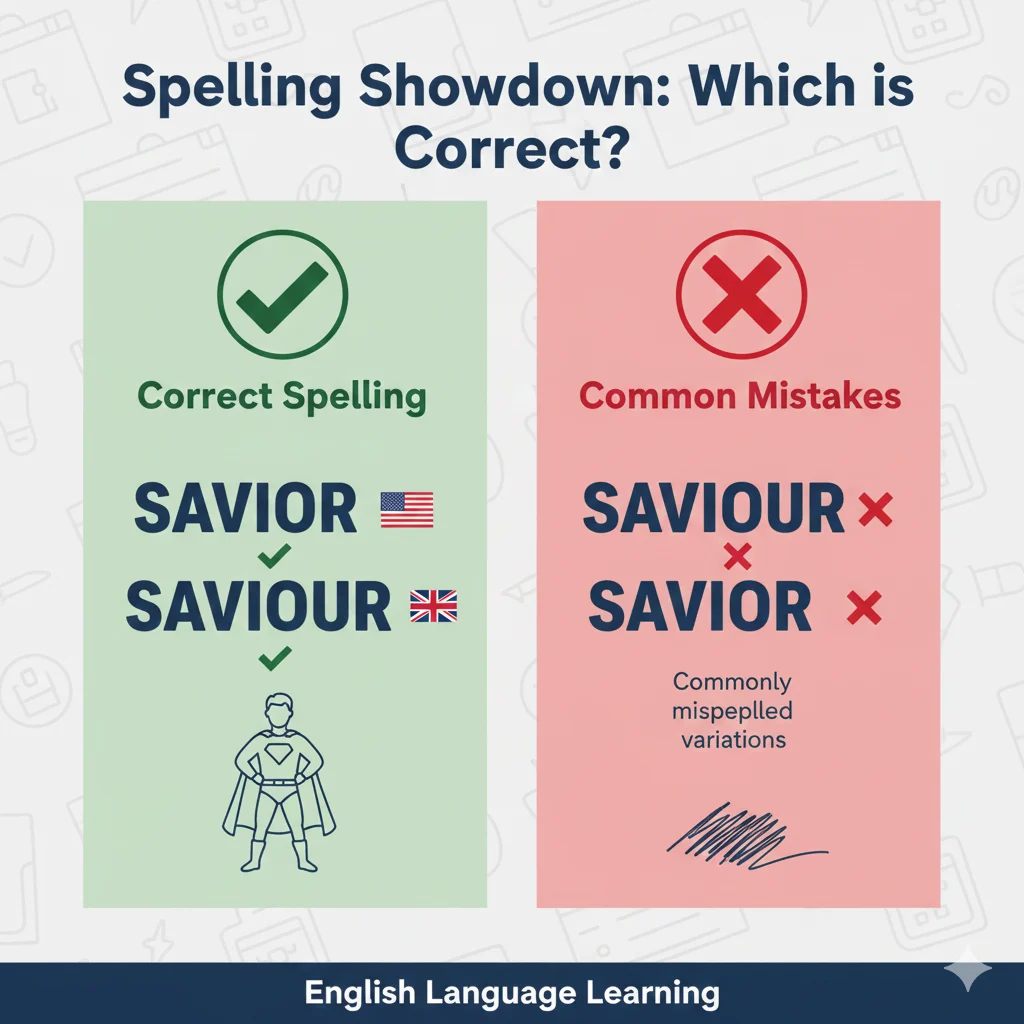
Both spellings can be used for general or religious contexts depending on regional spelling.
❌ Mistake 3: Using the wrong form for your audience
If your teacher or editor prefers British English, use saviour — not savior.
When to Use “Savior” (American English)
Use savior when:
- writing for American readers
- following American spelling rules
- writing school essays in the USA
- writing for US websites, books, or jobs
- using other “-or” spellings like color, favor, honor
Example Sentences
- My neighbor was a savior during the storm.
- Chocolate is my savior during stressful days.
- The police officer was a savior to the lost child.
- You were my savior when you fixed my computer.
- Good friends can be real saviors in hard times.
When to Use “Saviour” (British English)
Use saviour when:
- writing for British, Canadian, Australian, or South Asian audiences
- following British spelling rules
- writing school essays in countries that use British English
- using other “-our” spellings like colour, honour, favour
Example Sentences
- The kind stranger became a saviour for the injured dog.
- Wi-Fi was a saviour during the long train journey.
- Rain was a saviour for the dry fields.
- You’re my saviour! I lost my phone and you found it.
- Books were my saviour during the holidays.
Memory Hack
If the word favourite feels natural to you, then saviour is your correct spelling.
Quick Recap: Savior vs Saviour
- Both words have the same meaning: a rescuer or helper.
- Savior = American English
- Saviour = British English
- Choose a spelling style and stay consistent.
- Look at other spellings you use (color/colour) to guide your choice.
- Both are correct — just used in different regions.
Advanced Tips
1. Word Origin
Both spellings come from the Latin word salvare, meaning “to save.”
British English kept the older “-our” ending, while American English simplified it to “-or.”
2. Use in Formal Writing
In essays, reports, and publications, choose one spelling depending on your style guide.
For example:
- APA and Chicago Style → American spelling
- Oxford Style → British spelling
3. Use in Religious Contexts
Some Christian texts prefer the spelling “Savior” (capital S) in American English.
British religious texts use “Saviour.”
4. Online Writing
When writing for an international audience, British spelling is more widely understood.
Mini Quiz: Test Your Understanding
Fill in the blanks with savior or saviour (both depend on region):
- The firefighter was the __________ of the day.
- My best friend became my __________ during exams.
- The cold drink was a real __________ in the heat.
- She thanked the doctor for being her __________.
- The dog’s bark was the __________ that woke the family during the fire.
- You are my __________ for helping me with homework.
- The rain acted as a __________ for the dry crops.
5 FAQs
1. Is it “savior” or “saviour”?
Both are correct. “Savior” is American English and “saviour” is British English.
2. Do they have different meanings?
No. They have the same meaning: a person who saves or rescues someone.
3. Which spelling should I use in school?
Use the spelling your country teaches. US schools use “savior,” while UK-based systems use “saviour.”
4. Is one spelling more formal?
No. Both are equally formal depending on the region.
5. Can I mix both spellings in one document?
No. Always choose one style and stay consistent.
Conclusion
Choosing between “savior” and “saviour” is simple once you understand the key idea: they both mean the same thing, but they are used in different parts of the world. American English uses savior, while British English uses saviour. When you stay consistent with your spelling style, your writing looks clean, correct, and professional. With the examples, tips, and memory hacks in this guide, you now know exactly when and how to use each form. Keep practicing, keep reading, and you’ll grow stronger in English every day.

Caribbean-born novelist Jean Rhys (1890–1979) explored alienation, identity, and female psychology with lyrical, haunting, and emotionally rich prose.