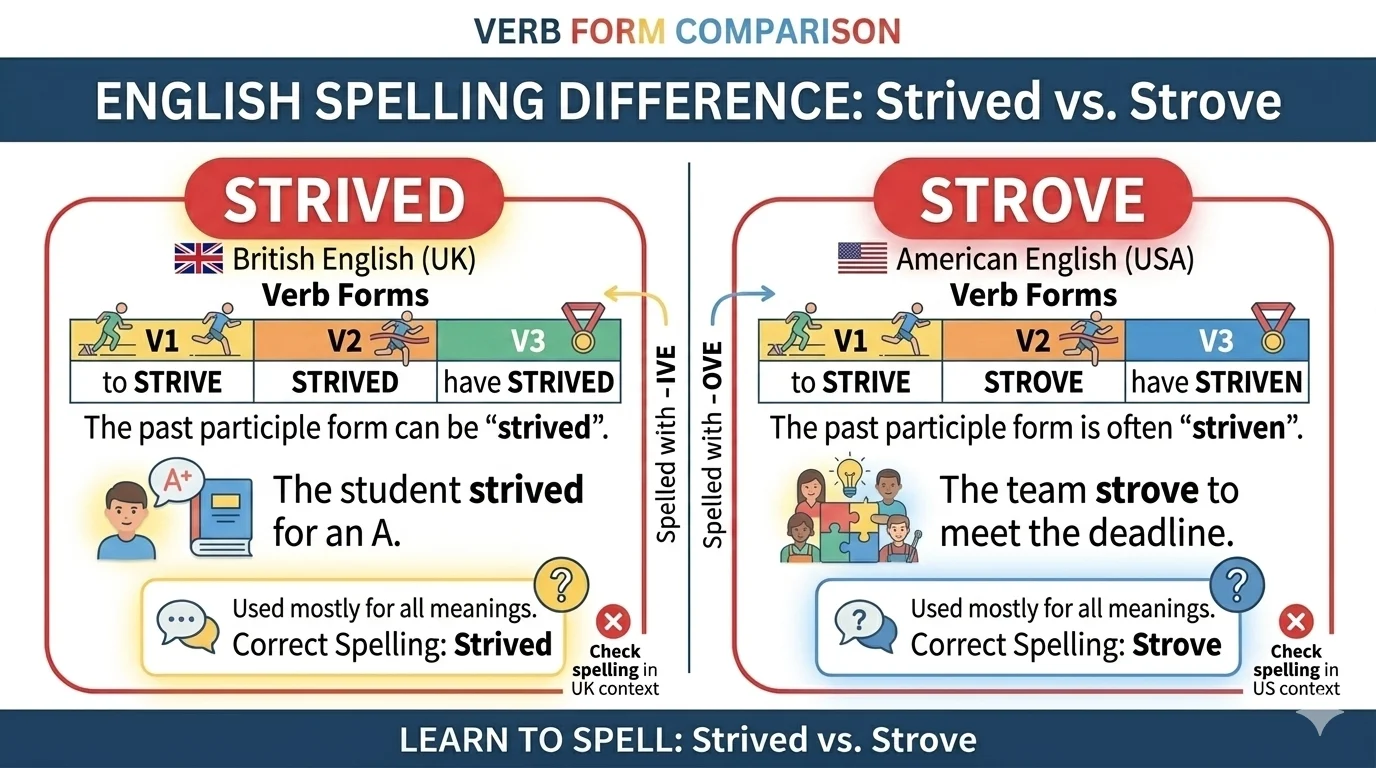
Many English learners often ask a simple but confusing question: strived or strove — which one is correct? When people talk about working hard or trying their best, they often use the verb strive. But when describing something that happened in the past, the question appears: what is the past tense of strive?
Some people write strove, while others write strived. Because both forms appear in books, articles, and conversations, learners become unsure which one they should use.
This guide explains everything in a clear and simple way. You will learn the difference between strived and strove, understand strived or strove grammar, and see many real-life examples that make the meaning easy to remember. We will also explain strive past tense and past participle forms, answer questions like is strived a word and is there such a word as “strove”, and show when each form sounds more natural.
By the end of this article, even beginners will clearly understand when to use strived or strove and how to use both words correctly in everyday English.
What Does the Word Strive Mean?
Before comparing strived or strove, it helps to understand the base verb strive.
Strive is a verb that means to try very hard to achieve something. It describes strong effort or determination to reach a goal.
People strive when they want to improve themselves, succeed in school, win a competition, or achieve a dream.
Simple Examples
- She strives to become a doctor.
- Students strive to get better grades.
- The team strives to win the championship.
In each sentence, strive means trying very hard.
What Is the Difference Between Strive and Effort?
Some learners also ask: What is the difference between strive and effort?
These words are related but they are not the same.
| Word | Type | Meaning |
|---|---|---|
| Strive | Verb | To try very hard |
| Effort | Noun | The work or energy you put into something |
Examples
- He put a lot of effort into studying.
- He strived to become the best student.
Here, effort describes the work itself, while strive describes the action of trying.
What Is the Past Tense of Strive?
Now let’s answer the main question: What is the past tense of strive?
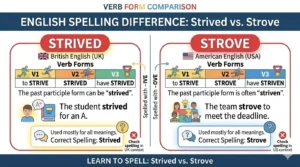
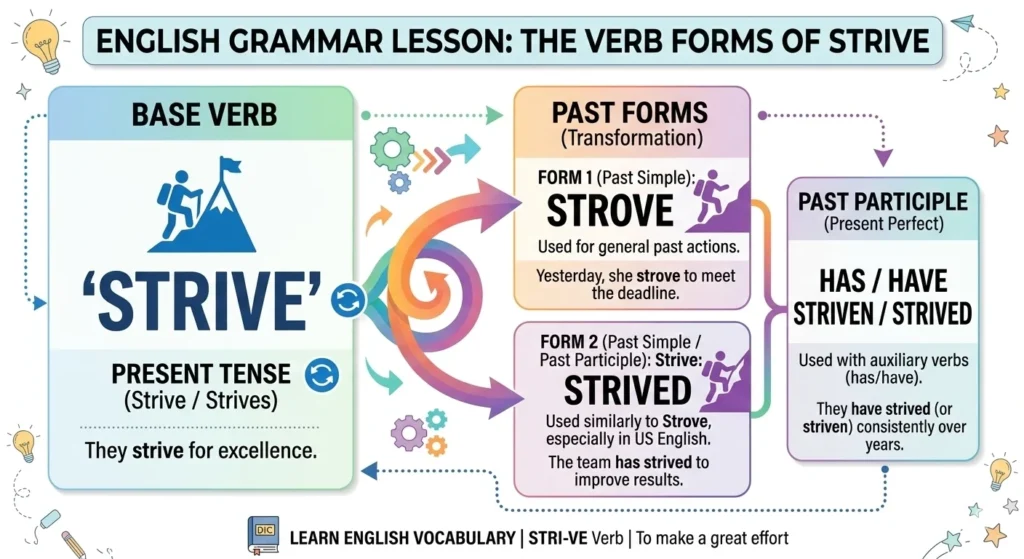
The traditional past tense of strive is strove. However, modern English also accepts strived as a past tense form.
So both forms are used:
- strove (traditional irregular past tense)
- strived (modern alternative)
Example:
- She strove to improve her skills.
- She strived to improve her skills.
Both sentences mean the same thing.
This is why people search for answers like “is it strived or strove?” or “is strove or strived correct?”
The short answer is: both can be correct, depending on the context.
Is There Such a Word as “Strove”?
Yes, strove is a real English word.
Many learners ask this question because strove sounds unusual compared to regular verbs like worked or played. But strove is simply the irregular past tense of strive.
English has many irregular verbs.
Examples:
- drive → drove
- write → wrote
- strive → strove
So when someone asks “Is there such a word as strove?”, the answer is definitely yes.
Is Strived a Word?
Another common question is: Is strived a word?
Yes, strived is also a valid English word. It appears in modern dictionaries and is widely used in everyday writing.
Many speakers prefer strived because it follows the pattern of regular verbs like:
- work → worked
- try → tried
- strive → strived
Because of this, strived feels easier for many English learners.
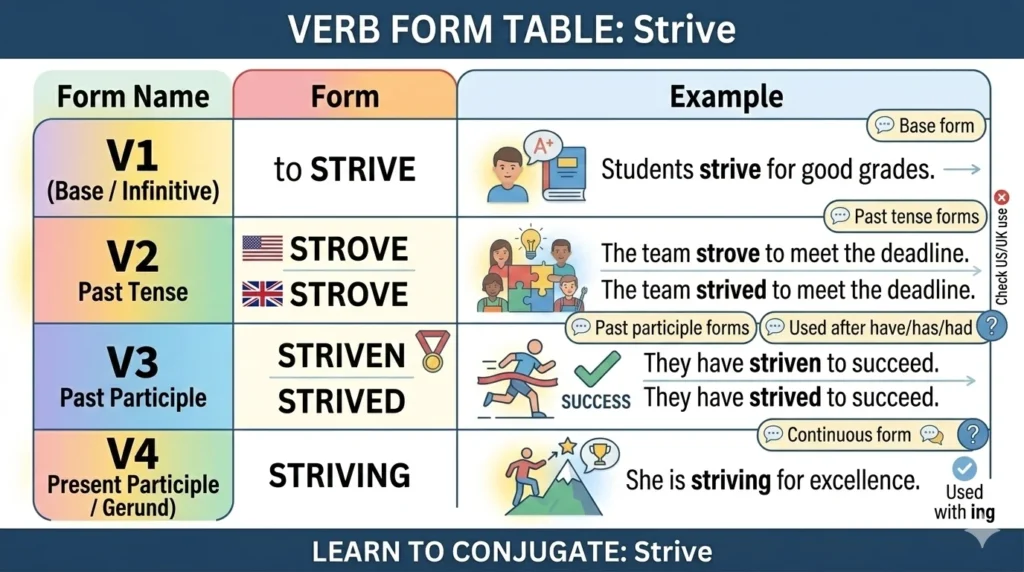
Strive Verb Forms (V1, V2, V3, V4)
To understand strived or strove grammar, it helps to look at all the verb forms.
Many English learners also ask: What are V1, V2, V3, V4 verb forms?
These simply describe the different forms of a verb used in grammar.
| Verb Form | Word | Example |
|---|---|---|
| V1 (Base form) | strive | I strive to improve. |
| V2 (Past tense) | strove / strived | She strove to win. |
| V3 (Past participle) | striven / strived | She has striven to win. |
| V4 (Present participle) | striving | She is striving to win. |
So when people ask about strived or strove or striven, they are asking about different verb forms.
Example Sentences
- She strove to succeed.
- She has striven to succeed.
- She has strived to succeed.
These examples explain the strive past tense and past participle forms.
Strove Meaning
The strove meaning is very simple. It means tried very hard in the past.
Example:
- The athlete strove to break the world record.
- The teacher strove to help every student succeed.
In both sentences, strove shows strong effort in the past.
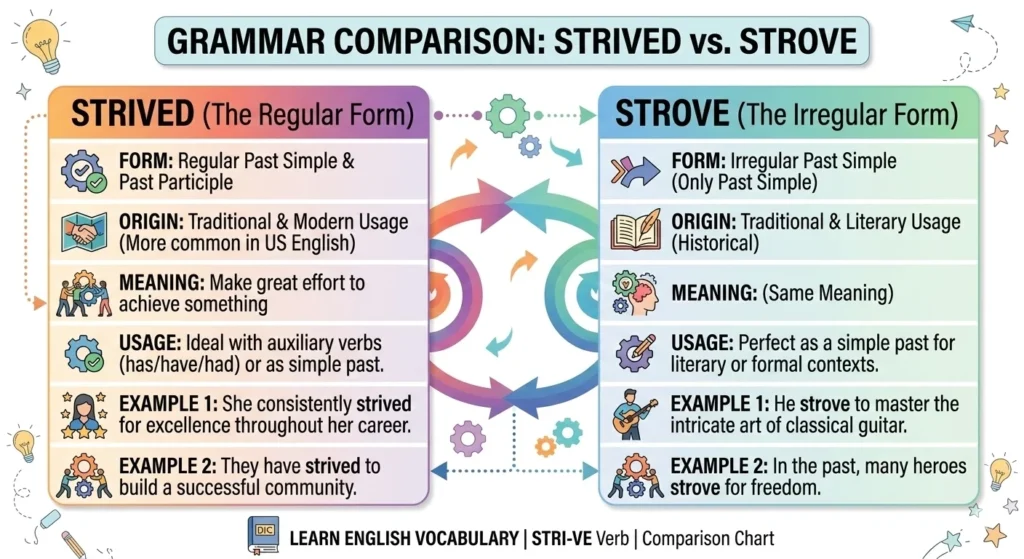
The Key Difference Between Strived and Strove
Understanding the difference between strived and strove becomes easier with a comparison.
| Feature | Strived | Strove |
|---|---|---|
| Type | Modern past form | Traditional past tense |
| Verb style | Regular-style form | Irregular verb form |
| Usage | Common in everyday English | Common in formal writing |
| Meaning | Tried very hard | Tried very hard |
Quick Memory Tip
Think of it like this:
Strove → classic English
Strived → modern English
Both mean the same thing, but strove sounds slightly more formal.
When to Use Strived
Many writers prefer strived in everyday language.
Here are common situations where strived fits naturally.
1. Casual conversation
Example:
- She strived to help her family.
2. Modern writing
Example:
- The company strived to improve its services.
3. Personal stories
Example:
- He strived to achieve his dream.
4. Past participle sentences
Example:
- They have strived to solve the problem.
5. School or student writing
Example:
- The student strived to improve his math skills.
These examples show natural strived or strove sentences used in daily life.
When to Use Strove
Even though strived is common, many writers still prefer strove in formal situations.
1. Literature and books
Example:
- The hero strove to protect his people.
2. Academic writing
Example:
- The researcher strove to discover new solutions.
3. Historical descriptions
Example:
- The leader strove for peace.
4. Speeches and formal communication
Example:
- Our ancestors strove for freedom.
5. Professional writing
Example:
- The organization strove to improve education.
Strove Synonyms
If you want other words that have a similar meaning to strove, you can use these strove synonyms:
- struggled
- tried
- worked hard
- attempted
- aimed
Example:
- She strove to succeed.
- She worked hard to succeed.
Both sentences mean nearly the same thing.
Common Mistakes With Strived and Strove
Many learners make small mistakes when using these forms.
Let’s correct them.
Mistake 1
❌ She has strove to improve.
Correct:
✔ She has striven to improve.
✔ She has strived to improve.
Why?
Because strove is usually the past tense, not the past participle.
Mistake 2
❌ He striven to win the race.
Correct:
✔ He strove to win the race.
✔ He strived to win the race.
Mistake 3
❌ They have strove very hard.
Correct:
✔ They have striven very hard.
✔ They have strived very hard.
Why English Has Two Past Forms
English grammar has changed over hundreds of years. Some verbs originally had irregular forms, but modern speakers sometimes change them into regular forms.
For example:
- dive → dove / dived
- dream → dreamt / dreamed
- strive → strove / strived
Because of this change, both forms may exist at the same time.
This is why learners often ask questions like:
- Is strove or strived correct?
- Strived or strove past participle?
The answer depends on context, but both forms are widely understood.
Strived or Strove Sentences
Here are more strived or strove sentences to help you understand how these words appear in real situations.
Using Strove
- The athlete strove to become the fastest runner.
- The scientist strove to find a cure.
- The leader strove for peace.
Using Strived
- The student strived to improve his English.
- The company strived to provide better service.
- The artist strived to create something unique.
Quick Recap: Strived vs Strove
Here is a quick summary to remember the strived or strove difference.
Strive
- Means to try very hard.
Strove
- Traditional past tense.
- Often used in formal writing.
Strived
- Modern alternative form.
- Common in everyday language.
Simple rule:
- Formal writing → strove
- Casual language → strived
Both forms are correct.
Mini Quiz
Test your understanding.
Fill in the blanks with strived, strove, or striven.
- She ______ to become a great teacher.
- The team has ______ to improve its performance.
- The leader ______ for justice.
- They have ______ to solve the issue.
- He ______ to reach his goals.
- The company ______ to provide better service.
- She has ______ to help the community.
FAQs
Is strove or strived correct?
Both strove and strived are correct past tense forms of strive, though strove is the traditional form.
What is the past tense of strive?
The past tense of strive is strove, but strived is also accepted in modern English.
What is the past participle of strive?
The traditional past participle is striven, but strived is also used.
Is there such a word as strove?
Yes. Strove is the traditional past tense of the verb strive.
Is strived a word?
Yes. Strived is a valid English word used in modern writing.
Conclusion
The confusion between strived or strove happens because English verbs sometimes have more than one past form. The verb strive traditionally changes to strove in the past tense and striven in the past participle. However, modern English also accepts strived as both the past tense and past participle.
This means both forms are correct, but they may sound slightly different depending on context. Strove often appears in formal writing, literature, and speeches, while strived is common in everyday language and modern communication.
The best way to remember the difference is through practice. Try writing your own sentences using strived, strove, and striven. Over time, choosing the correct form will feel natural.
Learning small grammar differences like this can make your English clearer, stronger, and more confident every day.

English novelist and poet Thomas Hardy (1840–1928) explored human struggles, social constraints, and tragic love with deep realism and vivid storytelling.