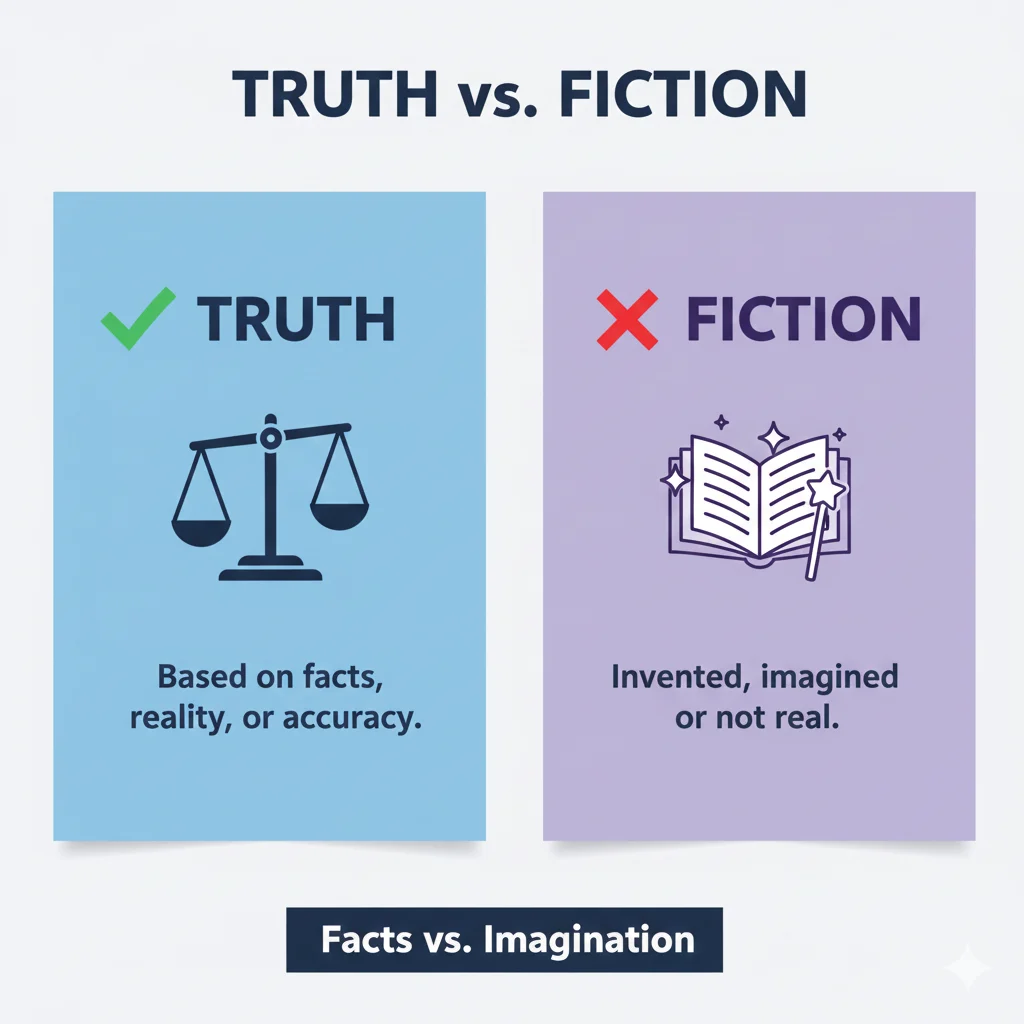
The phrase “truth or fiction” appears everywhere—movies, books, news, social media, and classroom debates. But many people still get confused about what it really means, how to use it correctly, and why it matters. Even adults sometimes mix the two or use them in the wrong context. That’s because “truth” and “fiction” sound simple, yet they describe two completely different ideas.
In this easy and friendly guide, you will learn the meanings, the difference between truth and fiction, how to use the phrase in sentences, and how to avoid common mistakes. Everything is explained in plain English, so even a Class 4 student can understand without difficulty. By the end, you will be able to use “truth or fiction” confidently in writing, speaking, and schoolwork.
What Does Each Word Mean?
Before understanding the full phrase “truth or fiction,” you must first understand the individual words.
What Does “Truth” Mean?
Truth means something that is real, correct, and actually happened.
If it matches facts, it is truth.
- Part of speech: Noun
Simple Examples of “Truth”:
- The truth is that the sun rises in the east.
- Ali told the truth about breaking the window.
- It is the truth that water boils at 100°C.
Think of truth like a clear mirror—it shows things exactly as they are.
What Does “Fiction” Mean?
Fiction means something that is made up, imagined, or not real.
It does not have to be true. Writers create fiction to tell stories.
- Part of speech: Noun
Simple Examples of “Fiction”:
- Harry Potter is a work of fiction.
- Stories about talking animals are fiction.
- The movie is fiction, not real life.
Think of fiction like a colorful painting—beautiful, creative, but not real.
The Key Difference Between Truth and Fiction
The main difference is simple:
- Truth = Real
- Fiction = Not real
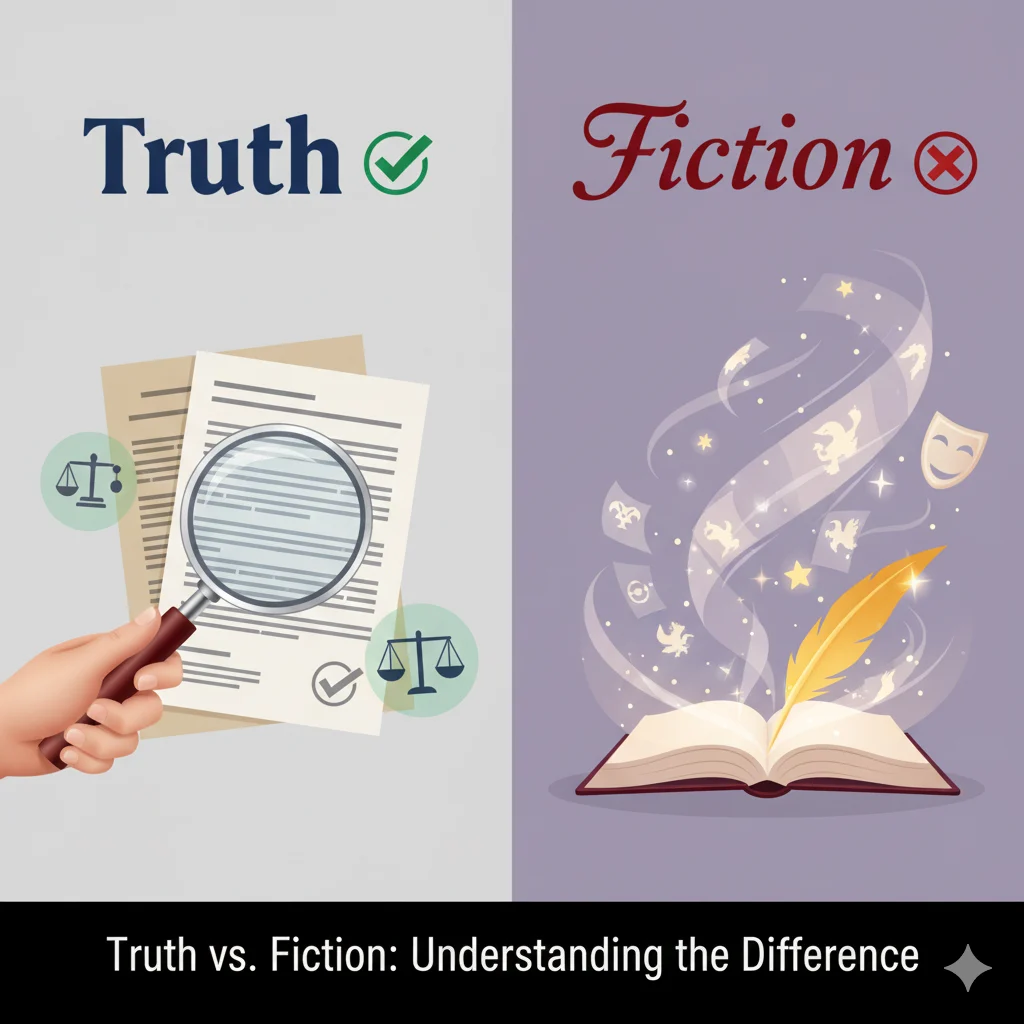
Truth is based on facts.
Fiction is based on imagination.
Here is a clear comparison table:
| Point | Truth | Fiction |
|---|---|---|
| Meaning | Real, factual, correct | Imagined, invented, not factual |
| Used When | Talking about facts, reality | Telling stories, creating characters |
| Example Sentence | “She told the truth about what happened.” | “The story is pure fiction.” |
Quick Tip to Remember
👉 “Truth” has the word “true” inside it.
👉 “Fiction” sounds like “fake-tion.” (A fun way to remember!)
Common Mistakes and How to Avoid Them
Even though “truth” and “fiction” seem simple, many learners misuse them. Here are the most common mistakes.
❌ Mistake 1: Using “truth” when talking about a made-up story
Incorrect:
This fiction movie is based on truth.
Correct:
This fiction movie is based on the truth.
👉 The word “fiction” must stay separate from “truth.” You can combine them, but you cannot mix them up.
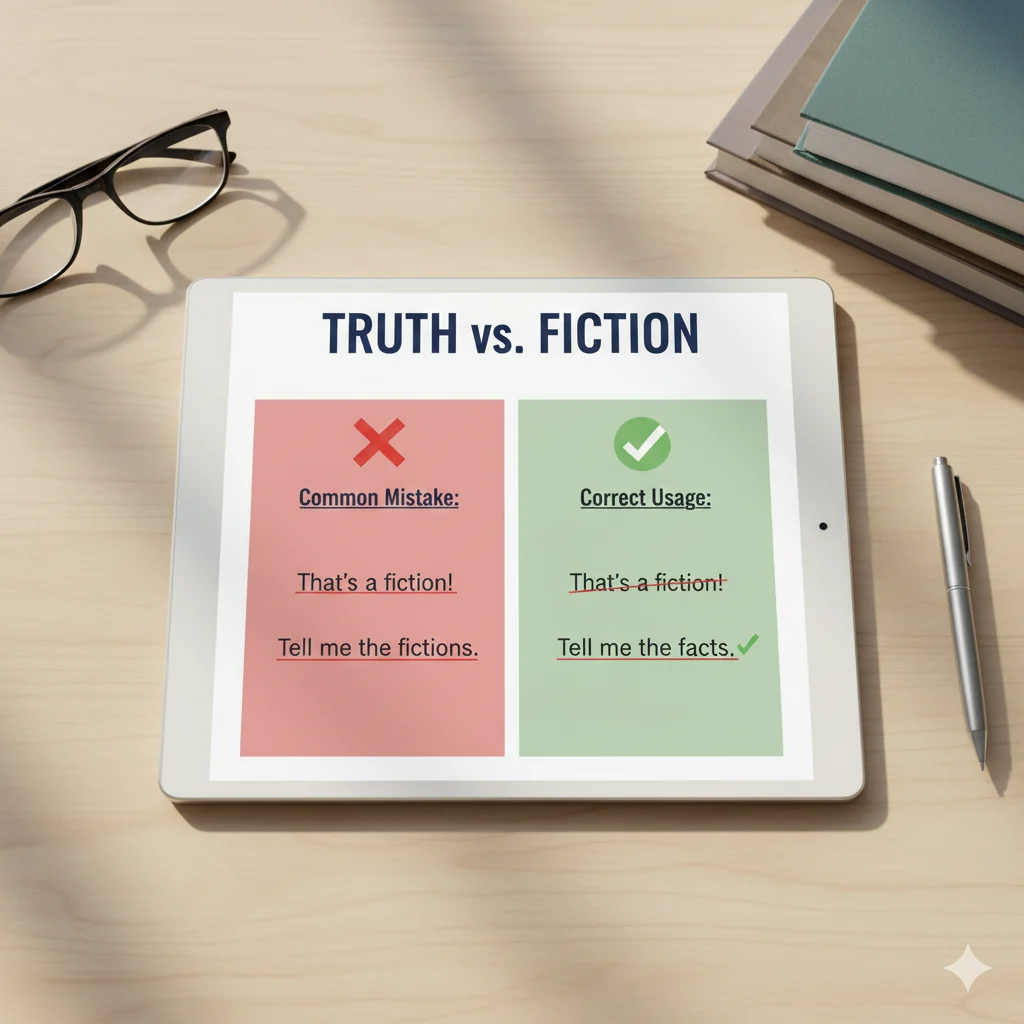
❌ Mistake 2: Saying “fiction” when describing facts
Incorrect:
Gravity is fiction.
Correct:
Gravity is truth.
Gravity is a scientific fact.
👉 Fiction cannot be used for real things.
❌ Mistake 3: Confusing the phrase “truth or fiction”
Many people use it without understanding its meaning.
Correct Meaning:
It is a comparison or question asking:
👉 Is it real (truth) or made-up (fiction)?
When to Use “Truth”
Use truth when talking about facts, reality, or something correct.
Here are simple examples:
- The truth is easy to understand.
- He always tells the truth.
- We want to know the truth about the story.
- The truth never changes.
- Teachers ask students to write the truth on tests.
Where You Use “Truth” in Real Life
- In school when answering factual questions
- In news when checking what is real
- In science when learning facts
- In daily conversations when someone is honest
Truth is connected to reality, facts, and honesty.
When to Use “Fiction”
Use fiction when talking about stories that are not real.
Here are simple examples:
- I enjoy reading fiction books.
- Superhero movies are fiction.
- The story of dragons is fiction.
- That rumor is fiction, not truth.
- The writer creates fiction to entertain people.
Where You Use “Fiction” in Real Life
- Reading storybooks
- Watching movies or cartoons
- Creating characters and adventures
- Writing imaginative essays
- Discussing rumors or things that never happened
Memory Hack
👉 Imagine the word Fiction = Fake + Imagination
This helps you remember it instantly.
Quick Recap: Truth vs Fiction
- Truth = Real, factual
- Fiction = Imagined, not real
- Use truth for facts
- Use fiction for stories
- “Truth or fiction” means: Is it real or made-up?
Advanced Tips (For Students, Writers, and Professionals)
1. Word Origins
- Truth comes from Old English trīewþ, meaning “faithfulness” or “fidelity.”
- Fiction comes from Latin fictio, meaning “to shape or create.”
So truth is about reality, while fiction is about creativity.
2. Use in Essays and Exams
In academic writing:
- “Truth” is used in research papers, science, and history.
- “Fiction” is used in literature studies, storytelling, and creative writing.
Teachers often ask:
“Is this statement truth or fiction?”
3. Use in Social Media and News
People often question rumors by saying:
- “Is this truth or fiction?”
- “Check the truth before sharing.”
This encourages people to avoid spreading false information.
4. How Misuse Changes Meaning
If you mix them up:
❌ Calling truth “fiction” makes real facts sound fake.
❌ Calling fiction “truth” makes stories seem real.
This can confuse readers or mislead people.
Mini Quiz: Test Your Understanding
Fill in the blanks with truth or fiction.
- Harry Potter is a work of _______.
- The _______ is that I forgot my homework.
- The teacher asked if the story was _______ or made-up.
- Some rumors on the internet are pure _______.
- We must always speak the _______.
- The movie is _______, not a real event.
- Scientists search for the _______ about the world.
(Answers: fiction, truth, truth, fiction, truth, fiction, truth)
FAQs
1. What does “truth or fiction” mean?
It means asking whether something is real (truth) or made-up (fiction).
2. Is fiction always unreal?
Yes. Fiction is created from imagination, not facts.
3. Can a story have both truth and fiction?
Yes. Many movies and books mix real facts with fictional parts.
4. How do I know if something is truth?
Check facts, evidence, and reliable sources.
5. Why do people confuse truth and fiction?
Because stories can feel real, and rumors sometimes sound true. This guide helps you separate them easily.
Conclusion
Understanding the difference between truth and fiction is important in school, daily conversations, social media, and writing. Truth is based on facts, while fiction is based on imagination. With the simple explanations and examples in this guide, you can now use the phrase “truth or fiction” confidently and correctly. Keep practicing by checking whether information is real or made-up. With time, your English will become clearer, stronger, and easier to use every day.

Scottish novelist Muriel Spark (1918–2006) crafted sharp, witty stories exploring human nature, morality, and society with dark humor and insight.