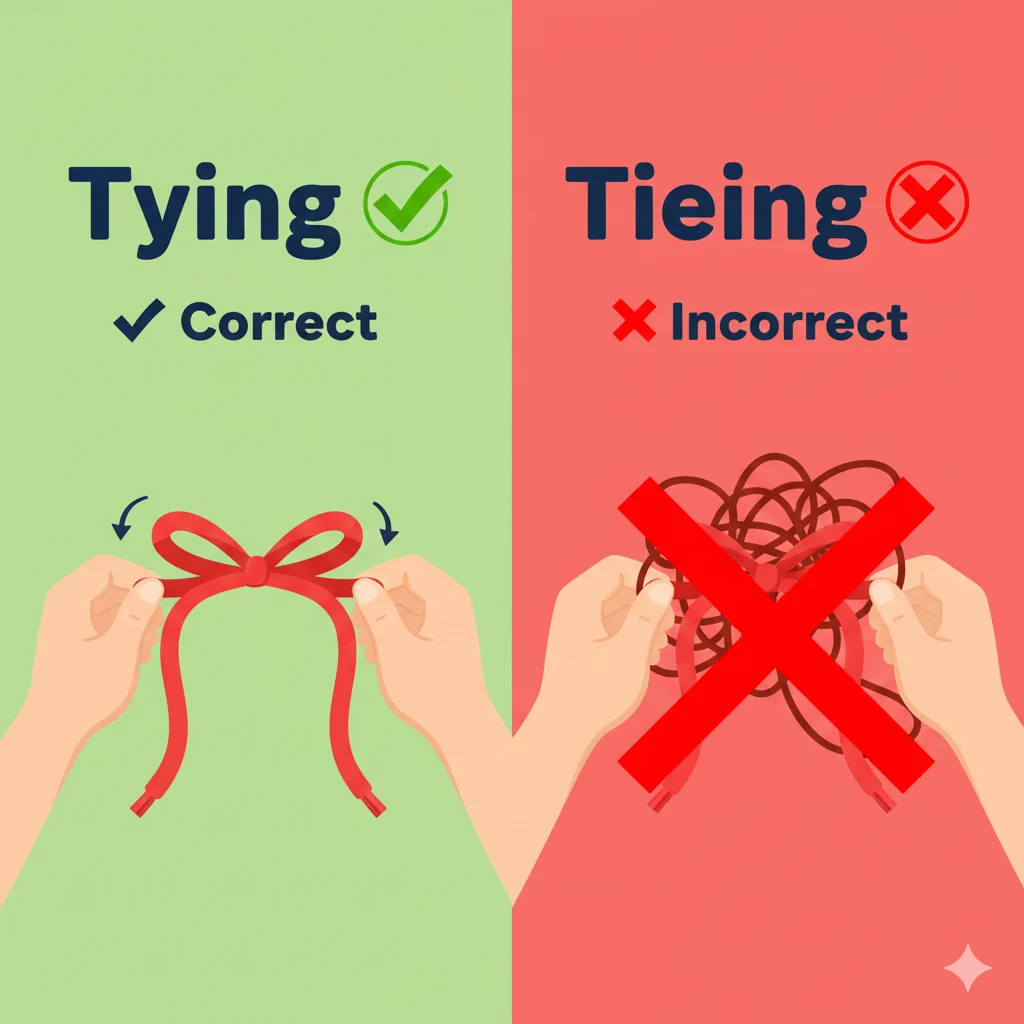
Some English words look so similar that people easily get confused while writing them. One of those pairs is “tying” vs “tieing.” You may have seen both spellings on the internet or in text messages, and it can be hard to know which one is correct. This is why many learners search for the difference between tying and tieing and want a simple explanation.
In this guide, you will learn the correct spelling, the meaning of each word, and how to use them properly in sentences. Everything is explained in easy, child-friendly English, with examples from daily life, school activities, and simple stories. By the end, even a class 4 student will understand the difference clearly.
Let’s make grammar simple and fix this common mistake once and for all!
What Does Each Word Mean?
Meaning of “Tying”
“Tying” is the correct spelling.
It is the present participle (-ing form) of the verb “tie.”
You use “tying” when you talk about joining, fastening, or attaching something.
Simple Examples of “tying”
- She is tying her shoelaces before going to school.
- I am tying a ribbon on my friend’s gift.
- The boy is tying his kite string tightly so it won’t fly away.
Mini-story:
Imagine Ali wants to fly a kite. The string keeps slipping, so he keeps tying it again and again. This shows the real meaning of the word — fastening something firmly.
Meaning of “Tieing”
“Tieing” is NOT a correct spelling.
It looks like it should be right because some verbs add -ing without changing the spelling. But in this case, English follows a special rule:
When a verb ends in -e, we remove the e before adding -ing.
Example:
make → making
write → writing
take → taking
tie → tying (NOT tieing)
So, “tieing” is an incorrect word, even though many people mistakenly use it.
Incorrect Examples (for understanding)
- She is tieing her hair. ❌
- I am tieing the rope. ❌
- He was tieing a knot. ❌
The Key Difference Between Tying and Tieing
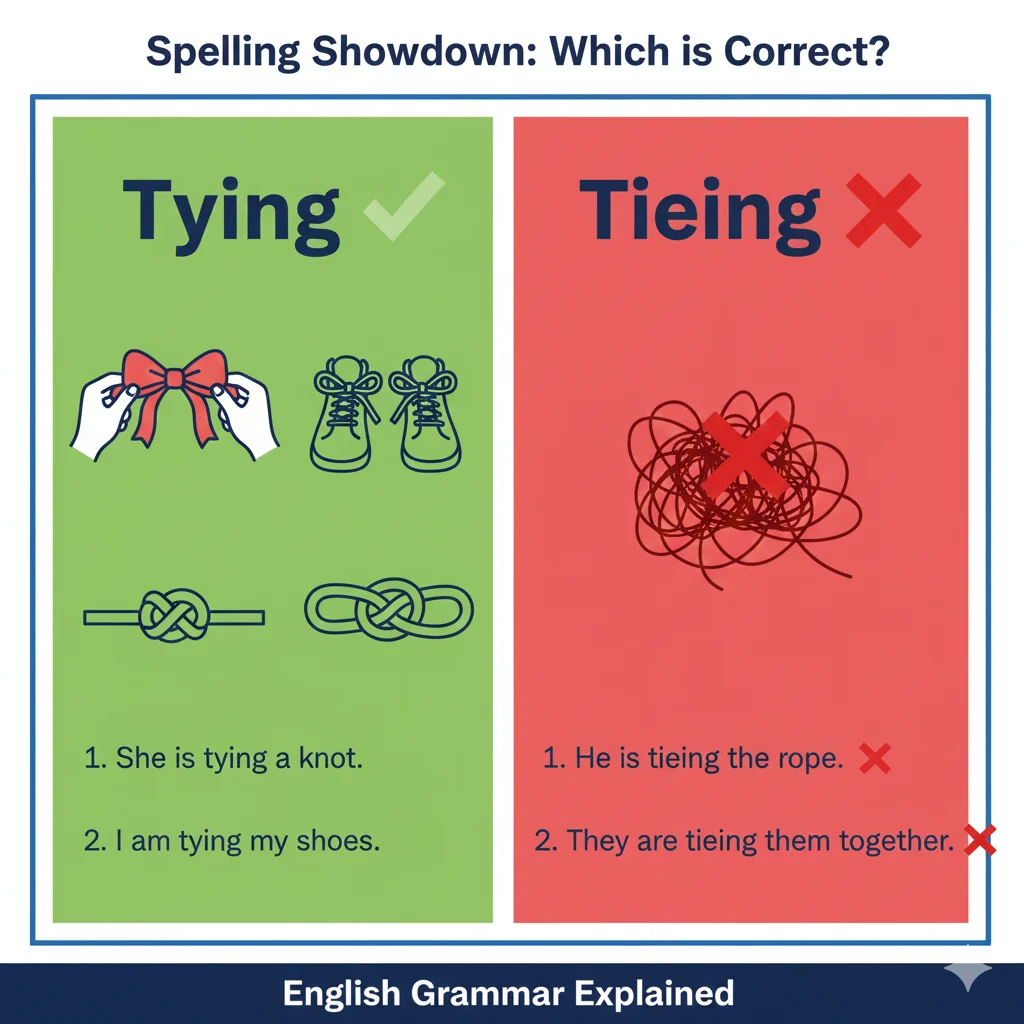
| Word | Meaning | Correct or Incorrect? | Example Sentence |
|---|---|---|---|
| Tying | The act of fastening something | ✔ Correct spelling | Sara is tying her shoelaces. |
| Tieing | Used by mistake instead of “tying” | ❌ Incorrect spelling | He is tieing the rope. (Wrong) |
Quick Tip to Remember
👉 If a word ends in “e,” drop the “e” before adding “-ing.”
That’s why tie → tying, not tieing.
Common Mistakes and How to Avoid Them
People often write “tieing” because they think:
“If the verb is tie, then adding -ing makes tieing.”
But English has a simple spelling rule:
Rule:
Drop the silent “e” before adding “-ing.”
Here are some common mistakes and their fixes:
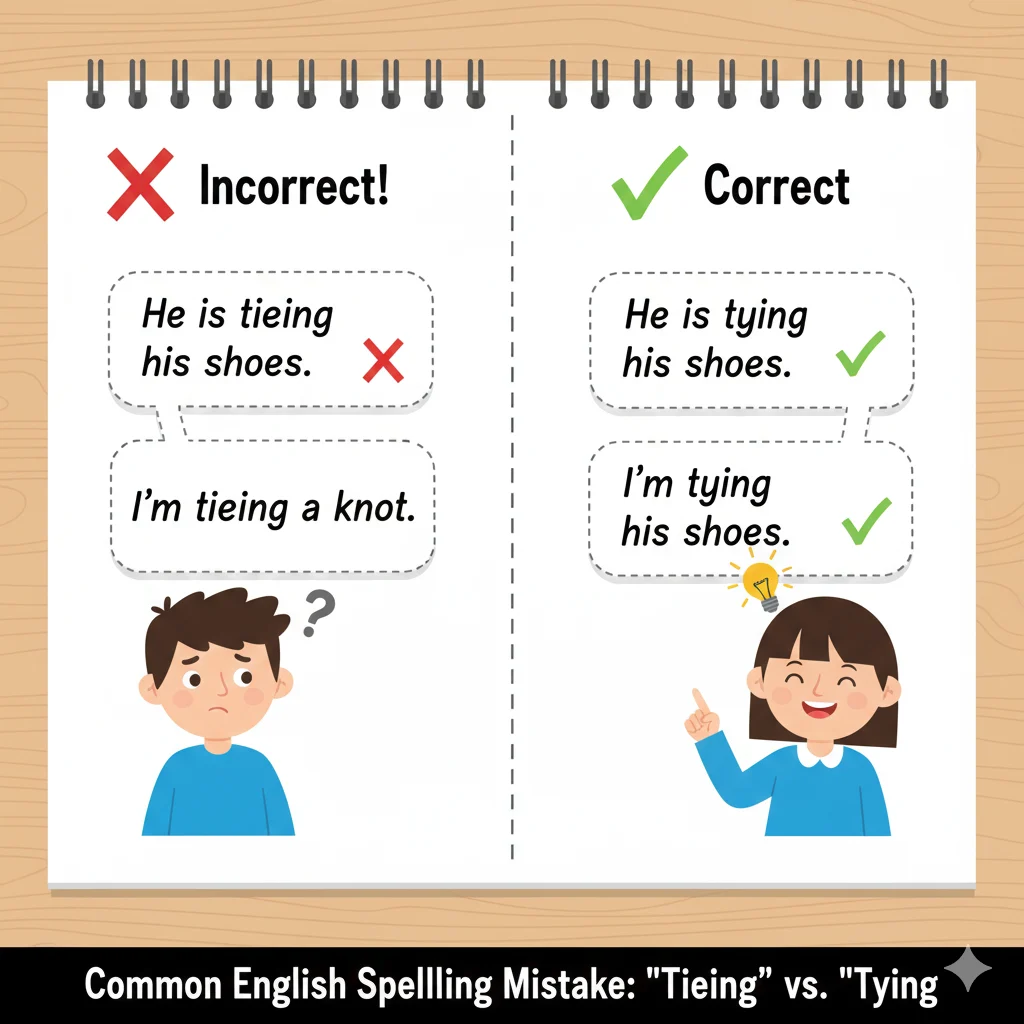
❌ Mistake 1:
She is tieing her hair for the party.
✔ Correction:
She is tying her hair for the party.
Why this happens:
The writer tries to keep the original word tie, but the silent “e” must be removed.
❌ Mistake 2:
I am tieing a knot in this rope.
✔ Correction:
I am tying a knot in this rope.
Why this happens:
People follow the pattern “play → playing,” but verbs ending in “e” follow a different rule.
❌ Mistake 3:
The girl was tieing ribbons on the balloons.
✔ Correction:
The girl was tying ribbons on the balloons.
Why this happens:
Writers assume “tieing” looks more natural, but it is grammatically incorrect.
When to Use “Tying”
Use “tying” whenever you talk about connecting, fastening, or knotting something. It is always used for actions that are happening now, recently, or repeatedly.
Easy situations where “tying” is used:
- Tying shoelaces
- Tying hair
- Tying a rope or knot
- Tying gifts with ribbons
- Tying animals (like goats or pets)
- Tying a boat to the dock
- Tying a tie (clothing)
Example Sentences (Simple & Clear):
- I am tying a bow on this present.
- The teacher is tying balloons for the classroom party.
- She is tying her hair because it is too hot.
- The boy is tying the dog’s leash before going for a walk.
- We are tying our kites so they do not fly away.
When to Use “Tieing”
Short Answer:
❌ Never.
“Tieing” is always incorrect.
There are no situations in grammar, writing, exams, essays, or daily English where “tieing” is accepted as the correct spelling.
Memory Hack to Remember
Imagine the letter “e” falling off a cliff before “-ing” arrives.
Tie → Tie-e falls → tying
This funny image helps many kids remember the rule!
Quick Recap: Tying vs Tieing
- “Tying” = ✔ Correct spelling
- “Tieing” = ❌ Incorrect spelling
- Drop silent e before adding -ing
- Only “tying” should be used in school, exams, writing, and daily life
- Use it when talking about fastening, knotting, or joining something
Advanced Tips
1. Word Origin (Easy Explanation)
The word “tie” comes from old English words meaning “to fasten” or “to connect.”
Over time, spelling changed, but the rule of dropping the “e” before “-ing” stayed.
2. Using “Tying” in Essays or Formal Writing
“Tying” is commonly used in:
- descriptive essays (e.g., “She was tying a red ribbon…”)
- stories
- instructions and guides
- exam answers that describe actions
Never use “tieing” in formal writing—it looks unprofessional.
3. Misuse in Texting or Social Media
People often type “tieing” on social apps because they type fast.
But in school English, professional writing, and grammar tests, only “tying” is correct.
Mini Quiz: Test Yourself
Fill in the blanks using tying.
- She is ______ her shoelaces before running.
- I am ______ a ribbon on your gift.
- The boys are ______ the goat near the tree.
- He was ______ a knot to fix the rope.
- Mom is ______ my hair for the wedding.
(Answer key: tying, tying, tying, tying, tying)
FAQs
1. Which one is correct: tying or tieing?
Tying is the only correct spelling. “Tieing” is always incorrect.
2. Why is “tieing” wrong?
English drops the silent “e” before adding “-ing,” so tie → tying.
3. Can “tieing” be used in casual writing?
No. Even in informal writing, texting, or social media, “tieing” is still a misspelling.
4. How do I remember the correct spelling?
Think of the “e” falling off before adding “-ing”: tie → tying.
5. Is tying a verb or noun?
“Tying” is the -ing form of the verb “tie.” It shows an action happening now or repeatedly.
Conclusion
The words “tying” and “tieing” may look similar, but only one of them is correct. With the simple rule of dropping the silent “e” before adding “-ing,” you can easily remember that “tying” is the correct form of the verb “tie.” Whether you are writing a school assignment, preparing for an English exam, or simply improving your writing skills, using the right spelling makes your English clearer and more confident. Keep practicing with real-life examples—like tying your shoes or tying a ribbon—and soon this rule will feel natural.
Good luck on your English-learning journey!

English novelist Elizabeth Gaskell (1810–1865) depicted Victorian society with compassion, exploring class, gender, and social reform in vivid storytelling.