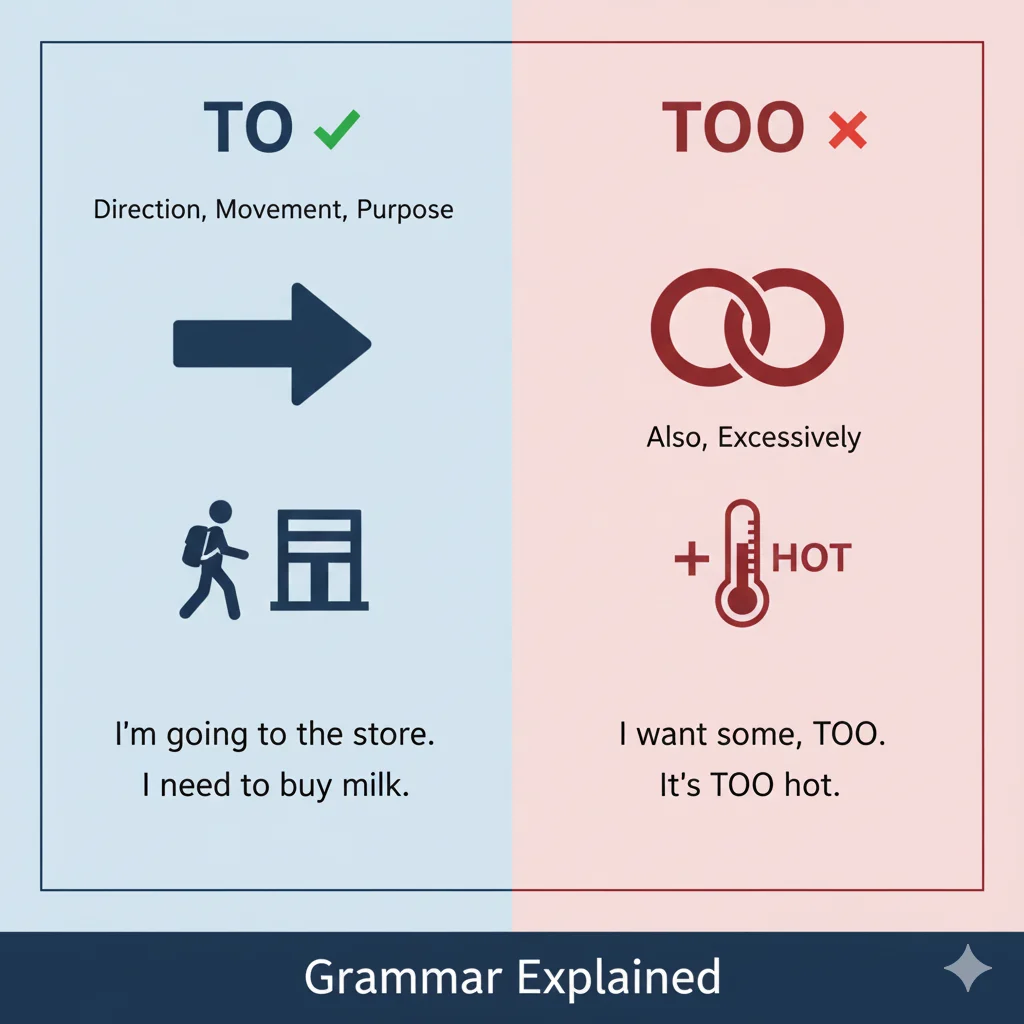
Many English learners, and even native speakers, often get confused between “to” and “too.” These two words sound similar but have very different meanings and uses. Using the wrong one can make your sentence confusing or even change its meaning entirely.
In this guide, you will learn the simple difference between “to” and “too,” their meanings, correct usage, and tips to avoid common mistakes. We will use short sentences and real-life examples from school, home, and daily conversations.
By the end of this article, even beginners and kids will be able to understand exactly when to use “to” or “too.” You’ll see examples, memory tricks, and a mini quiz to test your knowledge. Learning this will make your writing clearer and more professional.
What Does Each Word Mean?
1. To
Meaning: “To” is a preposition. It shows direction, purpose, or a relationship between two things.
Part of Speech: Preposition
Easy Examples:
- I am going to the park.
- Give this book to your friend.
- She listens to music every morning.
Memory Tip: Think of “to” as pointing somewhere, like an arrow → direction or goal.
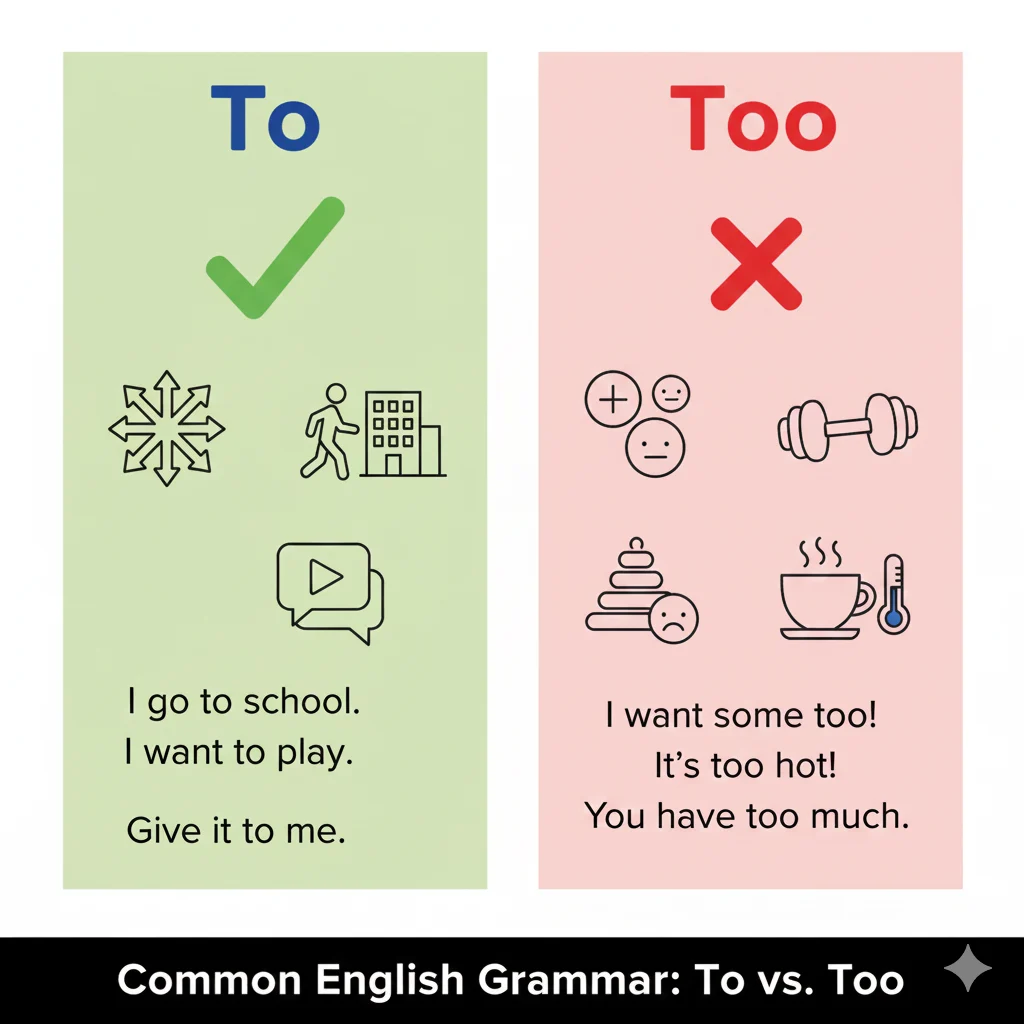
2. Too
Meaning: “Too” is an adverb. It means “also” or “more than needed/excessively.”
Part of Speech: Adverb
Easy Examples:
- I want to go too. (also)
- This bag is too heavy. (excessive)
- You are talking too fast. (more than needed)
Memory Tip: “Too” has an extra “o” like extra — it often shows addition or excess.
The Key Difference Between To and Too
| Word | Meaning | Part of Speech | Example Sentence | Quick Tip |
|---|---|---|---|---|
| To | Shows direction, goal, or relationship | Preposition | I am going to school. | Think “toward” or direction. |
| Too | Means also or excessively | Adverb | She is coming too. / It’s too hot outside. | Extra “o” = extra amount or addition. |
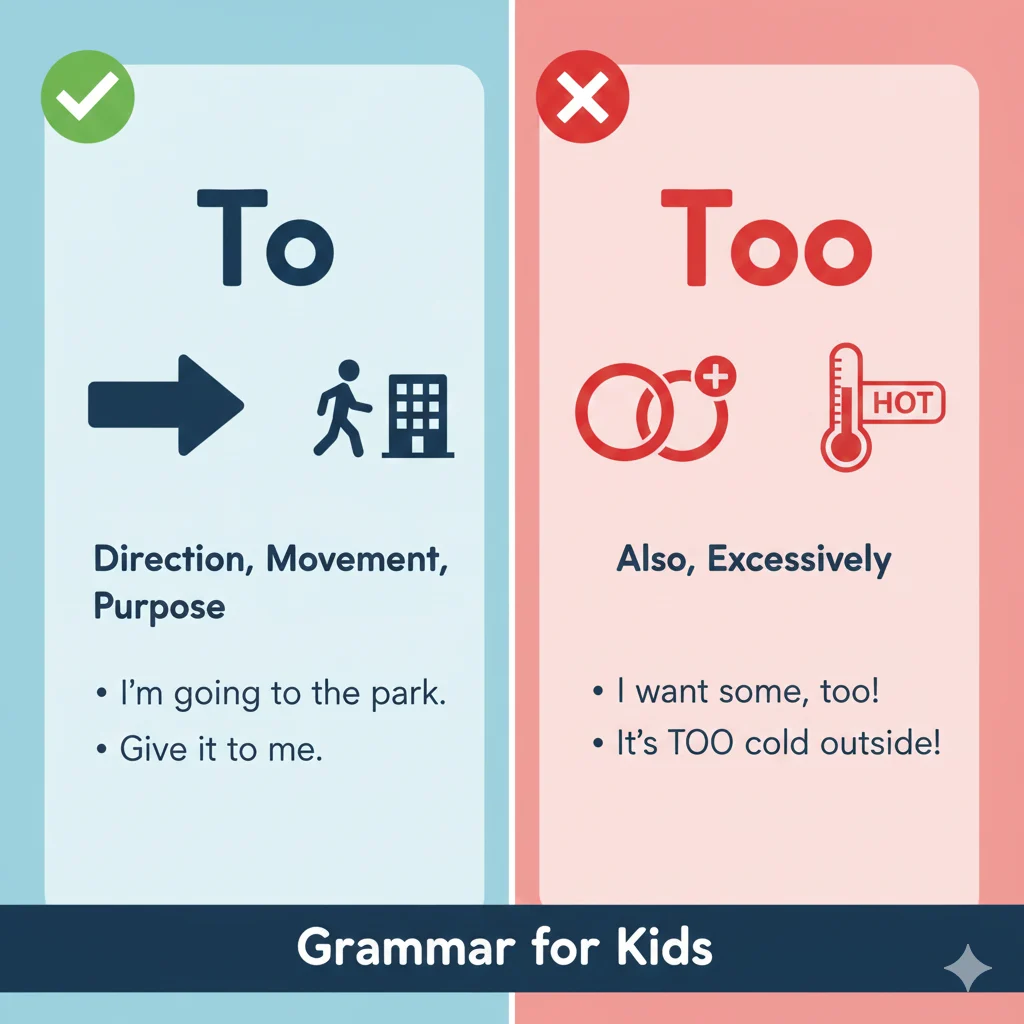
Quick Tip: If you can replace the word with “also” or “very/excessively,” then use too. Otherwise, use to.
Common Mistakes and How to Avoid Them
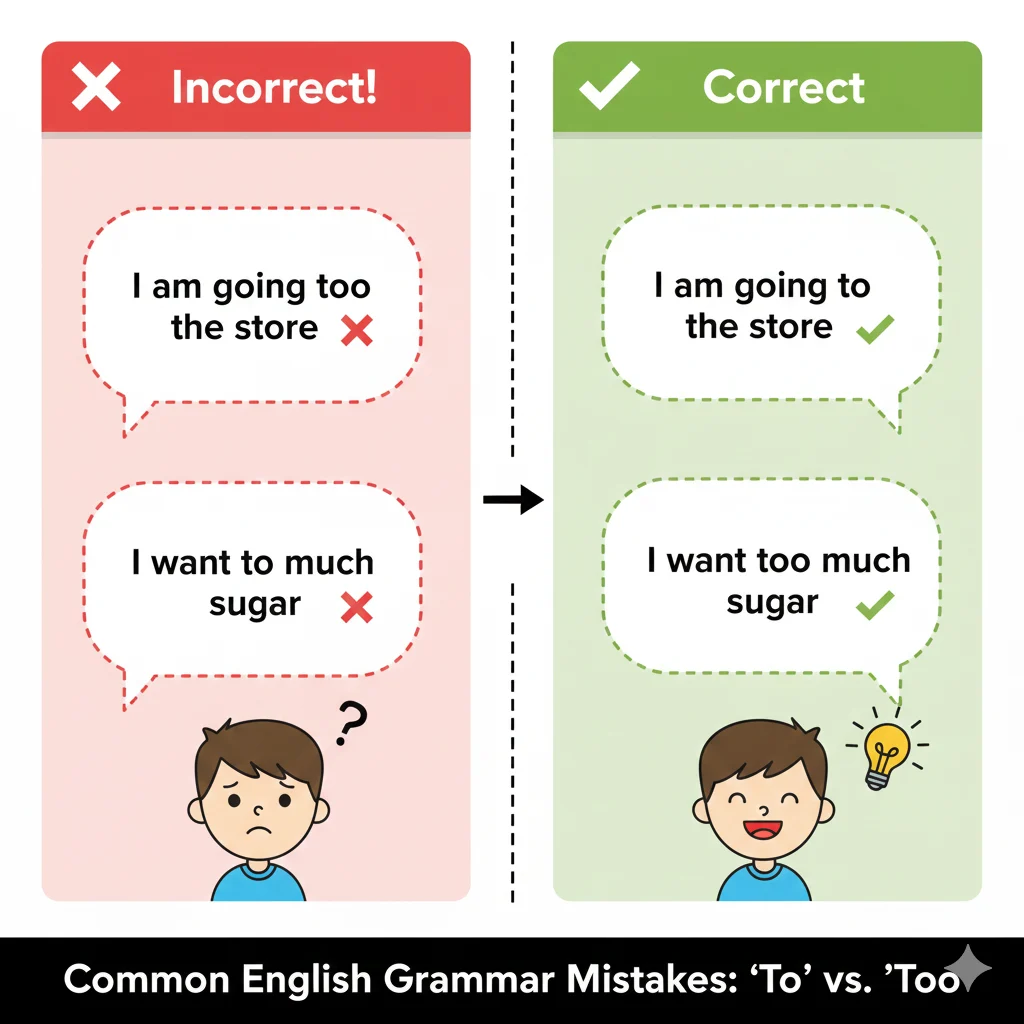
Incorrect: I am going too the store.
Correct: I am going to the store.
Why: “Too” means also or excessively, not direction.
Incorrect: She wants to come to.
Correct: She wants to come too.
Why: Here, “too” means “also,” not direction.
Incorrect: This soup is to hot.
Correct: This soup is too hot.
Why: “Too” expresses excess.
Tip: When in doubt, read the sentence aloud. Ask: Does it mean direction or addition/excess?
When to Use To
Use to in these situations:
- Showing direction or movement:
- I am going to the library.
- Walk to the gate slowly.
- Giving something or showing purpose:
- Give this pen to your teacher.
- I am writing a letter to my friend.
- Before verbs to form infinitives:
- I want to learn English.
- She likes to read books.
- Showing a relationship:
- This key belongs to my house.
- I am married to my best friend.
Memory Trick: Think of to as “toward” — it points somewhere or shows connection.
When to Use Too
Use too in these situations:
- To mean “also” or “in addition”:
- I want to play soccer, and my brother does too.
- Can I come too?
- To show excess or more than needed:
- This shirt is too small.
- You are talking too loudly.
- To stress a degree:
- The movie was too long.
- It is too cold to go outside.
Memory Trick: Extra “o” = extra amount or addition. Picture the extra circle as something extra or added.
Quick Recap: To vs Too
- To: direction, goal, connection. → I am going to school.
- Too: also, excessively. → I want to go too. / It’s too hot.
- Tip: Replace with “also” → use too. Shows direction → use to.
- Easy check: extra “o” = addition/excess. No extra “o” = direction/connection.
Advanced Tips
- Origin: “To” comes from Old English tō, meaning toward or at. “Too” comes from tō, also, later evolving to mean excessive.
- Formal Writing: Using “to” and “too” correctly is essential in essays, emails, and exams.
- Texting/Online: Mistakes like “I’m going too store” can confuse readers. Correct use makes you sound professional.
Mini Quiz: Fill in the Blanks
- I want ______ go to the mall.
- She is coming ______.
- This bag is ______ heavy.
- Please give this note ______ your teacher.
- Can I come ______?
- He listens ______ music every morning.
- The cake is ______ sweet.
Answer Key: 1) to 2) too 3) too 4) to 5) too 6) to 7) too
FAQs
1. Can I use “to” and “too” interchangeably?
No. “To” shows direction or purpose; “too” shows addition or excess.
2. How can I quickly remember the difference?
Extra “o” in too = extra (also/excess). “To” = direction/connection.
3. Is “to” always a preposition?
Mostly, but it can also form infinitives before verbs, e.g., “to eat.”
4. Can “too” appear at the start of a sentence?
Yes, for example: “Too many people attended the party.”
5. What are common mistakes with “to” and “too”?
Mixing them in sentences like “I am going too the store” or “She wants to come to” is common.
Conclusion
Now you know exactly when to use “to” or “too.” Remember: to shows direction, purpose, or connection, while too means also or excessively. Using the right word makes your sentences clear and professional.
Practice by reading, writing, and speaking English every day. Try to spot to and too in books, articles, and conversations. Over time, it will become natural. Even beginners can master this with simple tricks like “extra ‘o’ = addition/excess.”
Your English can improve quickly with small steps. Keep practicing, and soon, choosing between to and too will feel effortless.

Scottish novelist Muriel Spark (1918–2006) crafted sharp, witty stories exploring human nature, morality, and society with dark humor and insight.