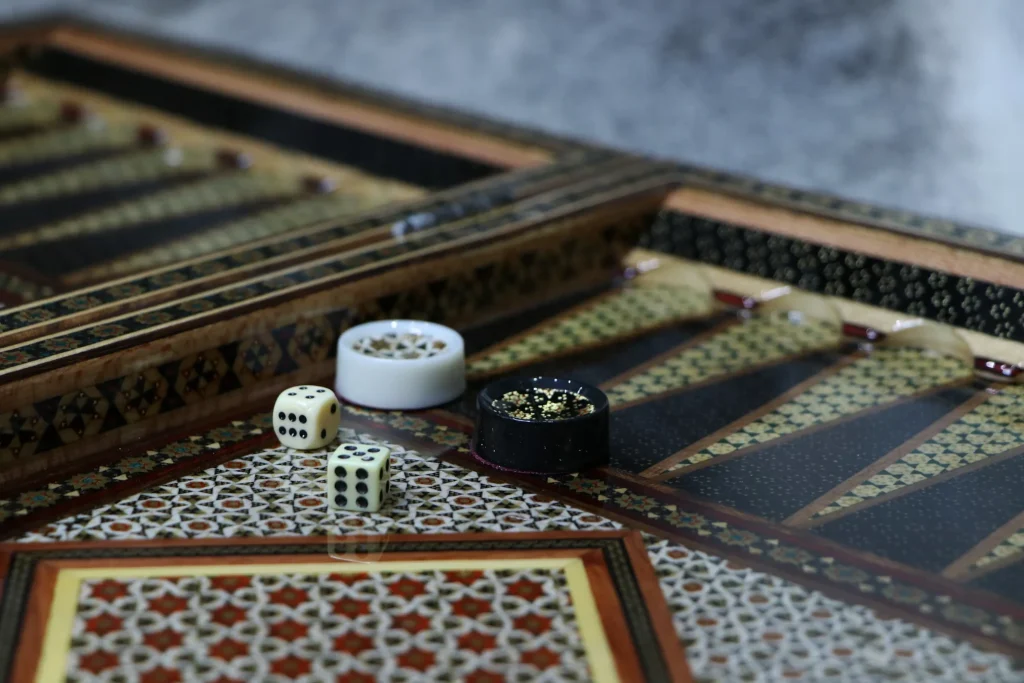
Walk into any kafenio in Nafplio or Chania after four in the afternoon and you will hear it before you see it: the clatter of dice hitting a wooden board, followed by the sharp snap of checkers slammed down for effect. Tavli, the Greek name for backgammon, is not a museum piece here. It is a live conversation between generations, played on boards that have outlasted governments, currencies, and at least three tourism booms.
What makes those boards an archive rather than just a pastime is what gets carried inside them. A grandfather teaches the doubling cube to a ten-year-old using the exact phrasing his own father used in 1968. The board itself, often bought secondhand at a Monastiraki stall, has usually changed hands three or four times, each owner leaving nicks and cigarette burns as a kind of signature.
The Kafenio Where Every Table Doubles as an Archive
That inherited vocabulary is also why Greece’s online gambling operators lean so hard on backgammon imagery rather than generic slot graphics. A platform like sankra casino builds its table-game lobby around the same visual language – wooden rims, ivory-toned checkers, a leather dice cup – because Greek players recognize it instantly and trust it more than a flashing neon wheel. The nostalgia is not decoration; it is a conversion tool, and operators who skip it lose the over-40 demographic within the first thirty seconds of a homepage visit.
Away from the marketing, the game itself is stubbornly analog. Most kafenio boards are still scored with chalk marks on the rim rather than an app, and a serious afternoon match can run for two or three hours across a best-of-seven set, with spectators leaning over shoulders to argue about a move that was made four turns ago. Waiters know better than to clear the coffee cups until the final point is called, since a half-finished frappé is treated as a reserved seat.
Three Games Under One Board: Portes, Plakoto, Fevga
Greece is unusual because it never settled on a single ruleset. Ask for “tavli” and you will actually get three separate games played in sequence on the same board, each with its own tactical logic and its own regional following.
Portes (“doors”) is the version closest to Western backgammon and usually opens the session; a competent pair can finish it in twelve to fifteen minutes. Plakoto follows, a pinning game where a lone checker can trap an opponent’s piece for the entire match – brutal in Crete, where local players are famous for holding a pin for forty moves out of pure stubbornness. Fevga closes the set, a pure race with no hitting at all, prized in Thessaloniki cafes for how fast it moves. Play all three back to back and a single sitting can stretch past an hour before anyone settles the bill.
| Variant | Core Mechanic | Typical Match Length | Regional Stronghold |
| Portes | Standard hitting and blocking | 12-15 minutes | Athens, nationwide |
| Plakoto | Pinning an opponent’s checker | 20-35 minutes | Crete |
| Fevga | Pure race, no contact | 8-12 minutes | Thessaloniki |
Reading the Doubling Cube
The doubling cube is where tavli stops being a children’s game and turns into arithmetic under pressure. Doubling too early against a strong Plakoto pin can hand the whole match to an opponent who was, seconds earlier, clearly losing; doubling too late leaves points on the table that a sharper player would have banked.
Village tournaments in the Peloponnese still run informal doubling clinics before the summer festival season, where older players walk teenagers through cube decisions using match transcripts scrawled in notebooks. It is the closest thing Greece has to a backgammon coaching manual, and none of it has ever been printed. A handful of these notebooks have been passed down for three generations, patched with tape where the spine gave out decades ago.
Why Greek Casinos Still Bow to a 5,000-Year-Old Board
The oldest known backgammon-style set, unearthed at Shahr-e Sukhteh in Iran, has been carbon-dated to roughly 3000 BC – older than the Acropolis by more than two millennia. Greece did not invent the game, but it arguably domesticated it, turning a royal pastime into daily furniture for every neighborhood square.
That five-thousand-year pedigree is precisely why casino floors in Athens and Rhodes still keep a physical tavli table between the roulette wheels, even when it earns the house almost nothing. Removing it would read, to a Greek clientele, less like a business decision and more like erasing a family photograph from the wall. Managers who have tried it report complaints within a week, usually from the same regulars who have played on that exact table since it opened.

