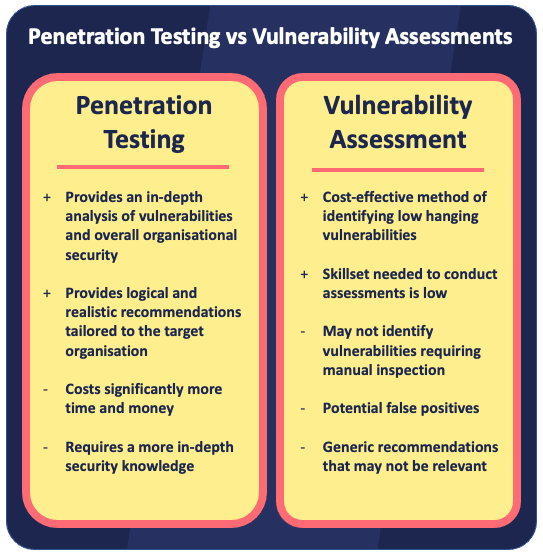
Security teams often treat vulnerability assessment vs penetration testing as one item on a compliance checklist, but the two serve different purposes at different points in a security lifecycle. Knowing where each one fits and how experienced teams decide what to act on determines whether a security program catches exposure or just produces paperwork.
What Each Approach Measures
A vulnerability assessment scans systems, networks, and applications for known weaknesses, such as outdated software, missing patches, misconfigured services, and exposed ports. It’s automated, repeatable, and broad in scope.
Finding a vulnerability is one thing. Penetration testing determines whether someone can use it. The tester attempts to exploit what was found, sometimes chaining several issues together to see how far an attacker could get. That process shows which findings create real exposure and which ones are unlikely to matter.
How Experienced Teams Prioritize Findings
Mature programs move past sorting by CVSS and working down the list. A scan can surface hundreds of findings, most of which are low-risk, and without a clearer signal, teams end up with alert fatigue and no sense of what to fix first. Two signals now handle that:
- CISA’s Known Exploited Vulnerabilities (KEV) catalog. A list of CVEs with confirmed, documented exploitation in the wild. A finding here jumps the queue regardless of its base severity score.
- EPSS (Exploit Prediction Scoring System). A FIRST.org model estimating the probability that a CVE will be exploited in the next 30 days, updated daily; only a small share of published vulnerabilities is exploited, which is why CVSS alone buries the findings that matter under hundreds that don’t.
A common tiering model: KEV-listed findings on internet-facing, business-critical assets get remediated within 24–72 hours; high-EPSS findings with public exposure but lower criticality within 7 days; everything else folds into the normal monthly patch cycle. Pen test results feed the same model; a finding that a tester successfully chains into access gets treated with KEV-level urgency, regardless of its original scan severity. Platforms like TopScan pull KEV and EPSS data directly into the scan results, so a Tier 0 finding surfaces flagged before anyone has to cross-reference it manually.
Where Frequency Becomes the Deciding Factor
Most compliance frameworks require both activities, but not on the same schedule. Under PCI DSS, external vulnerability scans are generally required quarterly, with some merchant categories under PCI DSS 4.0 scanning more often. Penetration testing is typically annual or after major infrastructure changes. It is manual and resource-intensive, which keeps it off scanning’s pace.
Vulnerability scans track what changes as systems evolve; penetration tests check whether those changes opened an attack path someone could actually use. A chained exploit path found once a year can sit open for months if nothing between engagements is watching for new exposure, which is why continuous scanning and periodic testing need to function as one connected system, not two separate compliance boxes.
Closing the Loop Between Scanning and Testing
Even with good prioritization, programs lose findings to disconnected tooling: scan data in one dashboard, remediation tickets in Jira, nothing syncing the two. TopScan routes prioritized findings straight into the ticketing systems engineering already uses, so nothing identified between formal pen tests sits unassigned.
Conclusion
Neither assessment answers every security question. A vulnerability assessment shows where weaknesses exist at scan time. A penetration test shows whether those weaknesses convert into real access. Together, they give security teams a stronger basis for deciding what gets fixed first and what can wait.

