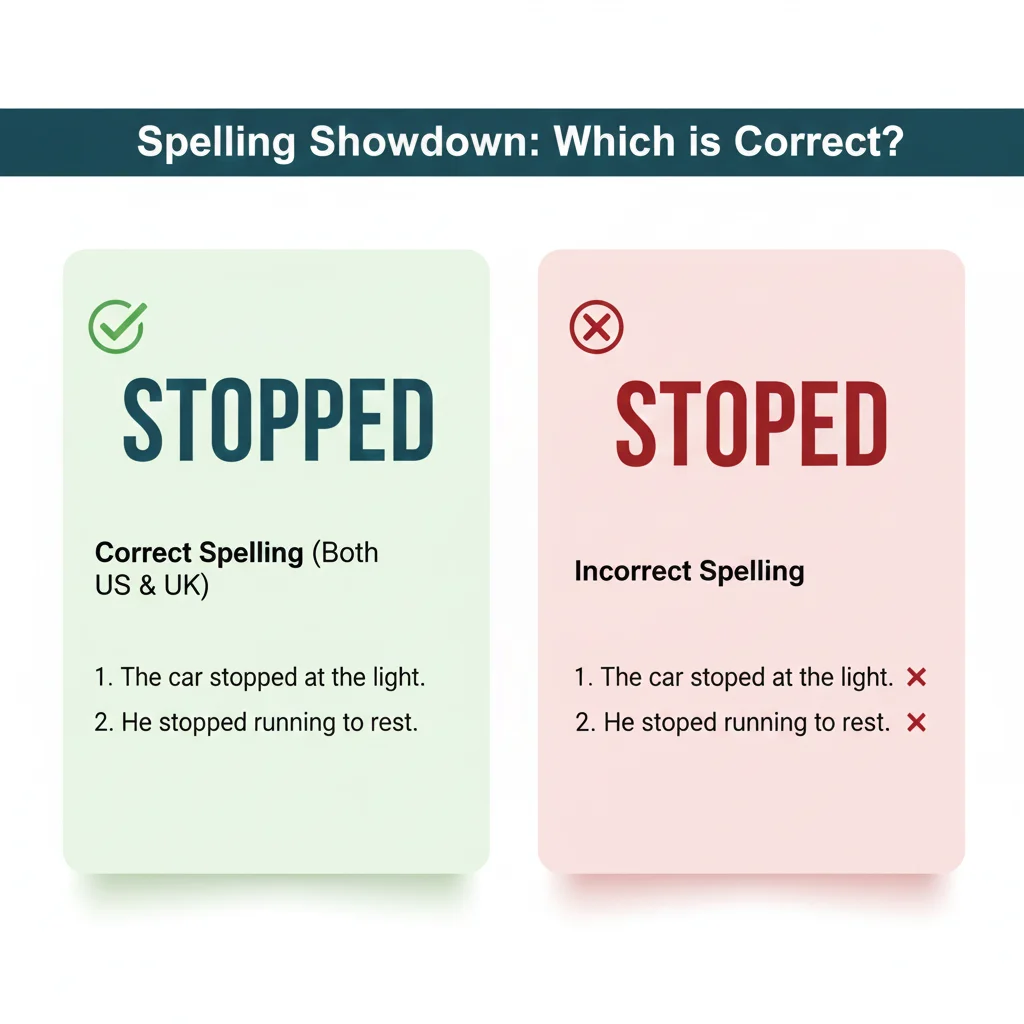
The correct spelling is “stopped.” The form “stoped” is not correct in standard English. Stopped is the past tense and past participle of the verb stop, which means to end an action or come to a halt.
People often search “stopped or stoped” when they want to check the correct spelling while writing emails, school assignments, articles, or social media posts. The goal is to quickly understand which spelling is correct and avoid common writing mistakes.
The word stopped follows a common English spelling rule. When a short verb ends with a vowel followed by a consonant (like stop), the final consonant is doubled before adding -ed. Because of this rule, the correct past tense becomes stopped, not stoped.
Example sentences:
He stopped working to take a short break.
She stopped the car at the red light.
The music suddenly stopped playing.
What Does Each Word Mean?
1. “Stopped” — Meaning
“Stopped” is the past tense and past participle of the verb “stop.”
You use it when something ended, paused, or did not continue.
Part of Speech:
Verb (past tense / past participle)
Simple Meaning:
Something was moving or happening, and then it came to an end.
Examples:
- The bus stopped at the traffic signal.
- My friend stopped talking when the teacher entered.
- It stopped raining after an hour.
2. “Stoped” — Meaning
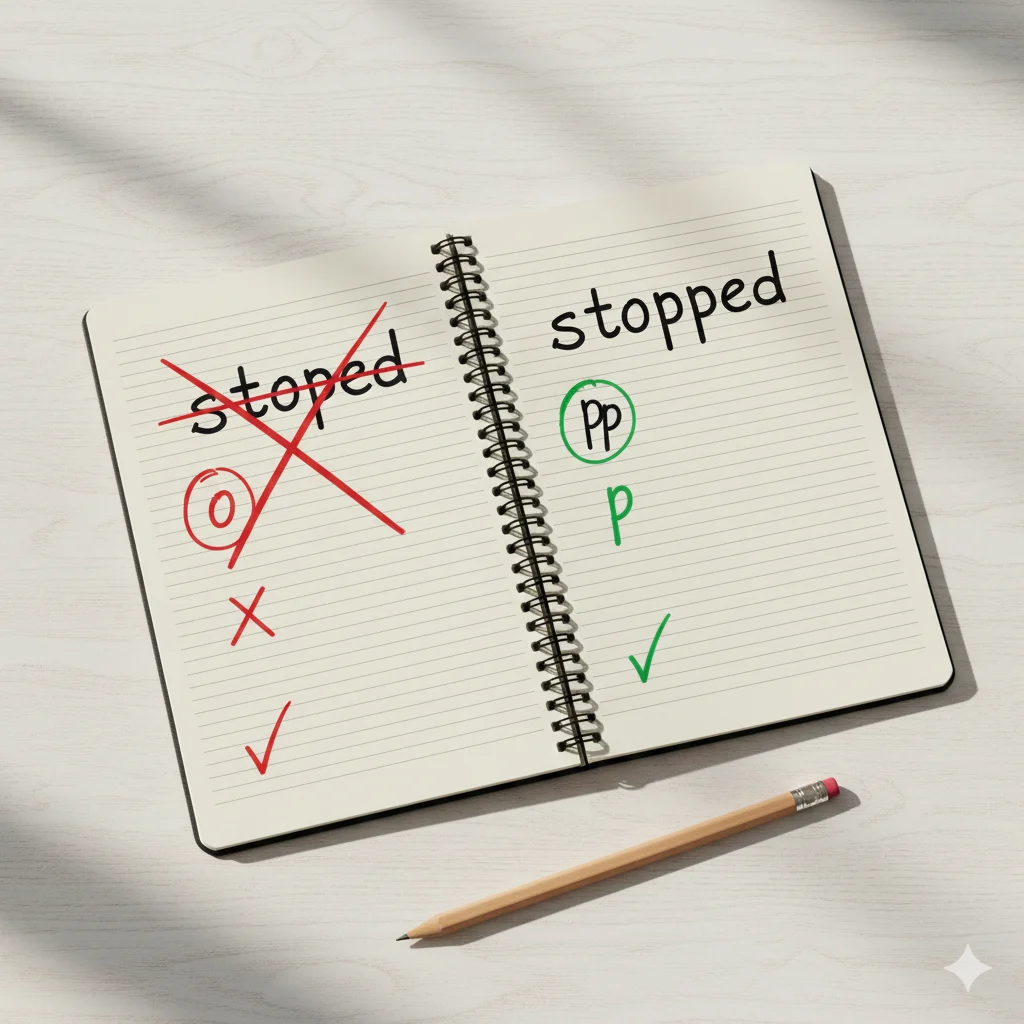
The word “stoped” is NOT a real English word.
It has no meaning, no use, and no correct example.
It is simply a spelling mistake that happens because some people forget the rule of doubling the last consonant before adding -ed.
Examples of Incorrect Usage:
❌ I stoped the car.
❌ He stoped playing.
❌ They stoped talking.
These sentences must use “stopped” instead.
The Key Difference Between “Stopped” and “Stoped”
The difference is very simple:
- “Stopped” = Correct
- “Stoped” = Incorrect
“Stopped” follows a normal English spelling rule called the CVC doubling rule (Consonant + Vowel + Consonant).
Since “stop” ends in C-V-C, we double p before adding -ed.
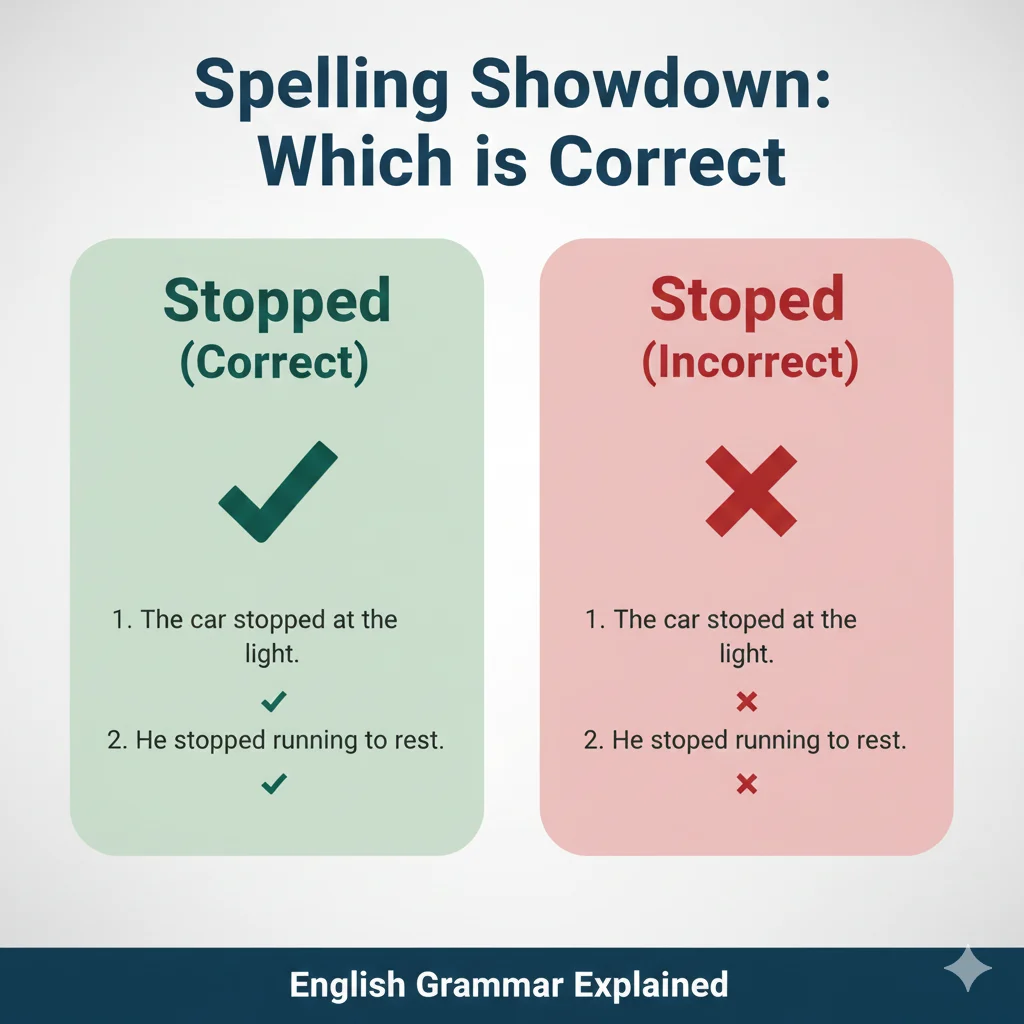
Comparison Table: Stopped vs Stoped
| Feature | Stopped (Correct) | Stoped (Incorrect) |
|---|---|---|
| Meaning | Past tense of stop | No meaning |
| Usage | Used in all forms of English writing | Should never be used |
| Grammar Rule | Double the last consonant before -ed | Breaks grammar rules |
| Example | She stopped the car. | ❌ She stoped the car. |
| Accepted in dictionaries | Yes | No |
Quick Tip to Remember
When a word ends with consonant + vowel + consonant (like s-t-o-p), double the last letter before adding -ed. So: stop → stopped.
Common Mistakes and How to Avoid Them
Mistake 1: Forgetting the Double “P”
❌ He stoped to drink water.
✔️ He stopped to drink water.
Why it happens: People type fast or forget the doubling rule.
Fix: Always check if the base word ends in C-V-C.
Mistake 2: Mixing American and British spellings
Some English words have different spellings (color/colour), but “stopped” is the same everywhere.
❌ British English uses “stoped”
✔️ Both US and UK use stopped

Mistake 3: Thinking “stoped” looks right
This is a visual mistake because “stoped” seems acceptable.
Fix: Say it aloud.
“Stop-ped” → You can hear the double “p” sound.
When to Use “Stopped” (With Examples)
Use “stopped” whenever you want to talk about something that ended in the past.
Use it when:
✔️ Someone paused an action
✔️ A machine or vehicle came to a halt
✔️ Weather or noise ended
✔️ An event or activity finished
Examples:
- The teacher stopped the class to explain the rule again.
- My phone stopped working yesterday.
- She stopped crying after watching cartoons.
- The car stopped suddenly.
- They stopped playing football because it was too hot.
These are all everyday situations — school, home, friends, driving, etc.
When to Use “Stoped” (With Memory Trick)
You should never use “stoped” in English writing because it is not a word.
Memory Hack:
Think of a red traffic light.
The word “stop” is on the sign.
When the car stops, the pressure doubles — just like the “p” doubles:
Stop → Stopped
So:
Red light? Double the P!
Quick Recap: Stopped vs Stoped
- Stopped = correct past tense of stop
- Stoped = incorrect spelling
- Always double the last consonant when a word ends with C-V-C
- Use “stopped” for everything in writing, schoolwork, texting, and formal English
- “Stoped” should never be used
Advanced Tips
1. Origin of the Word “Stop”
The word “stop” comes from Old English stoppian, meaning “to block or close.”
The past tense has always required consonant doubling in Germanic languages.
2. Using “Stopped” in Exams or Essays
Teachers expect students to write the correct spelling.
Using “stoped” will always be marked wrong, even in creative writing.
Correct usage makes writing:
- Clear
- Professional
- Easy to understand
3. Texting Habits
Many people type “stoped” when texting quickly. Over time, the mistake becomes a habit.
To avoid this:
- Slow down while typing
- Use autocorrect
- Practice writing the correct form in sentences
Small steps lead to strong English skills.
4. What Is a Stop Consonant?
Some learners also ask, “what is a stop consonant?”
In phonetics, a stop consonant is a sound made by completely stopping the airflow in the mouth and then releasing it suddenly.
Examples of stop consonant sounds in English include:
p
b
t
d
k
g
When you pronounce p in the word stop, your lips close fully and then release the sound. That is why p is called a stop consonant.
Understanding stop consonants can help learners notice pronunciation patterns and spelling rules in English words.
Mini Quiz: Choose the Correct Word
Fill in the blanks with stopped (never use “stoped”).
- The music suddenly ________.
- She ________ reading when her mom called.
- It ________ snowing after 10 minutes.
- They ________ at the shop to buy snacks.
- My laptop ________ working last night.
- The dog ________ barking after it ate.
- We ________ the game because it was too late.
(Answers: All = stopped)
How Do You Spell Stopped?
The correct spelling is stopped, with two “p” letters.
The base word is stop, and when we turn it into the past tense, English spelling rules require doubling the final consonant before adding -ed.
So the correct spelling process looks like this:
stop → stop + p → stopped
Many learners search “how do you spell stopped” because they are unsure whether the correct spelling is stopped or stoped. The correct spelling is stopped, with two “p” letters.
Examples:
She stopped the car near the school.
The rain stopped after an hour.
He stopped playing the game when dinner was ready.
A quick way to remember is this:
Short word + one vowel + one consonant → double the consonant before -ed.
That is why the correct spelling is always stopped, never stoped.
Stopped — Почему 2 “P”?
Some learners from other languages search “stopped почему 2 p”, which means “Why does stopped have two P letters?”
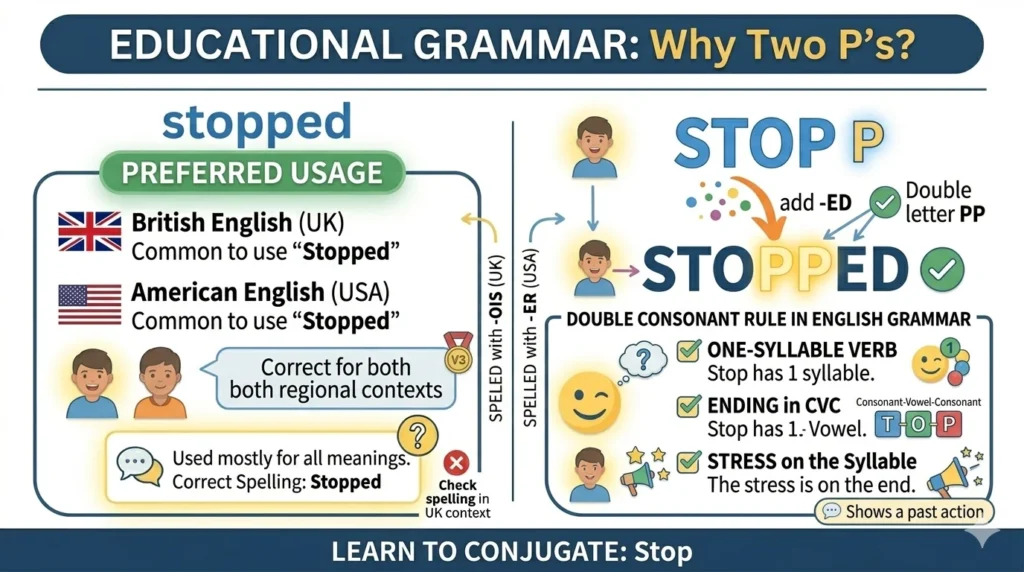
The answer comes from a basic English spelling rule.
When a short verb ends with one vowel + one consonant, we double the final consonant before adding -ed.
The word stop ends like this:
s-t-o-p
(consonant + consonant + vowel + consonant)
Because it is a short stressed verb, the final “p” must be doubled before adding -ed.
So the correct spelling becomes:
stop → stop + p + ed → stopped
This rule also applies to other words:
drop → dropped
plan → planned
hug → hugged
That is why stopped always has two “p” letters.
FAQs
1. Which one is correct: stopped or stoped?
“Stopped” is correct. “Stoped” is always wrong.
2. Why do we double the “p” in stopped?
Because “stop” ends in consonant + vowel + consonant, so English rules require doubling the final consonant before adding -ed.
3. Is “stoped” ever used in British English?
No. Both American and British English use stopped.
4. What is the past tense of stop?
The past tense is stopped.
5. How can I remember the correct spelling?
Use this trick: “Red light? Double the P!” → stop → stopped.
Conclusion
The difference between “stopped” and “stoped” is very simple: one is correct, and the other is not a real English word. Understanding this helps you write clearly, avoid spelling mistakes, and build stronger English skills. The rule is easy — if a word ends in consonant-vowel-consonant, double the last consonant before adding -ed. With the examples, tips, and memory hacks in this guide, you can confidently use “stopped” in school, work, or everyday writing. Keep practicing, stay curious, and your English will improve every single day.

Caribbean-born novelist Jean Rhys (1890–1979) explored alienation, identity, and female psychology with lyrical, haunting, and emotionally rich prose.