

Many people get confused between termite or ant because both are tiny insects, live in groups, and sometimes look alike. If you see small bugs in your home or garden, you might ask: Is it a termite or an ant? This confusion is very common—especially for beginners, kids, and even adults.
In this easy guide, you will learn the meaning, difference between termite and ant, and the correct usage of each word in English. We will use simple language, short sentences, and real-life examples so that even a class 4 student can understand everything clearly.
By the end of this article, you will know how to tell them apart, how to use the correct word in sentences, and how to avoid common mistakes. Let’s make termite vs ant super easy and fun to learn.
What Does Each Word Mean?
What Is a Termite?
A termite is a small insect that eats wood. Termites often live inside wood, soil, or walls. They are famous for damaging houses, furniture, and trees.
- Part of speech: Noun
- Simple meaning: A wood-eating insect
Easy examples:
- The termite ate the wooden chair.
- We called an expert to remove the termites from our house.
- Termites can damage homes if not stopped.
Mini story:
Think of a termite as a tiny wood-lover. If your house is made of wood, termites think it is a big food party.
What Is an Ant?
An ant is a small insect that you often see on the ground, walls, or near food. Ants live in groups called colonies. They do not eat wood like termites.
- Part of speech: Noun
- Simple meaning: A small insect that lives in groups
Easy examples:
- An ant is crawling on the floor.
- Ants are carrying food to their nest.
- I saw a line of ants near the sugar jar.
Mini story:
An ant is like a hard-working helper. It finds food and shares it with friends.
The Key Difference Between Termite and Ant
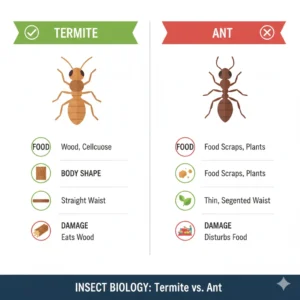
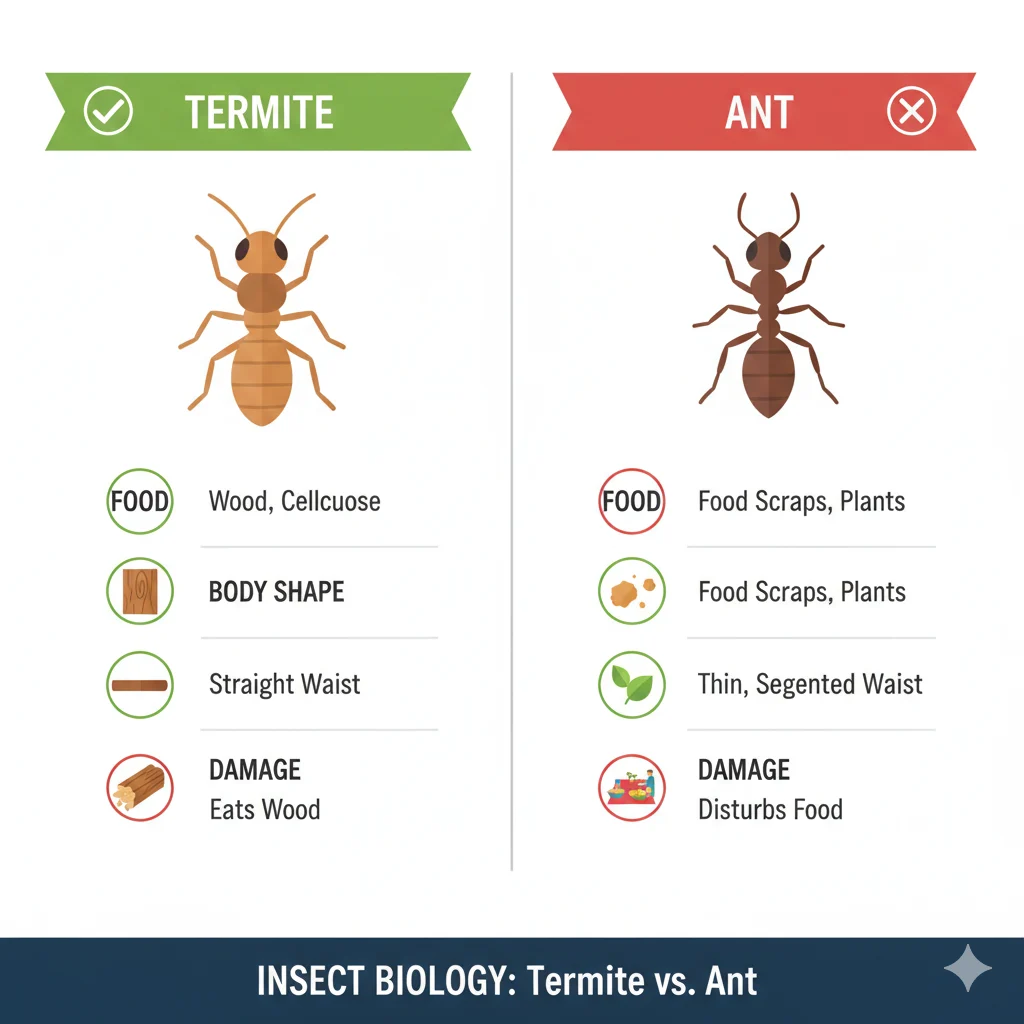
The main difference between termite and ant is what they eat and where they live. Let’s look at it clearly.
Termite vs Ant Comparison Table
| Feature | Termite | Ant |
|---|---|---|
| Meaning | Wood-eating insect | Small insect that collects food |
| Food | Wood, paper | Sugar, crumbs, insects |
| Damage | Can destroy houses | Usually harmless |
| Body shape | Soft, pale body | Hard, dark body |
| Usage in English | Talks about damage | Talks about insects seen daily |
Quick tip to remember:
👉 Wood = Termite
👉 Food crumbs = Ant
Common Mistakes and How to Avoid Them
People often mix up these two words. Let’s fix that.
Mistake 1
❌ There are ants eating my wooden door.
✅ There are termites eating my wooden door.
Why?
Ants do not eat wood. Termites do.
Mistake 2
❌ A termite was walking toward the sugar.
✅ An ant was walking toward the sugar.
Why?
Ants like sugar. Termites like wood.
Mistake 3
❌ Termites are marching in a line to food.
✅ Ants are marching in a line to food.
How to avoid mistakes:
Always think: Is it about wood or food?
When to Use Termite
Use termite when talking about wood damage, houses, furniture, or pest control.
Correct usage examples:
- The house has a termite problem.
- Termites can destroy wooden floors.
- We found termites inside the wall.
- A termite expert checked the building.
- Wooden doors can attract termites.
Real-life tip:
If something wooden is breaking or hollow, it might be termites.
When to Use Ant
Use ant when talking about small insects, food, kitchens, gardens, or daily life.
Correct usage examples:
- An ant climbed on my hand.
- Ants are near the picnic food.
- She cleaned the table to stop ants.
- Ants work together to carry food.
- I saw ants in the garden.
Memory hack:
🐜 Ant = Active (ants are always moving!)
Quick Recap: Termite vs Ant
- Termite
- Eats wood
- Damages houses
- Lives inside walls or soil
- Ant
- Eats food crumbs
- Mostly harmless
- Seen in kitchens and gardens
One-line rule:
If it eats wood, say termite. If it eats food, say ant.
Advanced Tips
Word Origin
- Termite comes from a Latin word meaning “wood worm.”
- Ant is one of the oldest insect names in English.
Formal Writing
In school essays or exams:
- Use termite when discussing building safety or science.
- Use ant in biology or daily observation writing.
Online Writing
Using the wrong word can confuse readers:
- Saying “ants destroyed my house” sounds incorrect.
- “Termites destroyed my house” is clear and correct.
Mini Quiz: Test Yourself
Fill in the blanks:
- The _____ damaged the wooden table.
- I saw an _____ near the sugar bowl.
- Houses need protection from _____.
- _____ live in big groups called colonies.
- A _____ expert checked our home.
(Answers: termite, ant, termites, ants, termite)
Frequently Asked Questions (FAQs)
1. What is the main difference between termite and ant?
Termites eat wood and cause damage. Ants look for food and crumbs.
2. Are termites more dangerous than ants?
Yes. Termites can damage houses. Ants usually do not.
3. Can ants eat wood like termites?
No. Ants do not eat wood.
4. Is termite or ant correct for kitchen insects?
Ant is correct for kitchen insects.
5. Why do people confuse termite vs ant?
They look similar and both live in groups.
Conclusion
Now you clearly understand the difference between termite and ant. You learned their meanings, correct usage, and simple ways to remember them. Termites eat wood and cause damage. Ants look for food and are part of daily life.
Keep practicing by noticing insects around you and naming them correctly. Small steps like this help you improve English every day. Learning confusing words becomes easy when examples are simple and fun. Keep going—you’re doing great!

English playwright and novelist Patrick Hamilton (1904–1962) captured psychological tension, social decay, and dark humor in gripping, unforgettable stories.