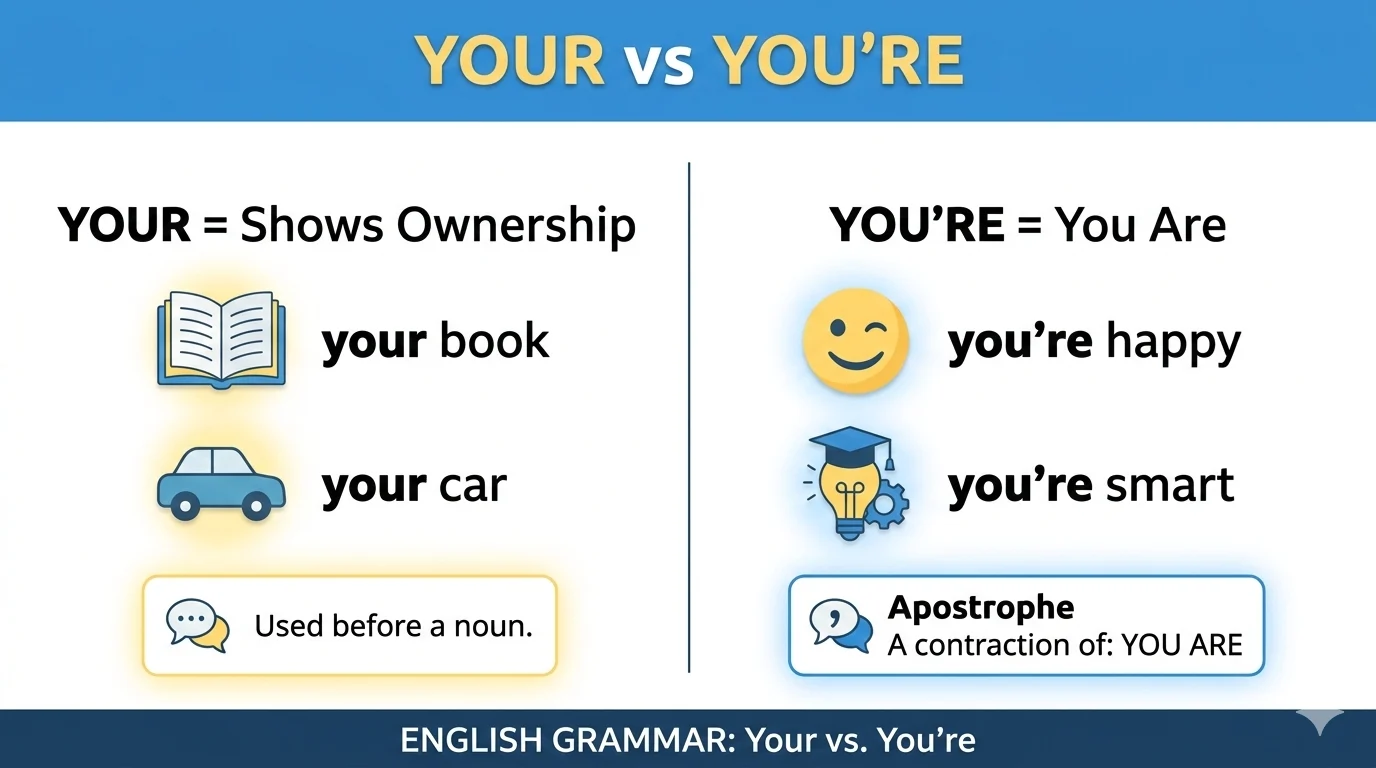
Have you ever stopped while writing and wondered, “Is it your or you’re?” You are not alone. Many students, adults, and even native English speakers feel confused about your or you’re. These two words sound exactly the same. But they have very different meanings.
This confusion leads to common questions like:
- What’s the difference between your and you’re?
- When to use your or you’re?
- Is it your or you’re welcome?
- Is it you’re pretty or your pretty?
- What is correct, your or you’re the best?
If you have asked any of these, this guide is for you.
In this complete and beginner-friendly lesson, you will learn:
- Your or you’re meaning
- The difference between your and you’re
- Your and you’re examples
- Common mistakes and how to fix them
- Memory tricks that really work
- Advanced grammar tips
- A mini quiz to test yourself
Everything is explained in simple English. Even a 4th-grade student can understand it easily.
Let’s begin.
What Does “Your” Mean in Your or You’re?
First, let’s understand your.
✅ Your Meaning (Simple Explanation)
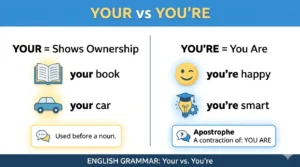
Your shows that something belongs to you.
It tells us about ownership.
It is called a possessive adjective because it describes a noun and shows possession.
Think of it like this:
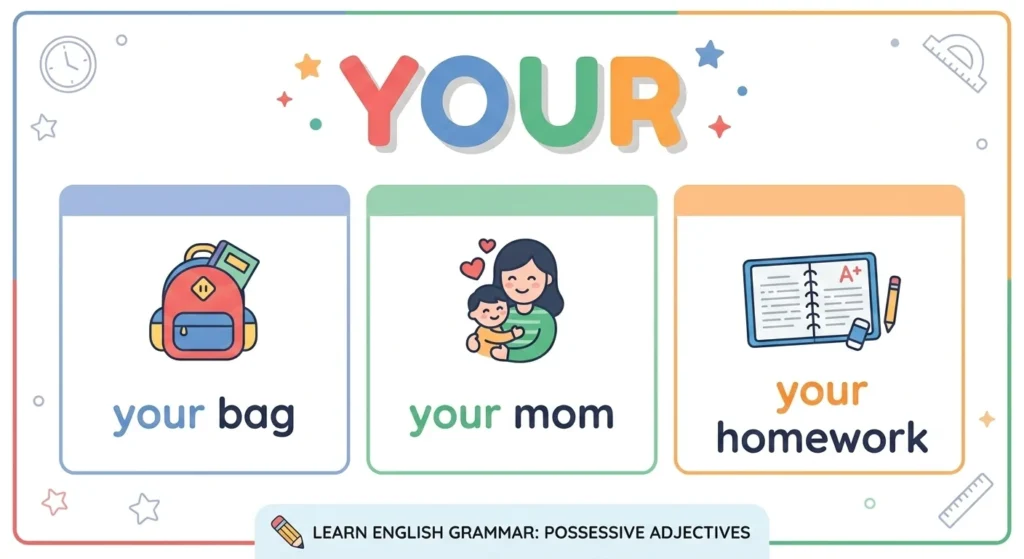
If something is yours, we use your before it.
🟢 Your and You’re Examples (For “Your”)
Here are easy examples:
- This is your book.
- I like your shoes.
- Where is your mom?
- Don’t forget your homework.
- Your dog is very friendly.
In every sentence above, something belongs to “you.”
- Your book → the book belongs to you
- Your mom → your mother
- Your idea → your thought
🏫 Real-Life Situations Using “Your”
At School:
- Is this your pencil?
- Please open your notebook.
At Home:
- Clean your room.
- Where are your keys?
With Friends:
- I love your haircut.
- Your bike is cool.
Whenever you talk about something owned by someone, use your.
What Does “You’re” Mean in Your or You’re?
Now let’s understand you’re.
✅ You’re Meaning (Very Simple)
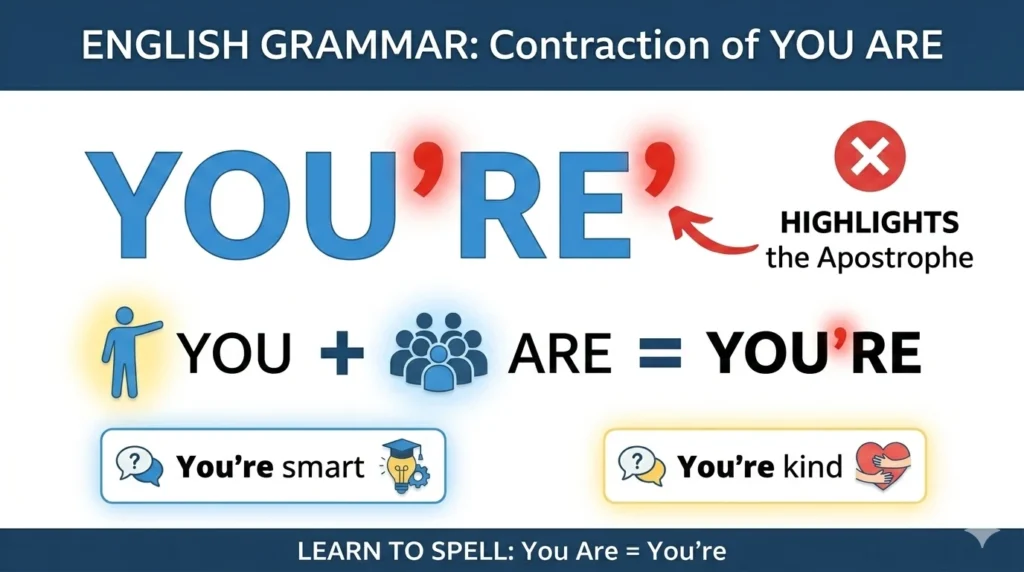
You’re is short for you are.
It is a contraction.
A contraction is when two words are joined together with an apostrophe (’).
You + Are = You’re
The apostrophe replaces the letter “a” in “are.”
🟢 You’re in a Sentence (Easy Examples)
- You’re very kind. (You are very kind.)
- You’re my best friend. (You are my best friend.)
- You’re going to win. (You are going to win.)
- You’re amazing. (You are amazing.)
- You’re late today.
If you can replace the word with you are, then you’re is correct.
That is the most important grammar rule in your or you’re difference.
The Key Difference Between Your and You’re
Let’s clearly compare your or you’re in a simple table.
| Word | Meaning | Type | Example |
|---|---|---|---|
| Your | Shows ownership | Possessive adjective | This is your bag. |
| You’re | Short for “you are” | Contraction | You’re very smart. |
🧠 Quick Trick to Remember
Replace the word with “you are.”
If it works → use you’re
If it does not work → use your
Example:
❌ Is this you are car? (Wrong)
✅ Is this your car? (Correct)
❌ Your very funny.
(Your = ownership. That does not fit.)
✅ You’re very funny.
(You are very funny. Correct!)
This is the easiest way to solve the your or you’re? confusion.
Common Mistakes and How to Avoid Them
Many people make small grammar mistakes with your or you’re. Let’s fix them.
❌ Mistake 1: Your welcome
People often search:
- Is it your or you’re welcome?
- What is correct, your or you’re welcome?
Correct answer:
✅ You’re welcome.
Why?
Because it means:
“You are welcome.”
Wrong:
❌ Your welcome.
Right:
✅ You’re welcome.
❌ Mistake 2: Your the best
People ask:
- Your or you’re the best?
Correct sentence:
✅ You’re the best.
Because it means:
“You are the best.”
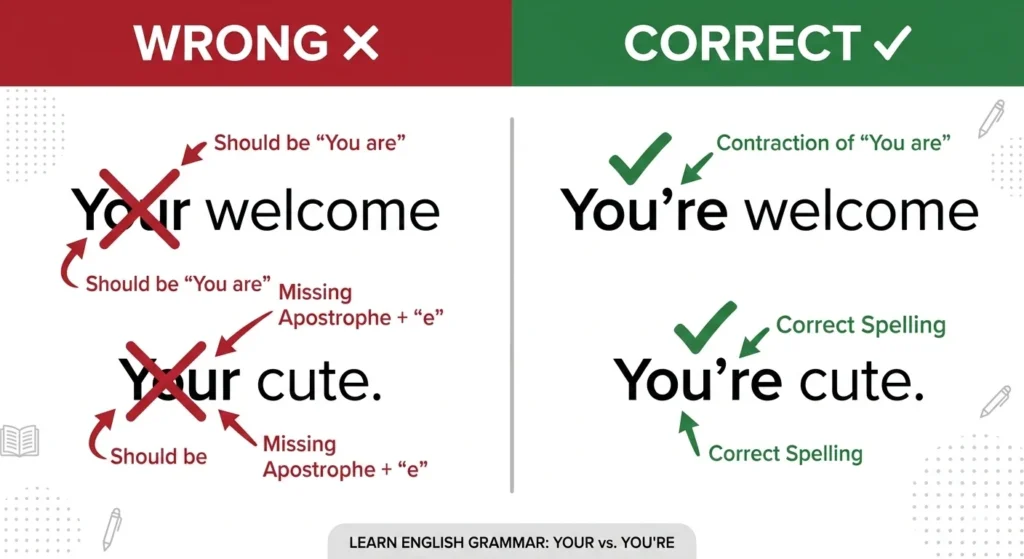
❌ Mistake 3: Your cute
People write:
❌ Your cute.
Correct:
✅ You’re cute.
It means:
“You are cute.”
❌ Mistake 4: I like you’re dress
Wrong:
❌ I like you’re dress.
Correct:
✅ I like your dress.
Because the dress belongs to you.
❌ Mistake 5: Is it you’re pretty or your pretty?
Correct answer:
✅ You’re pretty.
Because it means:
“You are pretty.”
When to Use Your (Detailed Guide)
Now let’s clearly answer:
When to use your or you’re?
Use your when:
- Something belongs to someone
- You talk about family
- You talk about belongings
- You describe someone’s things
Examples of When to Use Your
- Is this your mom?
- Where is your phone?
- I like your idea.
- Don’t forget your bag.
- Your smile is beautiful.
- Please check your email.
- Your house is big.
If you see a noun (book, car, mom, idea, house) after it — usually your is correct.
When to Use You’re (Detailed Guide)
Use you’re when you mean “you are.”
Examples of When to Use You’re
- You’re very kind.
- You’re going home.
- You’re my hero.
- You’re everything to me.
- You’re beautiful.
- You’re very smart.
- You’re welcome.
Let’s answer more common searches naturally:
- Your or you’re everything?
Correct: You’re everything. - Your or you’re beautiful?
Correct: You’re beautiful. - Your or you’re mom?
Correct: Your mom (because it shows ownership). - Your or you’re cute?
Correct: You’re cute.
What’s Better, Your or You’re?
Many students ask:
“What’s better, your or you’re?”
The answer is simple:
Neither is better.
They have different meanings.
The correct choice depends on the sentence.
Grammar is not about “better.”
It is about correct usage.
Your and You’re Difference in Tagalog
If you speak Tagalog, this may help.
- Your is like “mo” (shows ownership).
- You’re means “ikaw ay” (you are).
Understanding this makes the grammar difference easier for bilingual learners.
Advanced Grammar Tips (For Exams and Formal Writing)
Now let’s go deeper for better understanding.
Why Apostrophes Matter
The apostrophe in you’re replaces the missing letter “a” from “are.”
Without the apostrophe, the meaning changes.
- Youre (wrong spelling)
- You’re (correct)
In formal writing, missing apostrophes look careless.
Teachers and employers notice this mistake quickly.
Origin of the Words
- “Your” comes from old English possessive forms.
- “You’re” became common after contractions became popular in modern English writing.
Contractions make speech and writing shorter and smoother.
In Formal Writing
In formal essays, both forms are correct when used properly.
Example:
If you forget your password, you’re responsible for resetting it.
Notice:
- Your → shows ownership
- You’re → means you are
In Texting and Social Media
People often write:
- ur instead of your
- youre instead of you’re
But in professional emails, job applications, school work, and exams, always write the correct spelling.
Good grammar shows professionalism.
More Real-Life Practice Examples
Let’s practice more your and you’re examples.
- ______ going to love this.
- I like ______ new shoes.
- ______ my best friend.
- Is this ______ teacher?
- ______ very funny today.
- Don’t forget ______ homework.
- ______ welcome anytime.
Answers:
- You’re
- Your
- You’re
- Your
- You’re
- Your
- You’re
Quick Recap: Your vs You’re
Here is a simple summary of the your or you’re difference:
- Your = ownership
- You’re = you are
- Replace with “you are” to check
- If the sentence makes sense → use you’re
- If it talks about belongings → use your
Mini Quiz (Final Test)
Choose the correct word: your or you’re.
- ______ my favorite person.
- Where is ______ backpack?
- I think ______ amazing.
- Don’t forget ______ lunch.
- ______ going to win the game.
- Is that ______ sister?
- ______ very brave.
- Thank you! — ______ welcome.
- ______ house is beautiful.
- ______ my hero.
Answers:
- You’re
- Your
- You’re
- Your
- You’re
- Your
- You’re
- You’re
- Your
- You’re
Final Summary
Now you clearly understand:
- Your or you’re meaning
- The difference between your and you’re
- When to use your or you’re
- Common mistakes
- Correct usage in real life
Always remember:
If it means “you are,” use you’re.
If it shows ownership, use your.
Practice every day. Read carefully before sending messages or emails. Good grammar makes your writing strong, clear, and confident.
English becomes easier when you understand small rules like this.
Keep learning. Keep improving. You’re doing great!

English novelist and poet Thomas Hardy (1840–1928) explored human struggles, social constraints, and tragic love with deep realism and vivid storytelling.