Many English learners ask the same question again and again:
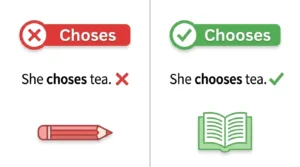
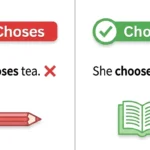
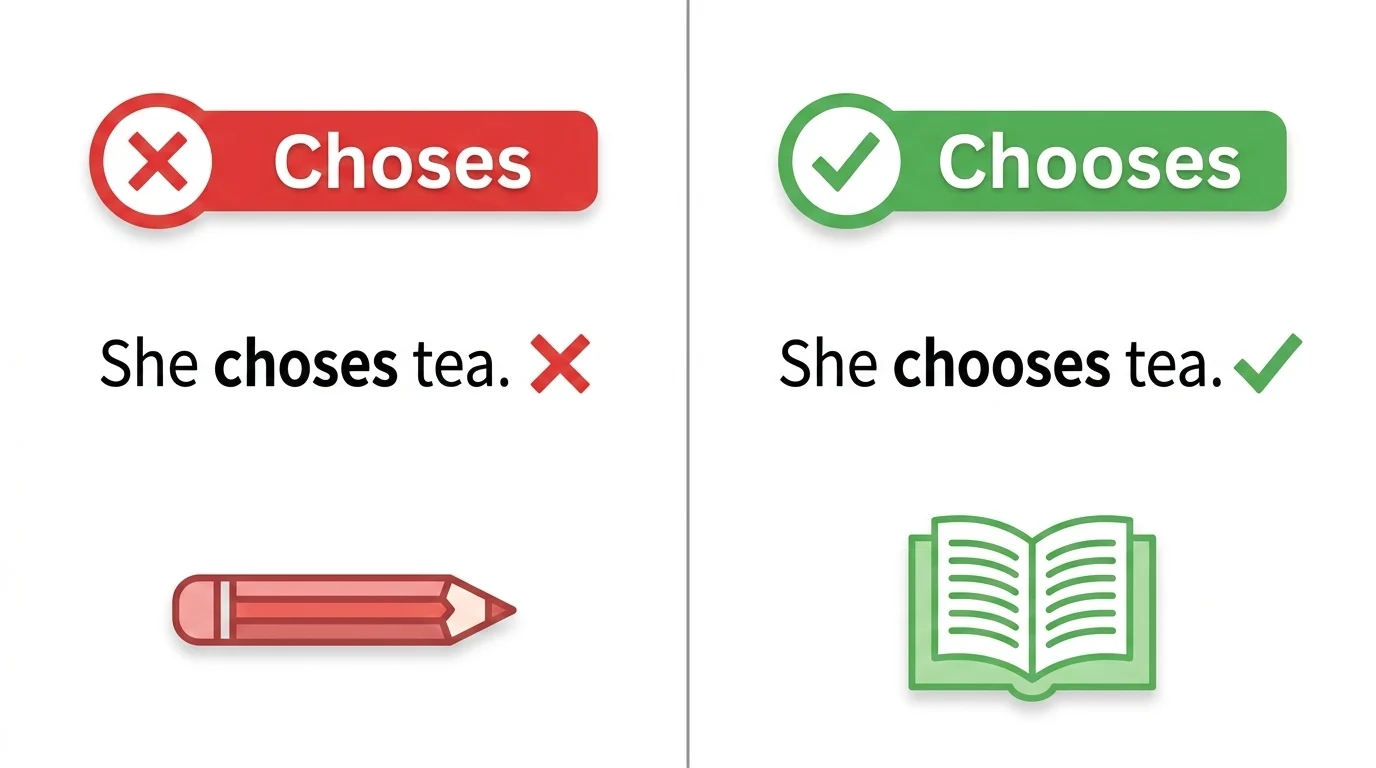
Which is correct, choses or chooses?
At first look, both words seem correct. They look almost the same. Only one letter is different. But in English grammar, that small difference changes everything.
The truth is simple:
- ✅ Chooses is correct.
- ❌ Choses is usually a spelling mistake.
In this complete guide, you will learn:
- The real meaning of choses or chooses
- The difference between choses and chooses
- Correct usage with easy examples
- Choses or chooses grammar rules
- Choses or chooses past tense explanation
- Chose pronunciation
- How to use chooses in a sentence
- How to use choosing in a sentence
- A mini worksheet to practice
Don’t worry. Everything will be explained in very simple English.
Let’s begin.
What Does “Chooses” Mean?
The word chooses comes from the base verb choose.
Base Form:
Choose
Present Tense (he/she/it):
Chooses
So if someone asks, What does “chooses” mean?
The answer is simple:
👉 It means picks, selects, or decides something.
It is used when one person (he, she, it) makes a choice now or regularly.
How Do You Use Chooses in a Sentence?
Here are easy examples:
- She chooses milk instead of soda.
- He chooses the blue shirt.
- My sister chooses a book every week.
- The teacher chooses a helper.
- The baby chooses the red toy.
See the pattern?
He / She / It + chooses
This is the correct usage.
What About “Choses”?
Now let’s talk about the confusing word: choses.
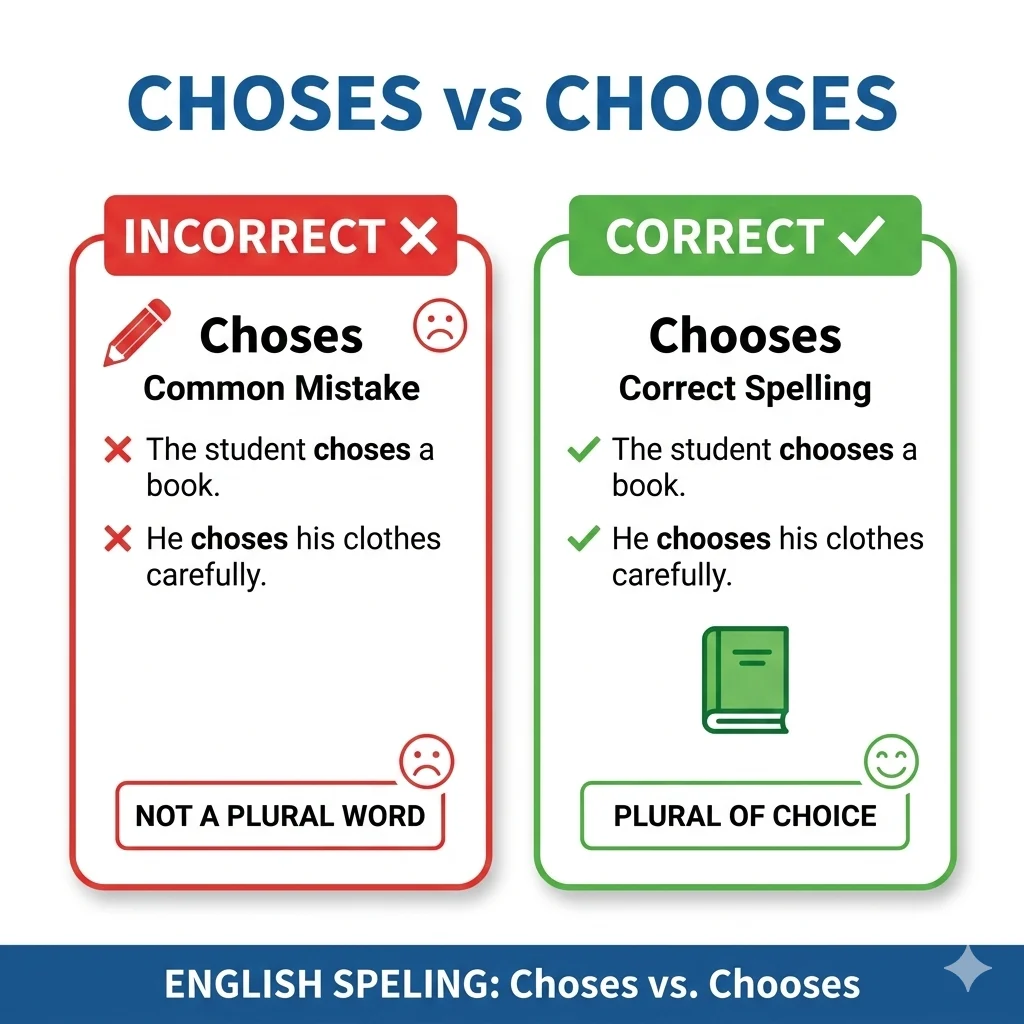
In modern English grammar, “choses” is not correct when used as a verb form of choose.
Many learners search for:
- Choses or chooses meaning
- Choses or chooses spelling
- Choses or chooses grammar
The confusion happens because English spelling can be tricky.
But here is the simple truth:
There is no present tense form called “choses.”
So if you write:
❌ She choses pizza.
It is wrong.
The correct sentence is:
✅ She chooses pizza.
Understanding Verb Forms (Very Important)
To fully understand the difference between choses and chooses, we must understand verb forms.
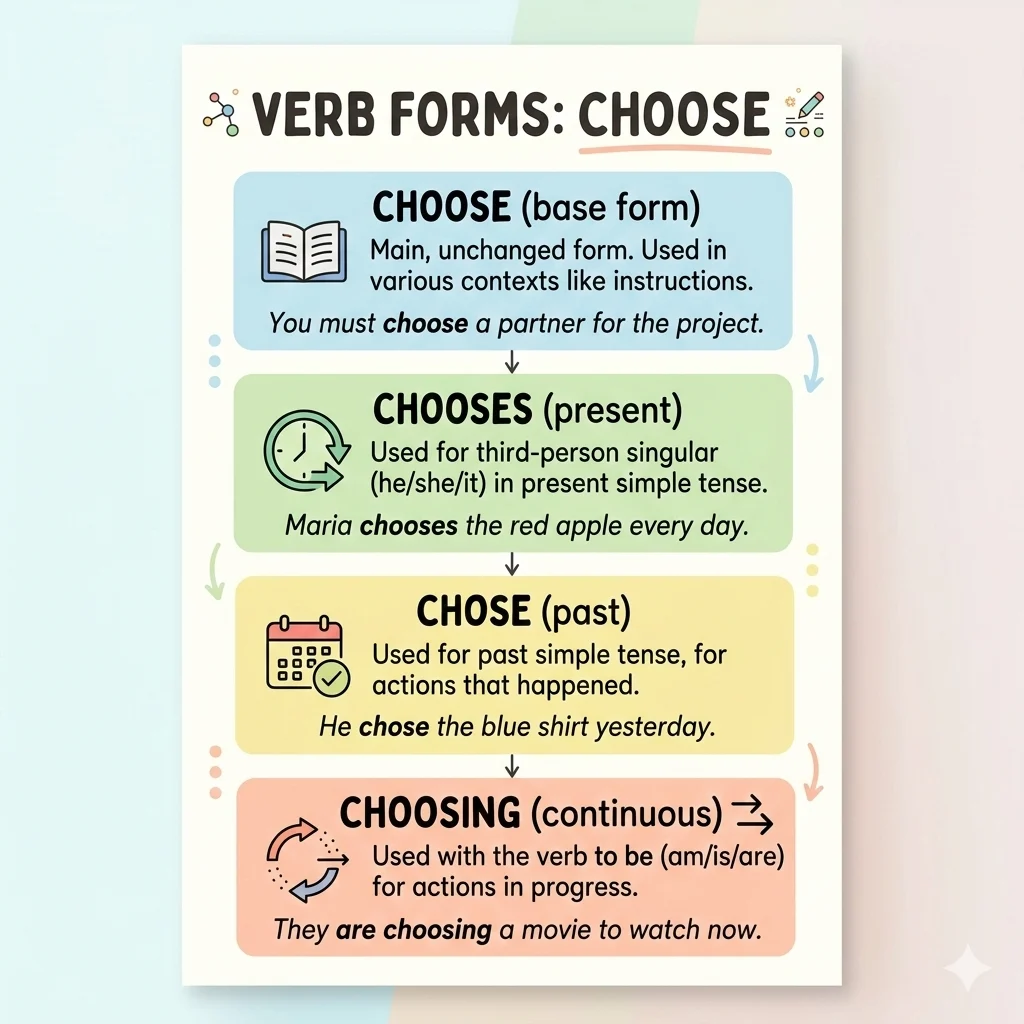
The verb “choose” has four main forms:
- Base form → choose
- Present (he/she/it) → chooses
- Past tense → chose
- Continuous → choosing
Let’s explain each one clearly.
1. Choose (Base Form)
Used with:
- I
- You
- We
- They
Examples:
- I choose tea.
- They choose fun games.
2. Chooses (Present Tense)
Used with:
- He
- She
- It
Examples:
- She chooses tea.
- He chooses honesty.
This is why “chooses” is correct.
3. Chose (Past Tense)
Many people confuse choses or chooses past tense.
The correct past tense is:
👉 Chose
Example:
- Yesterday, she chose tea.
- He chose the red bag.
- They chose wisely.
Never write:
❌ She chooses yesterday.
❌ She choses yesterday.
Both are wrong.
Chose Pronunciation
The word “chose” is pronounced like:
👉 /chohz/
It rhymes with “nose” and “rose.”
This helps you remember the correct past tense.
4. Choosing (Continuous Form)
If someone asks:
How do you use choosing in a sentence?
Here is the answer:
Choosing is used with:
- is
- am
- are
Examples:
- She is choosing a dress.
- I am choosing a gift.
- They are choosing teams.
This shows the action is happening now.
The Key Difference Between Choses and Chooses
Let’s clearly compare choses or chooses in a simple table:
| Feature | Chooses | Choses |
|---|---|---|
| Correct spelling | Yes | No |
| Present tense form | Yes | No |
| Used with he/she/it | Yes | No |
| Grammar status | Correct English | Common mistake |
| Example | She chooses cake. | ❌ She choses cake. |
Quick Memory Trick
Think of the word “goes.”
- He goes
- She goes
Now think:
- He chooses
- She chooses
Both end with -es.
This is your easy memory hack.
Why Do People Make This Mistake?
There are three main reasons for the choses or chooses confusion.
1. Spelling Looks Similar
The words look almost the same. Only one extra “o” makes the difference.
2. Fast Typing
When texting, people type quickly and forget letters.
3. Past Tense Confusion
People mix up:
- chooses (present)
- chose (past)
And they create the wrong word “choses.”
When to Use Chooses (Real-Life Situations)
Use chooses when:
- Talking about habits
- Talking about daily routines
- Talking about someone’s regular decisions
School Examples
- She chooses art class.
- The teacher chooses a monitor.
- He chooses his seat.
Family Examples
- Mom chooses healthy food.
- Dad chooses the movie.
Work Examples
- The manager chooses the best idea.
- She chooses her team carefully.
Choses or Chooses in a Sentence (Correct vs Incorrect)
Let’s fix some wrong examples.
❌ She choses ice cream.
✅ She chooses ice cream.
❌ He choses wisely.
✅ He chooses wisely.
❌ Yesterday she chooses tea.
✅ Yesterday she chose tea.
These choses or chooses examples show the grammar difference clearly.
Choses or Chooses Synonym
Synonyms of “chooses” include:
- selects
- picks
- decides
- prefers
- opts for
Example:
She selects tea.
She chooses tea.
Both are correct.
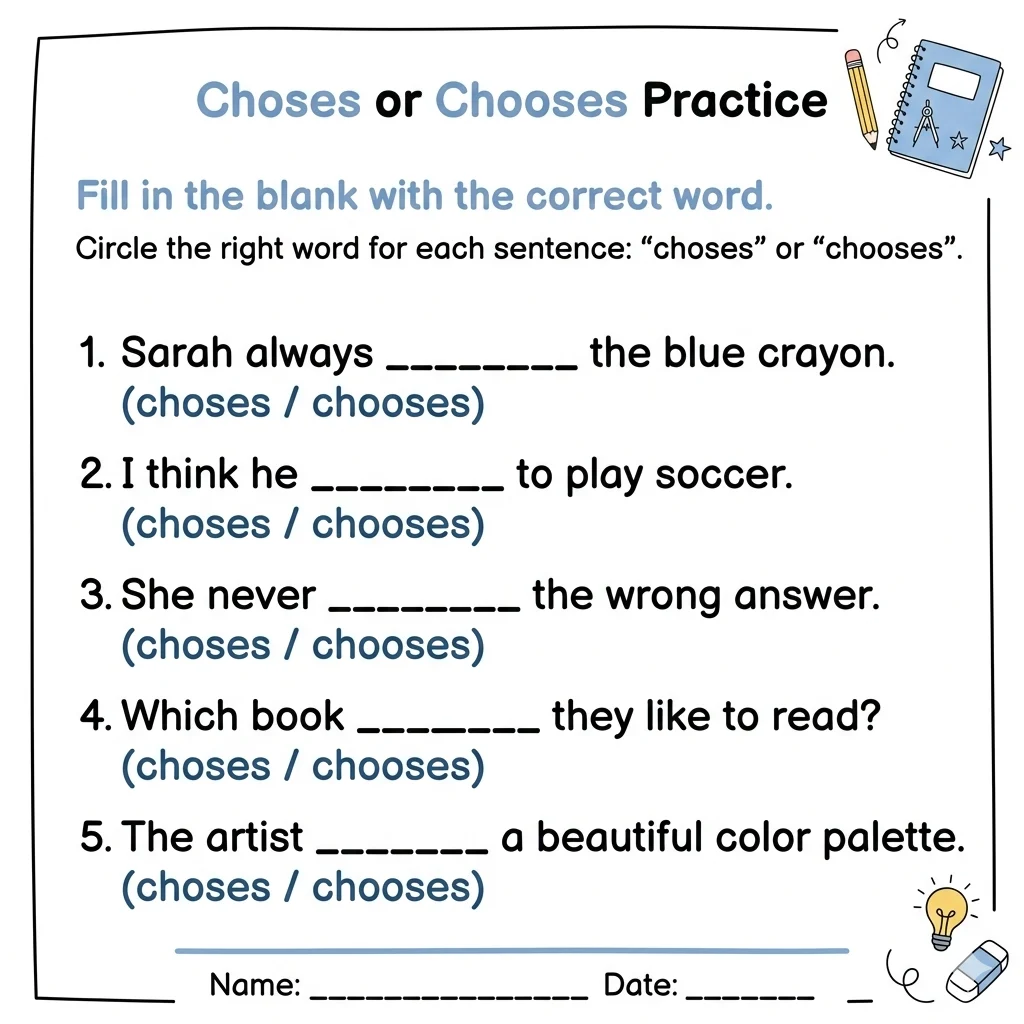
Choses or Chooses Worksheet
Here is a small practice worksheet.
Fill in the blanks:
- She ______ chocolate.
- Yesterday he ______ blue.
- The dog ______ the biggest bone.
- She is ______ a new dress.
- He always ______ kindness.
- They ______ wisely yesterday.
- My sister ______ books carefully.
Answers:
- chooses
- chose
- chooses
- choosing
- chooses
- chose
- chooses
This small choses or chooses worksheet helps you practice correct usage.
Advanced Grammar Explanation (Still Simple)
English has a rule:
If a verb ends in -se, and we use he/she/it, we usually add -es.
Examples:
- Use → uses
- Rise → rises
- Choose → chooses
This is the grammar rule behind chooses.
That is why “choses” does not follow any grammar rule.
Formal Writing and Exams
In school exams, writing “choses” will be marked wrong.
Teachers look for:
- Correct spelling
- Correct tense
- Proper verb form
If you understand choses or chooses grammar clearly, you will score better in writing tests.
Online Writing and Texting
On social media, people sometimes write:
“She choses.”
Even if many people write it, it is still incorrect.
Good writing always uses correct spelling.
Quick Recap: Choses vs Chooses
Here is a simple summary:
- Choose → base form
- Chooses → present tense (he/she/it)
- Chose → past tense
- Choosing → continuous form
- Choses → incorrect spelling
If you remember this list, you will never be confused again.
Mini Quiz
Choose the correct word:
- She ______ the red dress. (chooses/choses)
- Yesterday he ______ the wrong answer. (chooses/chose)
- The cat ______ the warm place. (chooses/choses)
- She is ______ a new phone. (choosing/chooses)
- He always ______ honesty. (chooses/chose)
- They ______ the winner yesterday. (chose/chooses)
Answers:
- chooses
- chose
- chooses
- choosing
- chooses
- chose
Frequently Asked Questions
1. Which is correct, choses or chooses?
The correct word is chooses. “Choses” is a spelling mistake in modern English grammar.
2. What does “chooses” mean?
It means selects, picks, or decides something in the present tense.
3. How do you use chooses in a sentence?
Example: She chooses fruit instead of candy.
Pattern: He/She/It + chooses.
4. How do you use choosing in a sentence?
Example: She is choosing a dress.
Use it with is/am/are to show action happening now.
5. What is the past tense of choose?
The past tense is chose, not choses.
Conclusion
Now you fully understand the difference between choses or chooses. Only chooses is correct in present tense. “Choses” is a common spelling mistake. The past tense is “chose,” and the continuous form is “choosing.”
Remember the simple rule:
He chooses.
She chooses.
It chooses.
Practice writing sentences daily. Check your spelling carefully. Small grammar improvements make your English stronger and clearer.
Keep learning every day. Good English grows step by step.

English novelist and poet Thomas Hardy (1840–1928) explored human struggles, social constraints, and tragic love with deep realism and vivid storytelling.