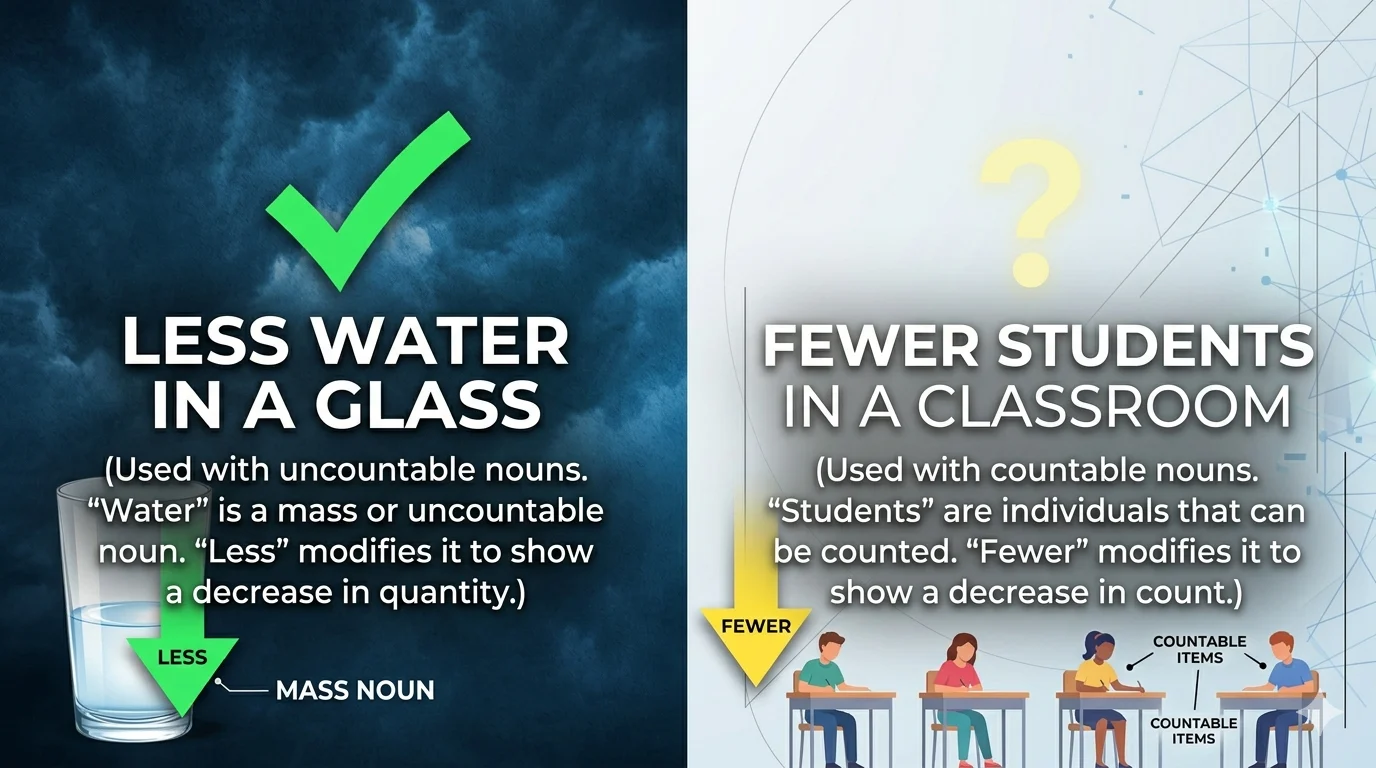
Many English learners often get confused between less or fewer because both words seem to mean the same thing. You may hear people say “less people,” “fewer people,” or even “less hours,” and wonder which one is actually correct. This small grammar doubt creates big confusion in both writing and speaking.
The main reason for this confusion is that both words describe a smaller amount, but they are used in different situations. English grammar has a simple rule based on whether the noun can be counted or not. Once you understand this rule, the confusion disappears completely.
In this complete guide, you will learn the meaning, difference, and correct usage of less or fewer, along with easy examples, common mistakes, and memory tricks. Everything is explained in very simple English so anyone can understand it easily.
What Does “Less or Fewer” Mean?
Before understanding the difference, let’s understand each word separately.
🔵 Meaning of LESS
“Less” means a smaller amount of something that cannot be counted individually.
👉 Used for:
- Time
- Money
- Water
- Sugar
- Air
- Distance
- Information
📌 Examples of “less”:
- I have less money today than yesterday.
- She spends less time on social media now.
- We need less water to save resources.
- There is less noise in the classroom today.
- He shows less interest in the game.
👉 Easy rule: If you cannot count it one by one → use less
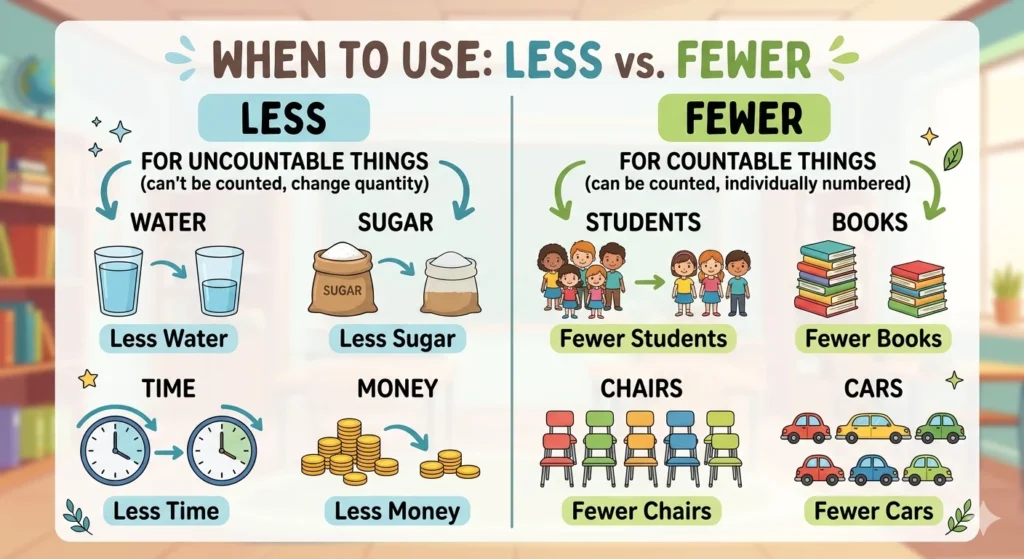
🔵 Meaning of FEWER
“Fewer” means a smaller number of things that can be counted individually.
👉 Used for:
- People
- Books
- Chairs
- Pens
- Cars
- Students
- Items
📌 Examples of “fewer”:
- There are fewer students in class today.
- I have fewer books than my brother.
- She made fewer mistakes in the test.
- We saw fewer cars on the road.
- He has fewer friends in this city.
👉 Easy rule: If you can count it → use fewer
🔴 Key Difference Between Less or Fewer
Understanding the less or fewer difference is very simple when explained clearly.
📊 Comparison Table
| Feature | Less | Fewer |
|---|---|---|
| Type of noun | Uncountable | Countable |
| Meaning | Smaller amount | Smaller number |
| Used for | Time, money, water | People, objects |
| Example | less water, less time | fewer people, fewer items |
| Grammar focus | Quantity | Countable units |
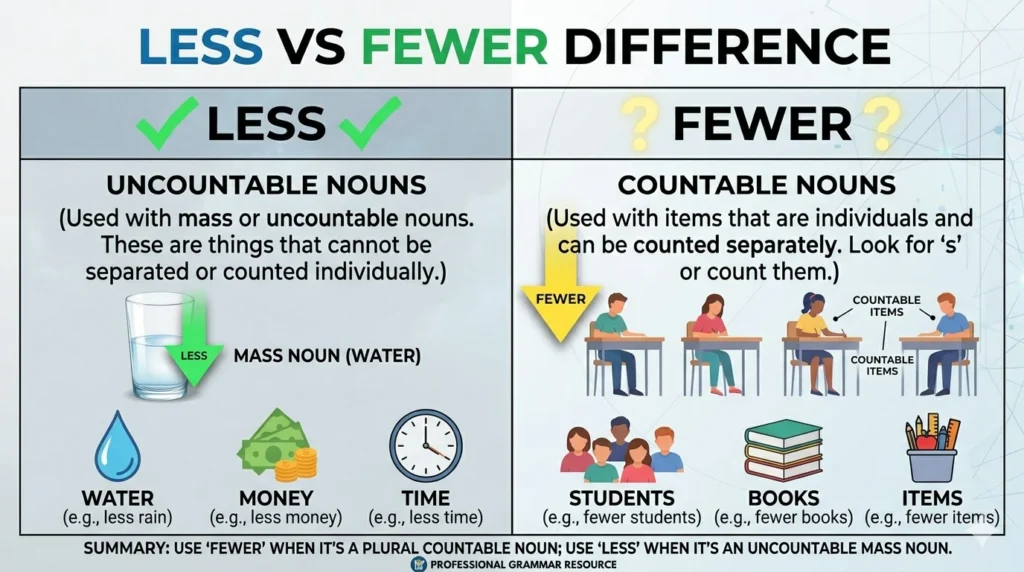
⭐ Super Simple Trick
- If you can count it → fewer
- If you cannot count it → less
🧠 Memory Example:
- Water → you cannot count → less water
- Chairs → you can count → fewer chairs
🟠 Common Mistakes in Less or Fewer Grammar
Many learners make mistakes because they try to translate directly from their language.
❌ Mistake 1:
There are less people in the hall.
✔ Correct:
There are fewer people in the hall.
❌ Mistake 2:
I have fewer money in my wallet.
✔ Correct:
I have less money in my wallet.
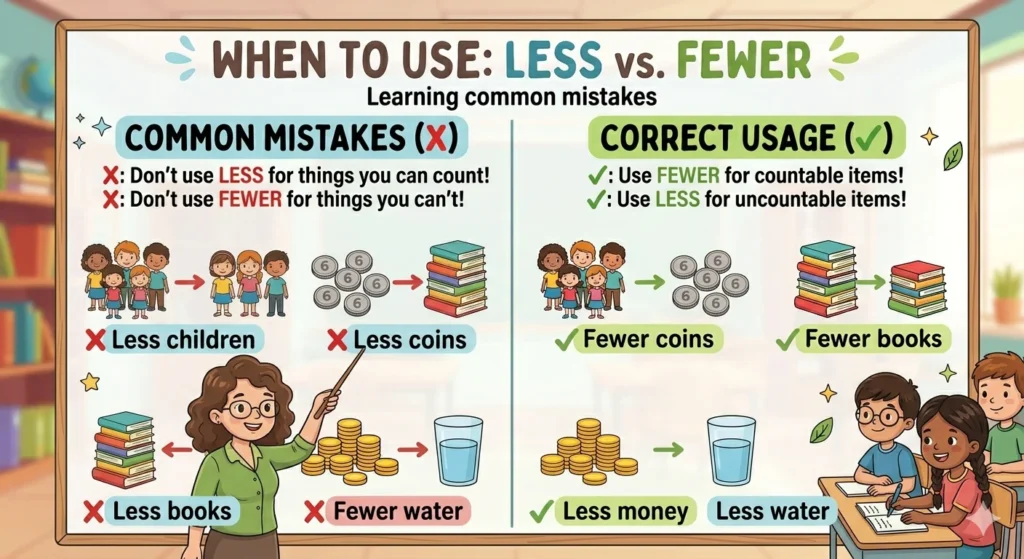
❌ Mistake 3:
She has less friends than me.
✔ Correct:
She has fewer friends than me.
❌ Mistake 4:
We need fewer water in bottles.
✔ Correct:
We need less water in bottles.
🧠 Why do these mistakes happen?
Because in daily speech, people focus on meaning, not grammar rules. But in exams and formal writing, correct usage of less or fewer grammar is very important.
🔵 When to Use LESS (With Simple Real-Life Examples)
Use less when talking about uncountable things.
📌 Examples:
- I have less time to study today.
- We need less sugar in tea.
- There is less traffic in the morning.
- She feels less stress after the holidays.
- He shows less patience than before.
🧠 Easy Trick:
Think: liquid, time, feelings = less
📌 Less with Time:
- I spent less time on homework.
- She works less at night now.
📌 Less with Money:
- I have less money this month.
📌 Less with Resources:
- We have less resources in rural areas.
🟢 When to Use FEWER (With Real-Life Examples)
Use fewer when talking about countable things.
📌 Examples:
- There are fewer students in class today.
- I have fewer pens in my bag.
- She made fewer mistakes in writing.
- We need fewer exercises for homework.
- There are fewer chairs in the room.
🧠 Easy Trick:
Think: items you can count = fewer
🔴 Less or Fewer People (Very Common Confusion)
✔ Correct: fewer people
❌ Incorrect: less people (informal but wrong in grammar)
👉 “People” can always be counted, so we use fewer
🟡 Less or Fewer Hours / Minutes / Time
This is tricky for many learners.
- ✔ fewer hours (countable units: hours)
- ✔ fewer minutes
- ✔ less time (time as general concept)
👉 Example:
- I worked fewer hours today.
- I spent less time studying.
🔵 Less or Fewer Resources
- ✔ fewer resources (countable items like machines, tools)
- ✔ less water, less energy (uncountable resources)
🟢 Less or Fewer Exercises (School Example)
- She solved fewer exercises today.
- He does less practice at home.
🟠 Quick Recap: Less or Fewer Rule
- Less = uncountable nouns
- Fewer = countable nouns
- “If you can count it → fewer”
- “If you cannot count it → less”
🔵 Advanced Tips
📌 1. Origin of Words
“Less” comes from Old English “læs,” meaning smaller amount.
“Fewer” comes from “feawer,” meaning smaller number.
📌 2. Formal Writing Rule
In exams, essays, and academic writing:
- Always use fewer with countable nouns
- Always use less with uncountable nouns
📌 3. Real-Life Usage in Modern English
In casual speech, people sometimes say “less people,” but this is considered informal. Proper grammar prefers fewer people.
📌 4. Common Online Mistakes
- “10 items or less” → informal signage
- Correct grammar: 10 items or fewer
🧠 Mini Quiz: Less or Fewer Exercises
Fill in the blanks:
- There are ___ students in the class.
- I have ___ water in my bottle.
- She made ___ mistakes in the test.
- We need ___ time to finish the work.
- He has ___ friends in this city.
- I want ___ sugar in my tea.
- There are ___ cars on the road today.
📘 Is Less or Fewer Grammar Easy Now?
Now you understand that less or fewer grammar is not difficult at all. The only thing you need to remember is whether you can count the noun or not.
❓ FAQs: Less or Fewer
1. Is it less or fewer?
Use less for uncountable and fewer for countable nouns.
2. When do we use less or fewer?
We use them depending on whether the noun can be counted.
3. Are there fewer people or less people?
Correct: fewer people
4. Is fewer means less?
They both mean “smaller amount,” but usage is different.
5. Is it 2 or less or 2 or fewer?
Correct: 2 or fewer
🟢 Conclusion:
The difference between less or fewer is simple once you understand the rule. Use less for things you cannot count and fewer for things you can count.
You learned real examples like:
- less or fewer people
- less or fewer hours
- less or fewer mistakes
- less or fewer resources
You also learned common mistakes, correct grammar rules, and easy memory tricks.
Now practice daily. The more you use English in real life, the more natural it becomes. Grammar is not about memorizing rules — it is about understanding patterns.
Keep learning step by step, and your English will become stronger every day.

