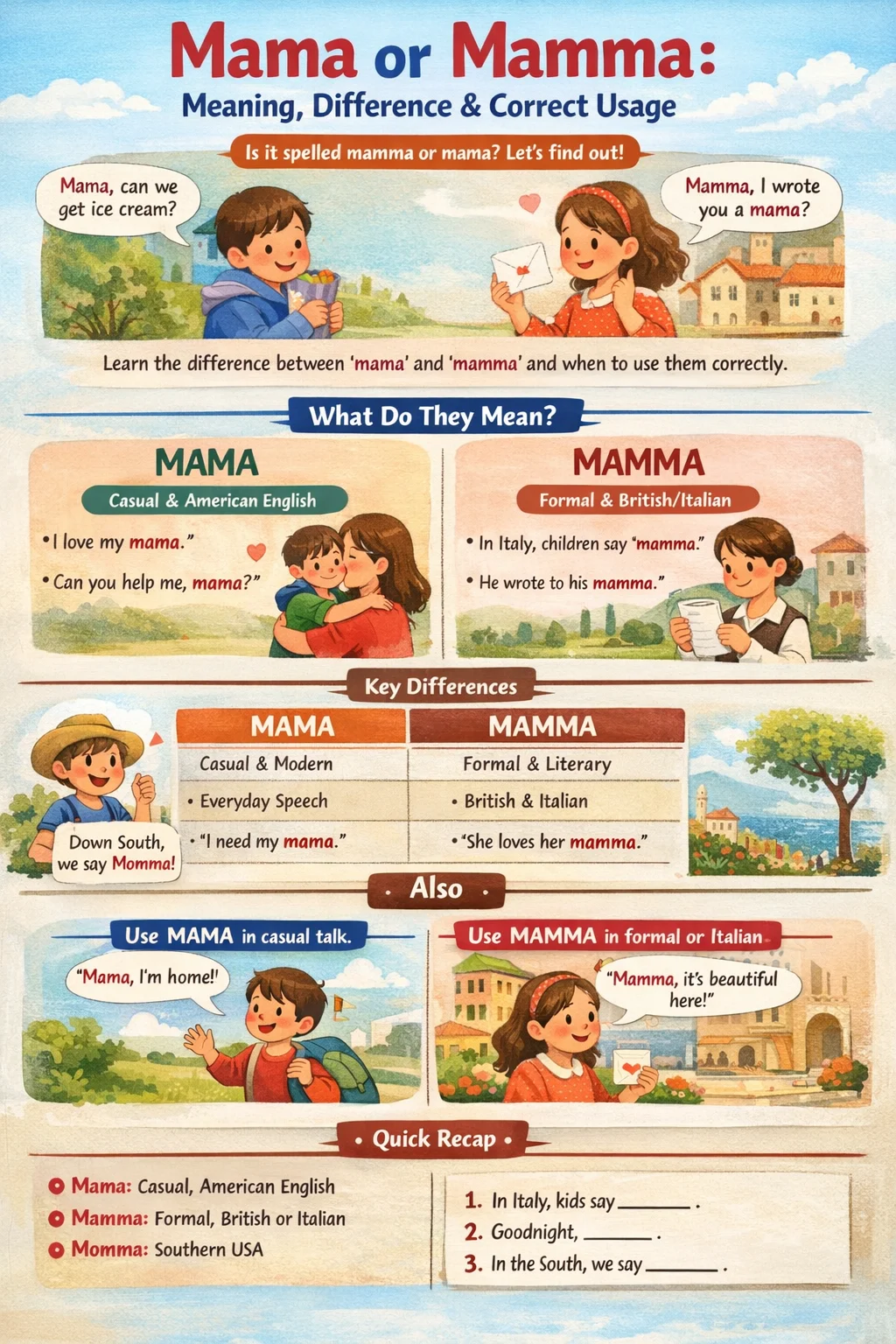
Many people, even native English speakers, often get confused between mama and mamma. Both words refer to a mother, but their spelling, usage, and context vary depending on region, style, or cultural tradition. Questions like Is it spelled mamma or mama?, Is mama or mamma in the UK?, and Is momma grammatically correct? are common among English learners.
This guide will help you understand the difference between mama and mamma, teach you when to use each, and provide examples that are easy to remember. We will also cover momma, regional differences in the US, UK, and Italy, and pronunciation tips.
By the end of this article, you will confidently choose the right word in everyday speech, storytelling, or formal writing. Even beginners and children will find this guide easy to follow thanks to simple explanations, real-life examples, and visual aids.
What Does Each Word Mean?
Mama
- Meaning: A casual, affectionate term for mother. Often used by children in conversation.
- Part of Speech: Noun
- Usage: Informal, everyday speech, American English.
Examples:
- “I love my mama so much.”
- “Mama, can I have some ice cream?”
- “He ran to his mama when he was scared.”
Think of mama as the word a child naturally uses. It’s soft, short, and easy to say.
Mamma
- Meaning: A more formal, literary, or Italian term for mother. Often used in British English, historical writing, or Italian contexts.
- Part of Speech: Noun
- Usage: Literature, essays, formal writing, Italian-inspired contexts.
Examples:
- “Her mamma was a kind woman who loved gardening.”
- “In Italy, children call their mother mamma.”
- “The soldier wrote letters to his mamma.”
Use mamma in stories, poems, or when emphasizing literary or Italian style.
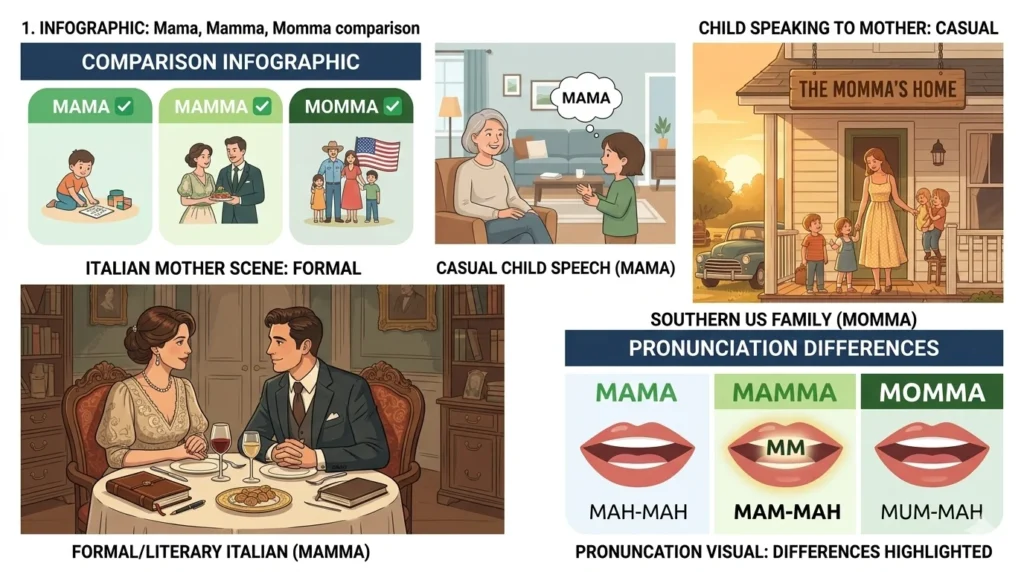
Momma
- Meaning: Common in Southern US English as an alternative to “mama.”
- Usage: Casual conversation, especially in the southern United States.
Examples:
- “Hey, momma, can you help me with this?”
- “Momma said it’s time for dinner.”
- “The child hugged his momma tightly.”
Quick Regional Notes
- Mama or mamma UK: British English often prefers mamma, especially in literature.
- Mama or mamma Italian: Italian children use mamma.
- Momma in the Southern US: Common in informal speech or storytelling.
The Key Difference Between Mama and Mamma
| Feature | Mama | Mamma | Momma |
|---|---|---|---|
| Meaning | Casual, loving word for mother | Formal/literary, Italian or British | Southern US informal term |
| Usage | Everyday speech, child-friendly | Literature, formal writing, Italian style | Casual speech in the South |
| Spelling | Single “m” | Double “m” | Single “m” with “o” |
| Examples | “I need my mama.” | “Her mamma prepared a wonderful dinner.” | “The child ran to his momma.” |
| Pronunciation | Soft, short | Slightly elongated “m” sound | Soft like mama, regional accent |
Quick Tip:
- Use mama for casual modern English.
- Use mamma in literature, essays, or Italian contexts.
- Use momma in southern US speech or storytelling.
Common Mistakes and How to Avoid Them
- Incorrect: “I love my mamma!” (in casual US text)
Correct: “I love my mama!”
Why: Casual American English prefers mama. - Incorrect: “She wrote to her mama from Italy.”
Correct: “She wrote to her mamma from Italy.”
Why: Italian usage favors mamma. - Incorrect: “Mama or momma is wrong.”
Correct: “Mama, mamma, or momma are all correct depending on region and style.”
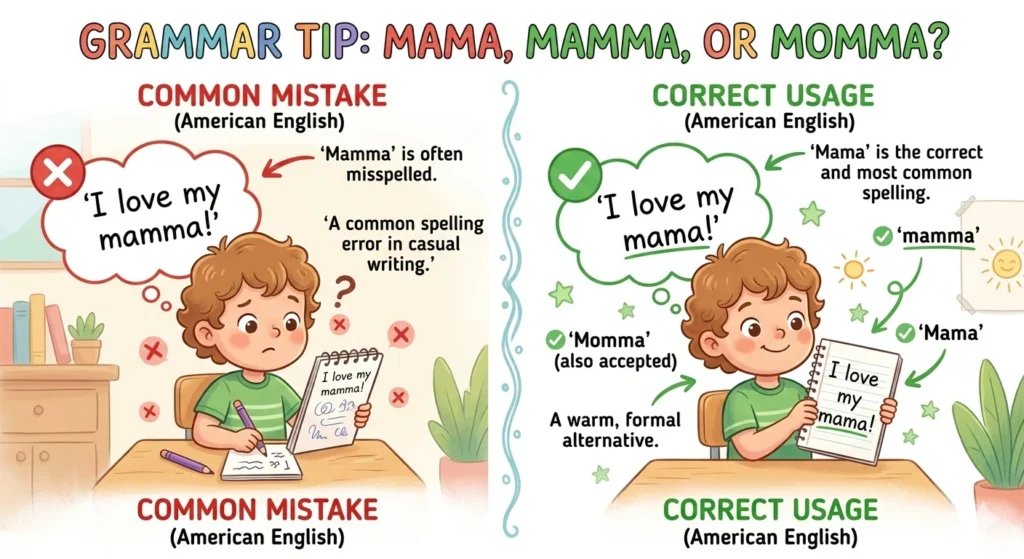
Tip: Always consider region, audience, and formality before choosing the spelling.
When to Use Mama
Use mama when:
- Talking to your mother in casual conversation
- Writing notes, texts, or emails to family
- Telling stories for children
- Using modern American English
Examples:
- “Mama, I finished my homework.”
- “My mama makes the best pancakes.”
- “He ran to his mama when he was scared.”
- “Can you help me, mama?”
- “Goodnight, mama, I love you.”
Memory Hack:
Think of a child saying “mama”—short, soft, and simple.
When to Use Mamma
Use mamma when:
- Writing literature, essays, or poems
- Referring to British English or Italian usage
- Talking about historical or formal settings
- Imitating Italian culture or style
Examples:
- “The young girl called out to her mamma.”
- “In Florence, children always say mamma.”
- “His letters were full of love for his mamma.”
- “The story described a kind mamma who cared for everyone.”
- “Grandma and mamma prepared the feast together.”
Memory Hack:
The extra “m” in mamma adds elegance or Italian flair, like in “mamma mia!”
Spelling Variations and Pronunciation
- How do you spell mama in English? → Usually mama, sometimes momma.
- Is momma grammatically correct? → Yes, especially in the Southern US.
- Mama Vs Momma pronunciation: Very similar; momma may sound slightly more emphasized.
- Mama or mamma for grandma: Typically, grandmothers are called grandma, but mamma can be used in literary or Italian contexts.
- How do you spell mama and papa? → Mama and papa.
- Is it spelled mama in Spanish? → Yes, mamá with an accent.
Quick Recap: Mama vs Mamma vs Momma
- Mama: Casual, American English, child-friendly
- Mamma: Formal, literary, British or Italian
- Momma: Southern US English, casual speech
- Pronunciation: Mama = soft & short; Mamma = slightly elongated; Momma = soft, regional accent
- Spelling Tip: Extra “m” for elegance or Italian influence
- Common Mistakes: Using mamma casually in US English or mama in literary text
Advanced Tips
- Origins:
- Mama comes from baby talk, widely used in English since the 19th century.
- Mamma originates from Latin mamma, meaning “breast” or “mother,” influencing Italian and British English.
- Formal Writing:
- Use mamma in essays, literature, or poems for style or historical effect.
- Avoid mamma in casual texting unless playful.
- Online & Texting:
- Using mamma in chats may seem formal or old-fashioned.
- Mama is safe for casual writing.
- Italian Usage:
- In Italian, mamma is standard.
- Phrases like “Mamma mia!” are internationally recognized.
Mini Quiz: Test Yourself
Fill in the blanks with mama, mamma, or momma:
- “I asked my ___ for help with my homework.” ✅ Answer: mama
- “In Italy, children call their mother ___.” ✅ Answer: mamma
- “Goodnight, dear ___.” ✅ Answer: mama
- “The soldier wrote letters to his ___.” ✅ Answer: mamma
- “My ___ makes amazing cookies.” ✅ Answer: mama
- “The storybook described a loving ___.” ✅ Answer: mamma
- “___ or momma? Which is correct in the South?” ✅ Answer: momma
FAQs
- Is it spelled mamma or mama?
Both are correct; context matters. Casual English prefers mama, formal or Italian contexts use mamma. - Is it mama or mamma in the UK?
British English often prefers mamma, especially in literature. - How do you spell mama in English?
Mama, momma, or mamma, depending on region and style. - Is momma grammatically correct?
Yes, common in Southern US English. - Mama or mamma for grandma?
Usually grandma, but mamma can be used in literature or Italian contexts. - How do you spell mama and papa?
Simple: mama and papa. - Is it spelled mama in Spanish?
Yes, in Spanish it is mamá with an accent. - Mama or mamma Reddit:
Discussions on Reddit often show mama is more common in modern English.
Conclusion
Now you can confidently use mama, mamma, or momma depending on context, region, and style:
- Mama: Casual, child-friendly, American English
- Mamma: Formal, literary, British or Italian English
- Momma: Southern US English
Practice using these words in conversation, storytelling, and writing. Over time, choosing the right word will feel natural. Small differences in spelling and style can make your English polished and professional.
Keep learning, practicing, and enjoy improving your English every day!

English novelist and poet Thomas Hardy (1840–1928) explored human struggles, social constraints, and tragic love with deep realism and vivid storytelling.