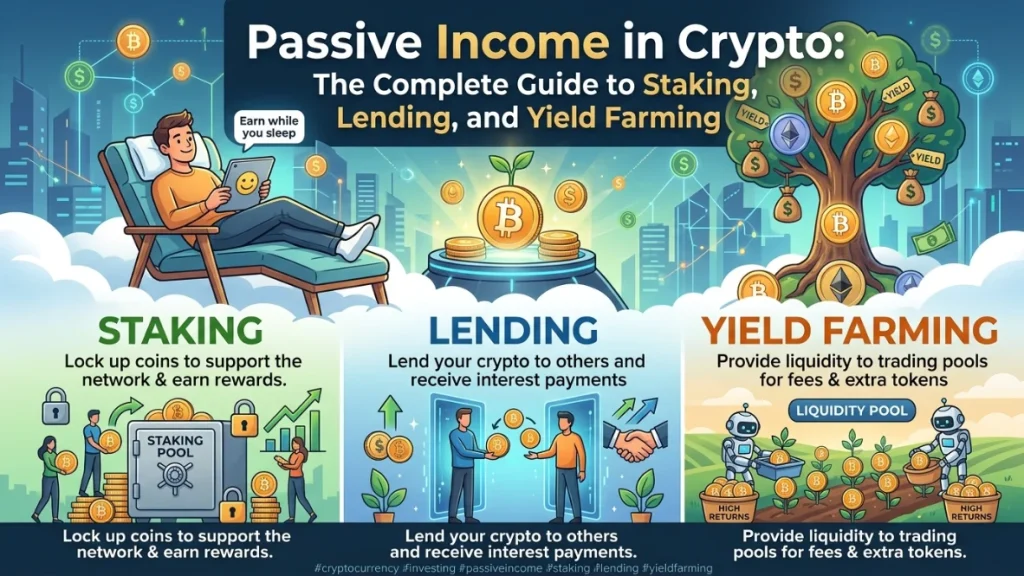
The rise of decentralized finance has completely changed how people think about earning money online. In the past, passive income usually meant savings accounts, real estate rentals, or dividend stocks. Today, cryptocurrency has introduced a new financial system where users can generate income directly from their digital assets.
Through methods like staking, lending, and yield farming, investors can put idle crypto to work and earn rewards without active trading. These systems are powered by blockchain networks such as Ethereum, allowing users to interact with financial protocols without traditional intermediaries.
In this guide, we will explore how each passive income method works, the risks involved, and how investors can start building sustainable crypto income streams.
Real-World Adoption and Ecosystem Growth
The growth of decentralized finance has expanded passive income opportunities globally. Many users now diversify their strategies across staking, lending, and liquidity provision instead of relying on a single method.
In addition, new ecosystems are integrating cross-platform financial tools, making it easier for users to move assets and optimize returns across different protocols.
Some platforms, including TMTCash, are helping bridge the gap between traditional digital finance and emerging blockchain-based systems by offering simplified access to digital asset ecosystems.
At the same time, gaming and entertainment ecosystems such as TMTCash Casino reflect how digital platforms are increasingly integrating crypto-friendly environments where users can interact with modern financial tools in more flexible ways.
What Is Crypto Passive Income?
Crypto passive income refers to earnings generated by holding or deploying digital assets in blockchain-based financial systems. Instead of actively buying and selling, users earn rewards by participating in network activities or providing liquidity.
The most common strategies include:
- Staking cryptocurrencies
- Lending digital assets
- Providing liquidity in DeFi protocols
- Participating in yield farming strategies
These methods are part of the broader decentralized finance ecosystem known as DeFi.
1. Crypto Staking: Earning Rewards by Supporting Blockchain Networks
What Is Staking?
Staking involves locking up cryptocurrency to support blockchain operations such as transaction validation and network security. In return, users earn rewards paid in the same token.
How It Works
When users stake their assets:
- Tokens are locked into a staking protocol
- The blockchain uses them to validate transactions
- Users receive periodic rewards
Benefits of Staking
- Predictable returns
- Low technical complexity
- Strong network participation benefits
- Suitable for long-term holders
Risks of Staking
- Locked funds for a fixed period
- Market volatility
- Potential validator penalties in rare cases
Staking is generally considered the safest passive income strategy in crypto.
2. Crypto Lending: Earning Interest from Idle Assets
What Is Crypto Lending?
Crypto lending allows users to lend their digital assets to borrowers through decentralized or centralized platforms. In return, lenders earn interest payments.
How It Works
- Users deposit crypto into a lending platform
- Borrowers take loans using collateral
- Interest is distributed to lenders
Benefits of Lending
- Regular income stream
- Flexible participation
- Works with stablecoins and volatile assets
- Lower complexity than yield farming
Risks of Lending
- Platform failure risk
- Borrower default in some systems
- Market volatility affecting collateral value
Crypto lending is ideal for users seeking stable and predictable passive returns.
3. Yield Farming: Maximizing Returns Through Liquidity Provision
What Is Yield Farming?
Yield farming involves providing liquidity to decentralized exchanges and earning rewards from trading fees and incentive tokens.
This strategy is one of the most dynamic parts of decentralized finance (DeFi), often offering higher but more volatile returns.
How It Works
- Users deposit token pairs into liquidity pools
- Traders use these pools for swaps
- Providers earn transaction fees and rewards
Benefits of Yield Farming
- High potential returns
- Multiple reward sources
- Supports decentralized trading systems
- Flexible investment strategies
Risks of Yield Farming
- Impermanent loss
- Smart contract vulnerabilities
- Complex strategy requirements
- High market exposure
Yield farming is best suited for experienced users who understand risk management.
Comparing Staking, Lending, and Yield Farming
Each passive income method serves a different type of investor:
Staking
- Best for: Long-term holders
- Risk level: Low
- Returns: Stable but moderate
Lending
- Best for: Conservative investors
- Risk level: Low to medium
- Returns: Predictable interest income
Yield Farming
- Best for: Advanced users
- Risk level: Medium to high
- Returns: Potentially high but variable
Choosing the right strategy depends on risk tolerance and investment goals.
How to Start Earning Passive Income in Crypto
If you are new to crypto income strategies, follow these steps:
Step 1: Choose a Secure Wallet
Use a trusted wallet that supports staking, lending, and DeFi integrations.
Step 2: Pick Your Strategy
Select staking, lending, or yield farming based on your risk appetite.
Step 3: Research Platforms
Check security audits, user reviews, and transparency.
Step 4: Start Small
Begin with a small amount to understand how rewards work.
Step 5: Diversify
Avoid putting all funds into one strategy.
Key Risks to Consider
While crypto passive income can be attractive, it is not risk-free. Key risks include:
- Market volatility
- Smart contract vulnerabilities
- Platform insolvency
- Regulatory uncertainty
- Liquidity risks
Proper diversification and research are essential for long-term success.
The Future of Crypto Passive Income
The future of passive income in crypto is rapidly evolving. Emerging trends include:
- AI-powered yield optimization
- Automated DeFi strategies
- Cross-chain staking systems
- Tokenized real-world assets
- More stable and regulated yield products
As decentralized finance continues to mature, passive income strategies will likely become more accessible, safer, and more automated.
Conclusion
Crypto passive income is transforming how people build wealth in the digital economy. Through staking, lending, and yield farming, investors can earn rewards while contributing to blockchain ecosystems.
Each method comes with its own balance of risk and reward, making education and strategy selection essential. As the industry evolves, platforms will continue to simplify access to these opportunities, making passive income more mainstream in the Web3 era.
FAQs
1. What is the safest crypto passive income method?
Staking is generally considered the safest due to its predictable returns and lower risk profile.
2. How much can I earn from crypto lending?
Returns typically vary depending on platform and market conditions but are usually more stable than yield farming.
3. Is yield farming suitable for beginners?
No, yield farming is more complex and better suited for advanced users.
4. Do I need a large investment to start?
No, many platforms allow users to start with small amounts.
5. Can I combine staking, lending, and yield farming?
Yes, diversification is a common strategy to balance risk and reward.

