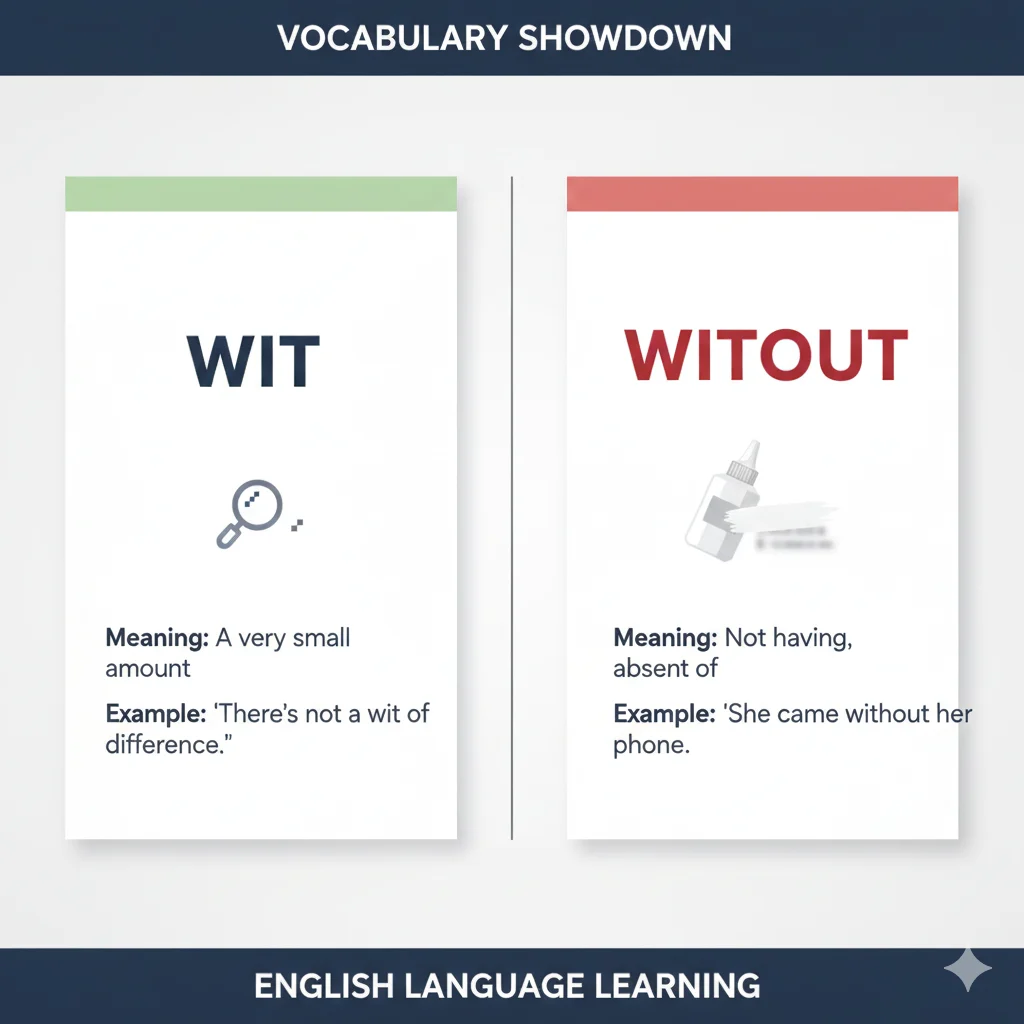
The correct word is without. Whit is a real word, but it has a completely different meaning. Without means “not having something” or “in the absence of.”
If you’re searching “whit or without,” your intent is to find the correct spelling and meaning. This confusion often happens due to typing mistakes or pronunciation, especially in fast writing or informal messages.
Here’s the simple rule: Use without when you mean “not having.” Example: I can’t finish this task without help. The word whit means “a very small amount,” but it is rarely used in everyday English. Using without correctly improves clarity and avoids mistakes..
What Does Each Word Mean?
Meaning of “Whit”
Whit is a real English word.
It means: a very small amount, a tiny bit, or almost nothing.
Think of “whit” like a speck of dust — very small.
Part of speech: noun.
Easy Examples of “Whit”:
- He didn’t care a whit about the noise.
- There isn’t a whit of proof.
- She wasn’t scared one whit.
A mini-story to remember:
Imagine you drop one tiny grain of sugar on the table. That tiny grain is a “whit.”
One Whit Meaning
“One whit” means “not at all” or “not even a little.”
It is usually used in negative sentences.
Examples:
- I don’t care one whit about what people say.
- He didn’t change one whit after the warning.
- She wasn’t afraid one whit.
👉 Simple Rule:
One whit = not at all
Not a Whit Meaning
“Not a whit” also means “not at all” or “zero amount.”
It has the same meaning as “one whit.”
Examples:
- There is not a whit of truth in this story.
- He showed not a whit of fear.
- She has not a whit of doubt.
👉 Easy Trick:
One whit = Not a whit = zero
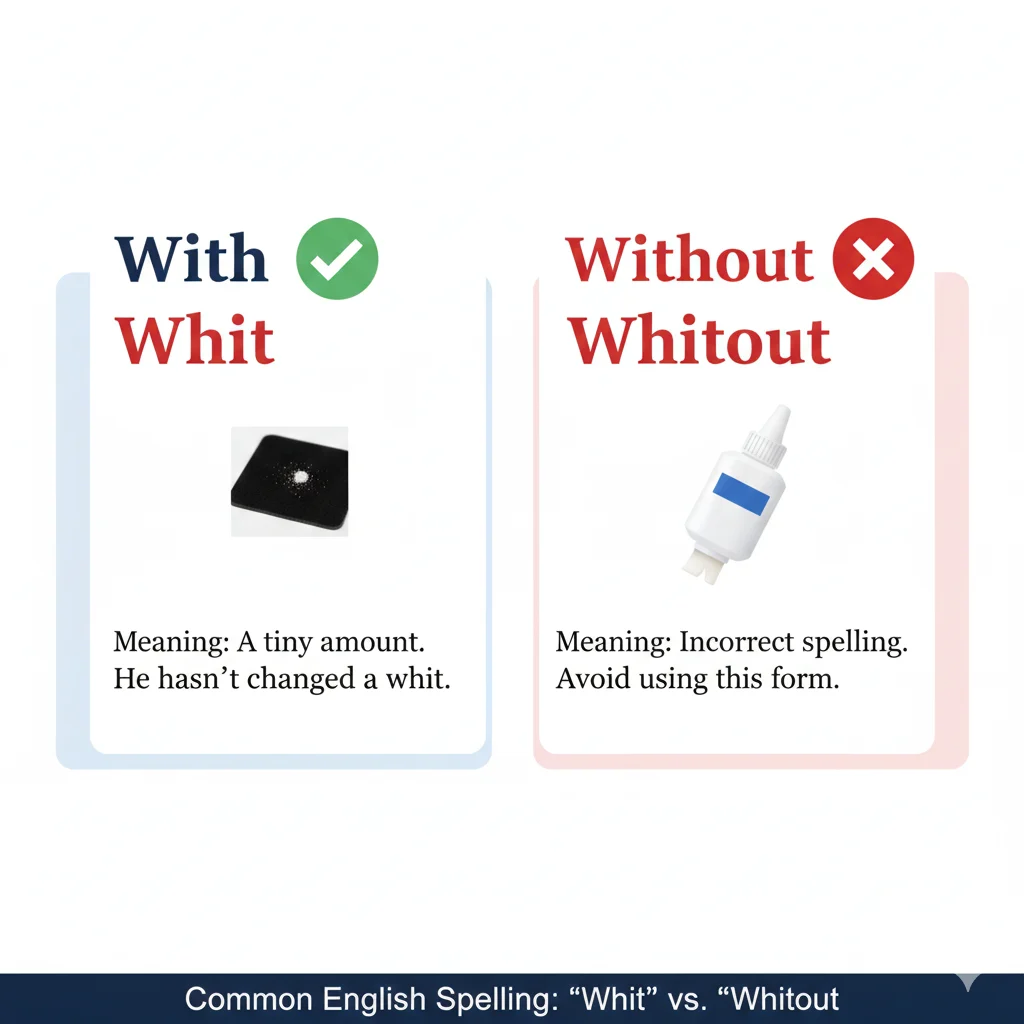
Meaning of “Whitout”
“Whitout” is not a standard English word.
It is a brand name of correction fluid used to cover mistakes on paper.
It is similar to White-Out, the commonly known correction product.
So, in everyday English, “whitout” refers to:
✔ A correction fluid
✔ A tool to hide or fix writing mistakes
Part of speech: noun.
Easy Examples of “Whitout”:
- I used whitout to fix the spelling mistake.
- Please bring your pen, notebook, and whitout.
- She covered the wrong word with whitout.
Remember it like this:
Whitout = tool used to COVER mistakes.
The Key Difference Between Whit and Whitout
Here is the simple difference:
| Word | Meaning | Usage | Example |
|---|---|---|---|
| Whit | A very tiny amount; almost nothing | Used to talk about emotions, proof, care, importance | “He didn’t care a whit.” |
| Whitout | Correction fluid (brand name) | Used to cover errors on paper | “Please use whitout to fix the mistake.” |
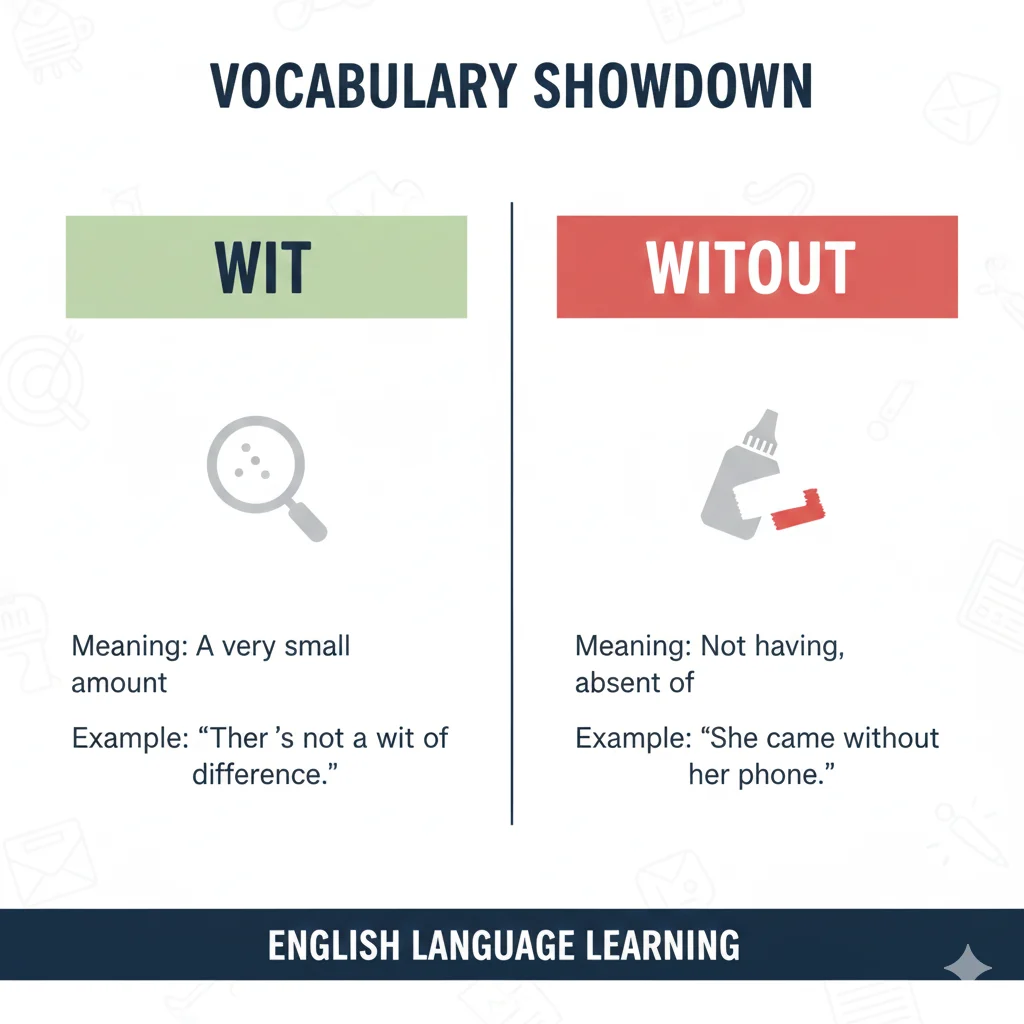
Quick Tip to Remember
- W-H-I-T = tiny (short word = small amount)
- WhitOUT = used to cover things OUT
Common Mistakes and How to Avoid Them
❌ Incorrect:
“I don’t care a whitout about it.”
✔ Correct:
“I don’t care a whit about it.”
Why?
Because “whit” means a tiny amount. “Whitout” is correction fluid.
❌ Incorrect:
“Please give me some whit to fix my mistake.”
✔ Correct:
“Please give me some whitout to fix my mistake.”
Why?
You need a correction tool, not a “tiny amount.”
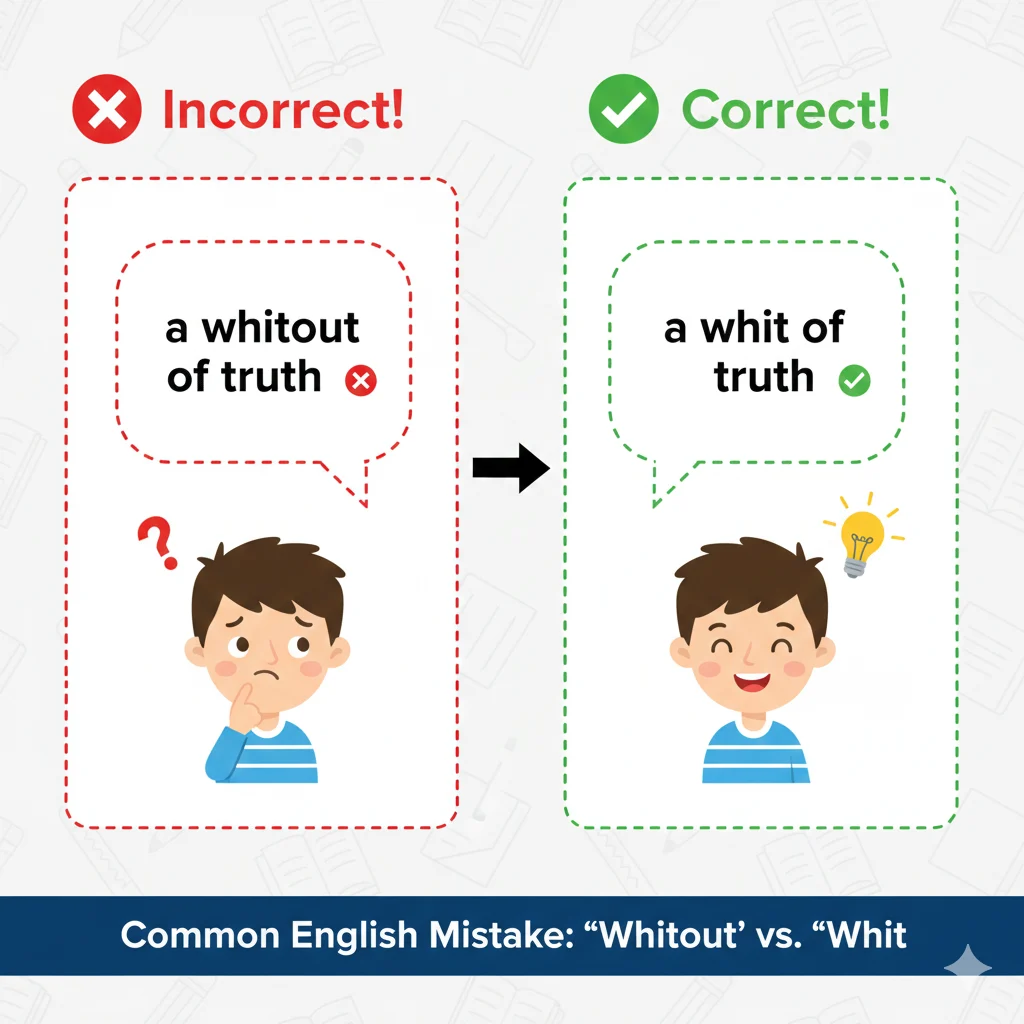
❌ Incorrect:
“There isn’t whitout of truth in this.”
✔ Correct:
“There isn’t a whit of truth in this.”
Why?
We are talking about “a small amount,” not a writing product.
When to Use “Whit”
Use whit when you want to talk about:
✔ A very tiny amount
✔ No care, no fear, no proof
✔ Almost nothing
Simple Example Sentences:
- He didn’t move one whit.
- There isn’t a whit of dust on the shelf.
- She isn’t worried a whit.
- I don’t believe a whit of that story.
- He didn’t change one whit after the trip.
Real-Life Uses
- Expressing emotions (“not scared a whit”)
- Talking about evidence (“no whit of proof”)
- Everyday conversations (“don’t care a whit”)
When to Use “Whitout”
Use whitout when you want to talk about:
✔ A correction fluid
✔ Fixing writing mistakes
✔ School or office stationery
Example Sentences:
- I spilled ink, so I used whitout to cover it.
- Please buy pens, pencils, and whitout today.
- She forgot her whitout at home.
- The teacher used whitout to fix the date.
- Students often use whitout during exams.
Memory Hack
WhitOUT = To wipe OUT your mistake.
Quick Recap: Whit vs Whitout
- Whit = tiny amount, almost nothing
- Whitout = correction fluid
- Whit is used in sentences about feelings, proof, importance
- Whitout is used in school, writing, and stationery
- They are NOT interchangeable
Advanced Tips (For Strong Grammar Learners)
Word Origin
- Whit comes from old English meaning “a small particle.”
- Whitout became known from the brand “Wite-Out,” later spelled differently in some regions.
What Is “Whit” Short For?
“Whit” is not short for any other word.
It is a complete English word.
It comes from Old English “wiht,” which means a very small thing or tiny amount.
👉 Simple Meaning:
Whit = already a full word (not a short form)
Use in Formal Writing
- “Whit” is acceptable in essays or formal writing.
- “Whitout” is not used in academic content except when discussing stationery.
Use in Digital Writing
Avoid using whitout digitally unless you mean the physical product.
For digital editing, you “delete” or “erase,” not “whitout.”
Mini Quiz: Test Yourself
Fill in the blanks with whit or whitout:
- I don’t care a ____ about the noise.
- Please pass me your ____ so I can fix this line.
- There isn’t a ____ of dust on this table.
- She used ____ to cover the wrong date.
- He didn’t change one ____ after the trip.
- Bring your pen and ____ to school.
- There isn’t a ____ of truth in that story.
(Answers: whit, whitout, whit, whitout, whit, whitout, whit)
FAQs
1. What is the main difference between “whit” and “whitout”?
“Whit” means a tiny amount. “Whitout” is correction fluid for fixing writing mistakes.
2. Is “whitout” a real English word?
It is mainly a brand name, but many people use it as a general word for correction fluid.
3. Can I use “whit” in formal writing?
Yes, “whit” is acceptable in essays, articles, and formal English.
4. Is “whitout” the same as “white-out”?
They refer to similar correction fluids, but “White-Out” is a popular brand name.
5. Which word should I use in the sentence “I don’t care a ___”?
Use whit because it means a very small amount.
Conclusion
Understanding the difference between “whit” and “whitout” is simple when you remember this: one refers to a tiny amount, and the other is a tool used to fix mistakes. With the meanings, examples, rules, and tips in this guide, you can confidently choose the correct word in your writing.
Keep practicing these small grammar points — they make your English stronger every day!

