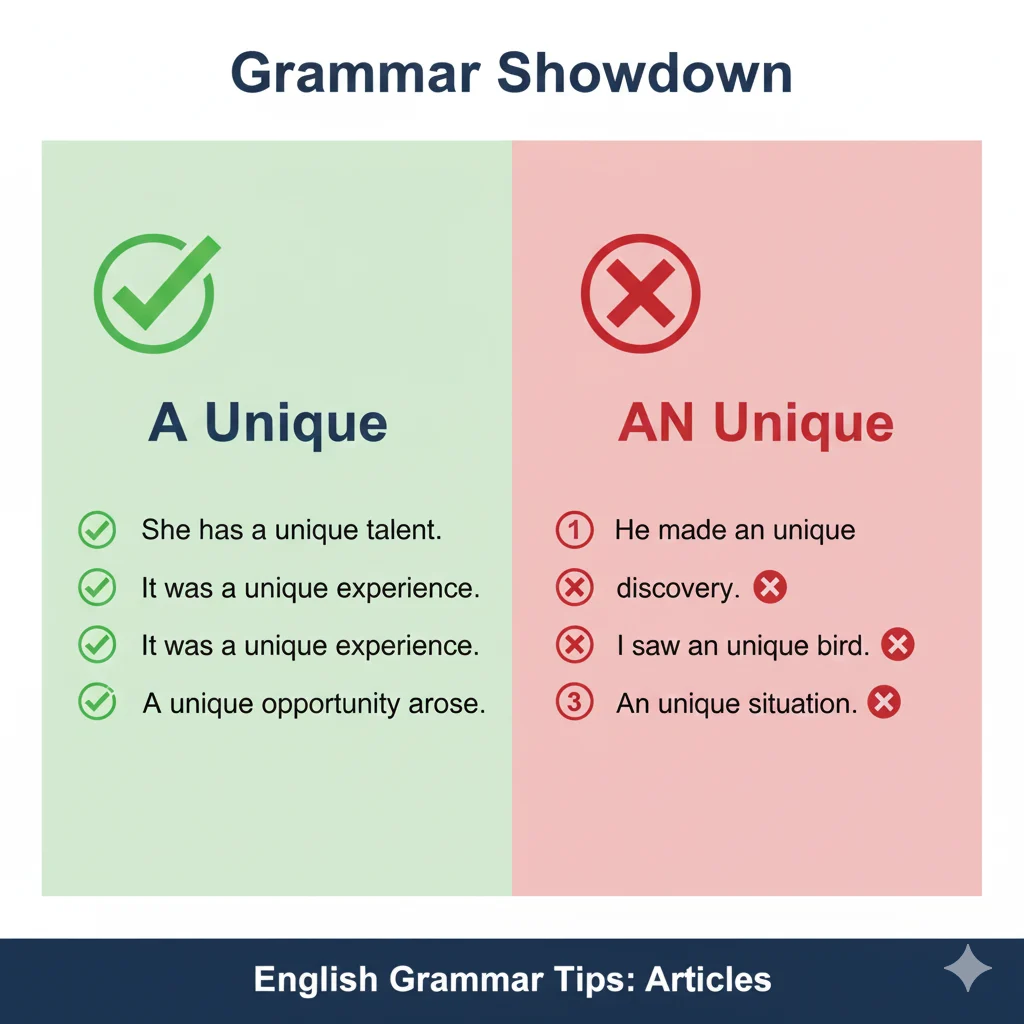
The correct phrase is a unique, not an unique. Although “unique” starts with the vowel letter u, it begins with a “you” sound (/juː/), so we use a, not an.
If you’re searching “a unique or an unique,” your intent is to learn the correct article rule and avoid common grammar mistakes. This confusion happens because English articles depend on sound, not just spelling.
Here’s the simple rule: Use a before words that start with a consonant sound. Example: She has a unique idea. Use an before vowel sounds. Example: an apple, an hour. Since “unique” sounds like “you-nique,” a unique is correct.
What Does Each Phrase Mean?
A Unique
- Meaning: Something that is one of a kind or special.
- Part of Speech: Adjective (describes a noun) preceded by the article “a.”
Examples:
- She has a unique talent for painting.
- That is a unique opportunity you shouldn’t miss.
- He wore a unique jacket that everyone admired.
Tip: Think of “a” as introducing a singular, special thing.
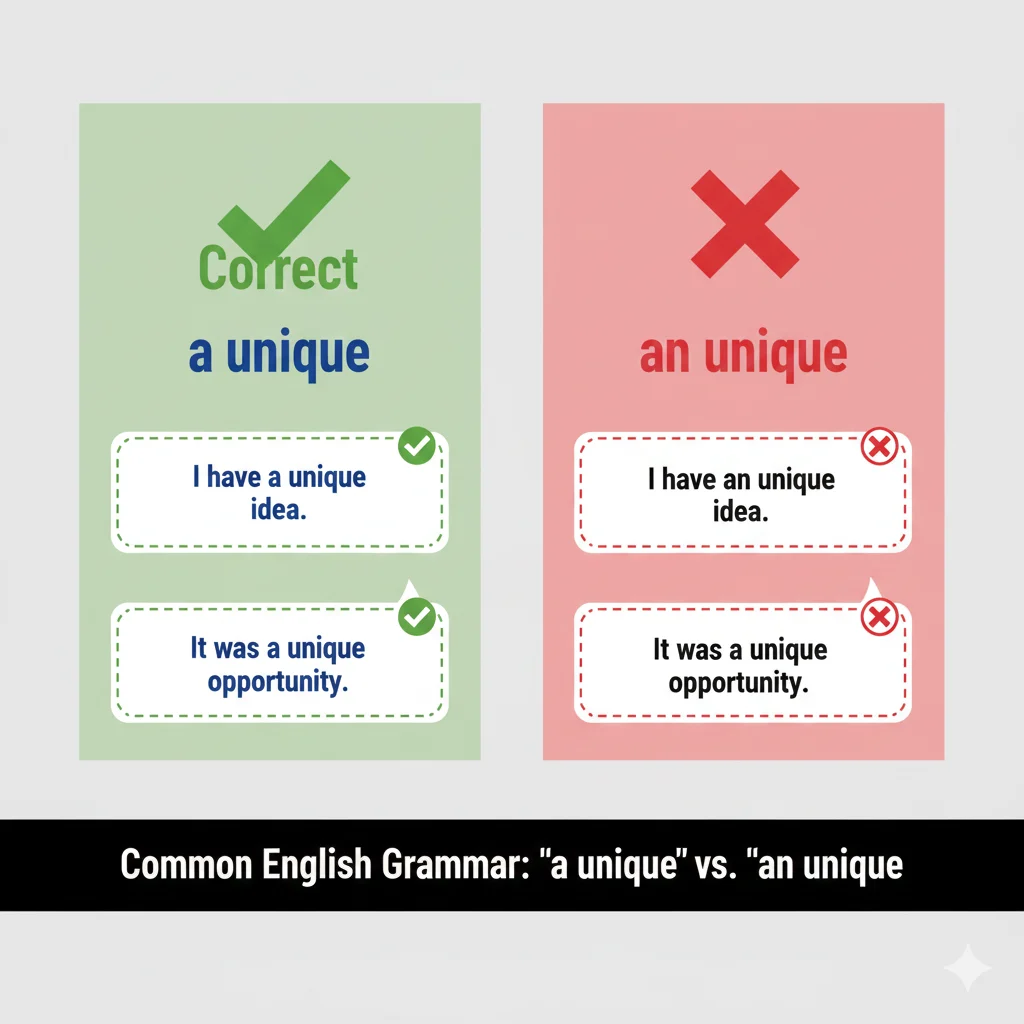
An Unique
- Meaning: This is actually incorrect in standard English.
- Why: The article “an” is only used before words that start with a vowel sound (a, e, i, o, u). Since “unique” starts with a “yoo” consonant sound, “an unique” is wrong.
Incorrect Examples People Use:
- She has an unique idea. ❌
- It was an unique moment. ❌
Correct Version:
- She has a unique idea. ✅
- It was a unique moment. ✅
Memory Trick: If it sounds like it starts with “y” (yoo-nique), use a, not an.
The Key Difference Between A Unique and An Unique
| Phrase | Meaning | Correct Usage | Example Sentence |
|---|---|---|---|
| A Unique | One of a kind, special | Always use “a” before “unique” | She owns a unique collection of coins. |
| An Unique | ❌ Incorrect in English | Do not use “an” before “unique” | ❌ An unique jacket caught my eye. |
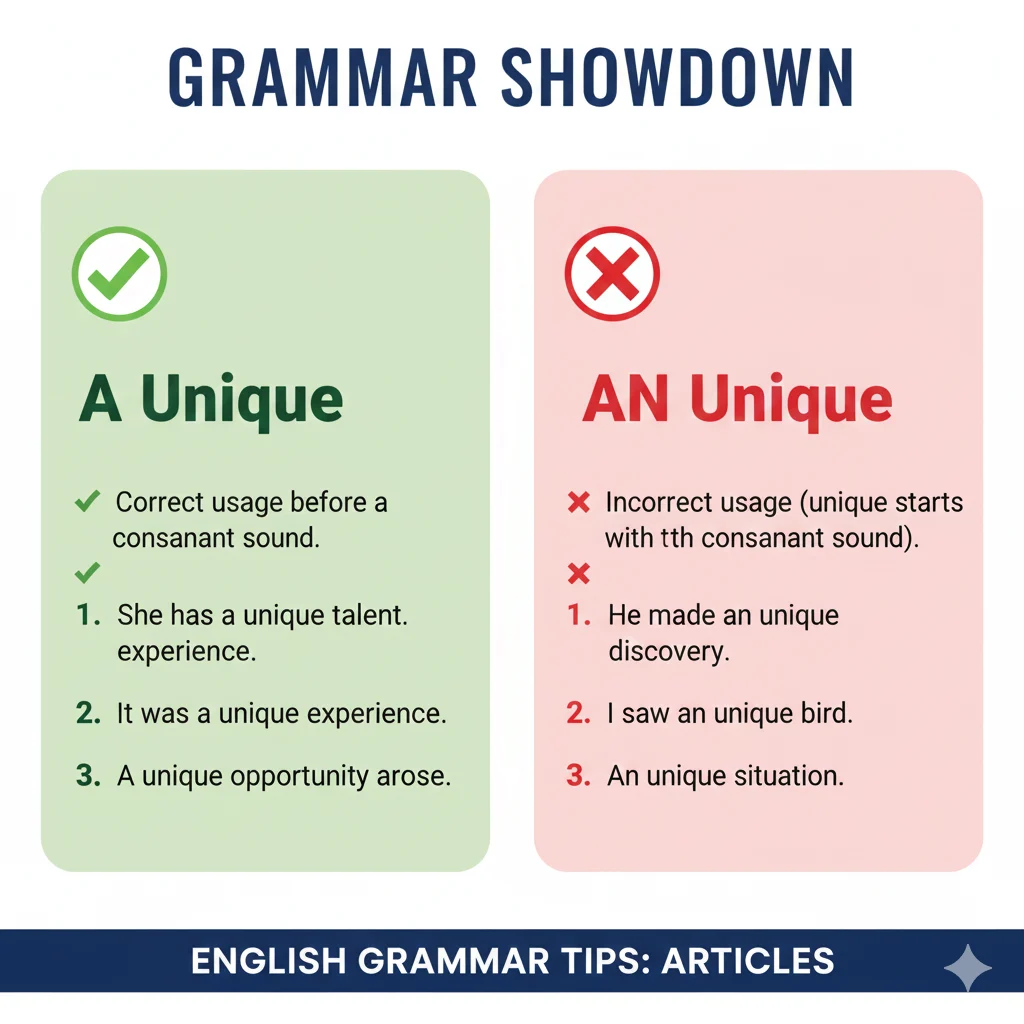
Quick Tip: Listen to the sound. If the word starts with a consonant sound, use a. If it starts with a vowel sound, use an. “Unique” starts with a “yoo” sound → a unique.
Why Pronunciation Matters More Than Spelling
One of the biggest reasons people get confused between a unique and an unique is that they focus only on spelling instead of pronunciation.
In English grammar, articles (a and an) are based on sound, not just the first letter of a word. This is why some words that begin with vowels still take “a”, while others take “an.”
Examples:
- A unique idea ✅ (starts with “yoo” sound)
- A university student ✅ (sounds like “yoo-niversity”)
- An umbrella ✅ (starts with a vowel sound)
- An honest person ✅ (silent “h” → vowel sound)
Key Insight:
Even though “unique” starts with the letter u, it sounds like “you-nique.” Since “y” is a consonant sound, we use a, not an.
Pro Tip:
Whenever you’re unsure, say the word out loud. Your ears will often catch what your eyes miss.
Common Mistakes and How to Avoid Them
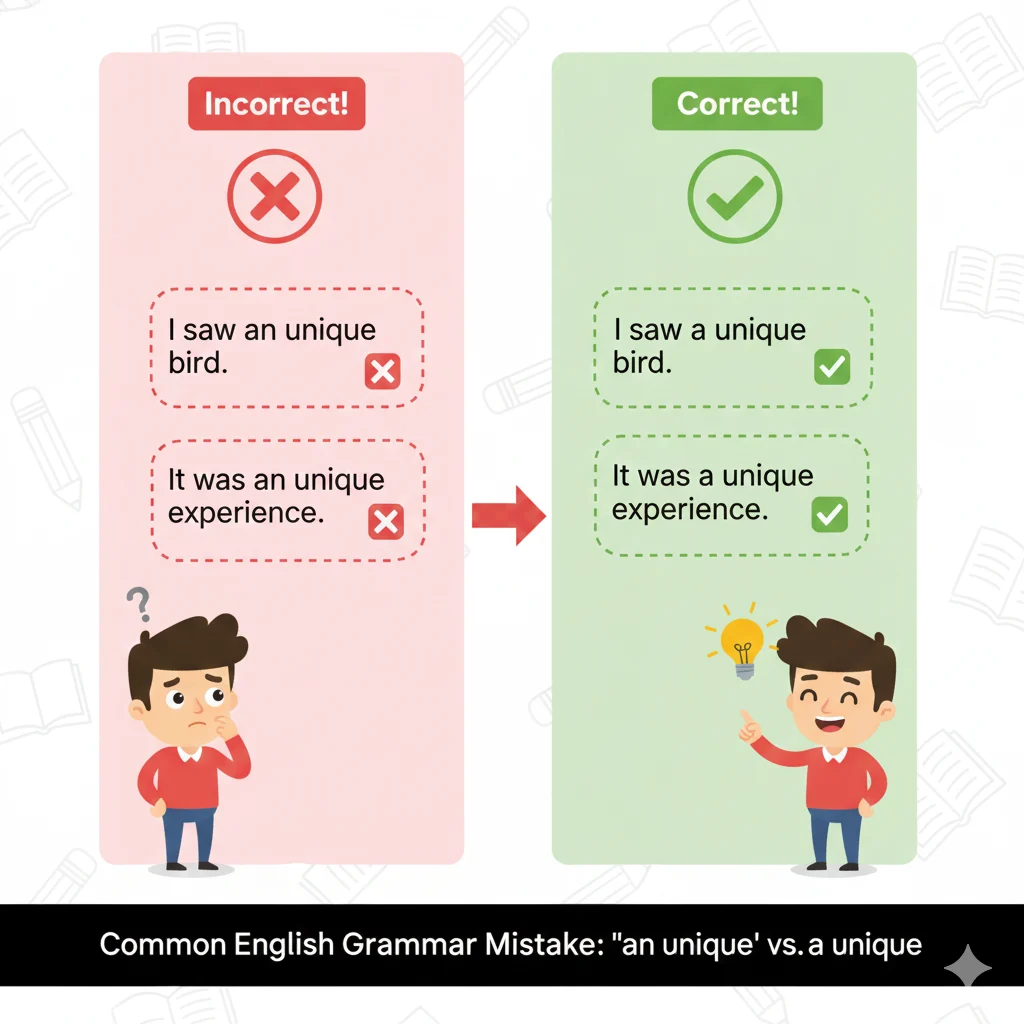
Mistake 1: Using “an” before unique
- ❌ He bought an unique gift.
- ✅ He bought a unique gift.
Why: “Unique” starts with a consonant sound, not a vowel sound.
Mistake 2: Confusing “a” and “an” for all words starting with vowels
- ❌ She is an university student.
- ✅ She is a university student.
Rule: If it starts with “yoo,” it’s a, not an.
Mistake 3: Overthinking
- Some people think “unique” is unusual enough to need “an.” Don’t! Stick to the sound rule.
When to Use A Unique
You should use a unique when referring to something one-of-a-kind or special. Here are practical examples:
- She has a unique perspective on the problem.
- This museum has a unique exhibit about ancient tools.
- He is a unique friend who always supports me.
- I found a unique solution to the math problem.
- That restaurant offers a unique menu you won’t find anywhere else.
Real-Life Situations:
- School: “She gave a unique presentation in class.”
- Family: “Mom prepared a unique dessert for the party.”
- Writing: “This is a unique story idea for your essay.”
Is “Unique” Always the Best Word Choice?
While “unique” means one of a kind, it’s often overused in everyday writing. Sometimes, using a more specific word can make your sentence stronger and clearer.
Better alternatives to “unique”:
- Rare → for something uncommon
- Special → for emotional value
- Distinctive → for something that stands out
- Unusual → for something different
- Original → for creative ideas
Examples:
- She has a unique style.
👉 She has a distinctive style. (more precise) - This is a unique opportunity.
👉 This is a rare opportunity. (stronger impact)
Pro Tip:
Use “unique” only when something is truly one of a kind. Overusing it can make your writing sound less powerful.
When to Use An Unique
Simply don’t use it. Remember, “an unique” is grammatically incorrect. Replace it with a unique every time.
Memory Hack:
Visualize the “yoo” sound in your mind. If it starts with “yoo,” always choose a. Imagine saying it aloud:
- ❌ An yoo-nique idea?
- ✅ A yoo-nique idea ✅
Quick Recap: A Unique vs An Unique
- A Unique: Correct → Use before singular nouns with “unique” (one-of-a-kind things).
- An Unique: Incorrect → Don’t use in English.
- Tip: Listen to the first sound: “yoo” → a, vowel sound → an.
Advanced Tips
- Origin: “Unique” comes from the Latin word unicus, meaning “single” or “only one.”
- Formal Writing: Always write a unique in essays, reports, or exams. Using an unique will be considered a grammatical error.
- Online/Texting: People often write “an unique” by mistake in messages or blogs. Correct it to maintain professionalism.
Mini Quiz
Fill in the blanks with a unique or an unique:
- She has ___ approach to solving problems.
- That is ___ opportunity you shouldn’t miss.
- I found ___ restaurant that serves rare dishes.
- He owns ___ collection of rare stamps.
- This is ___ idea I’ve never heard before.
- My sister showed me ___ talent I didn’t know she had.
- We visited ___ museum with fascinating exhibits.
Answers: All should be “a unique”.
FAQs
- Can I ever use “an unique”?
No, “an unique” is grammatically incorrect in English. Always use a unique. - Why do people say “an unique”?
They mistakenly follow the rule for vowels without considering the pronunciation. - Is “unique” always singular?
Yes, “unique” describes something one-of-a-kind and usually modifies a singular noun. - Can “unique” be used with plural nouns?
No, “unique” usually refers to a single item or idea. - What’s a simple memory tip for “a unique”?
Think of the “yoo” sound at the start → use a.
Conclusion
Choosing between a unique and an unique is simpler than it seems. Remember the golden rule: listen to the first sound of the word. “Unique” starts with a consonant sound “yoo,” so always use a unique. By understanding the meaning, part of speech, and proper usage, you can avoid common mistakes and write confidently.
Practice using a unique in your daily conversations, school essays, or emails. Soon, you won’t even need to think about it — it will feel natural. English is full of small rules like this, and mastering them step by step will make you a better writer and speaker. Keep practicing, stay curious, and enjoy learning!

