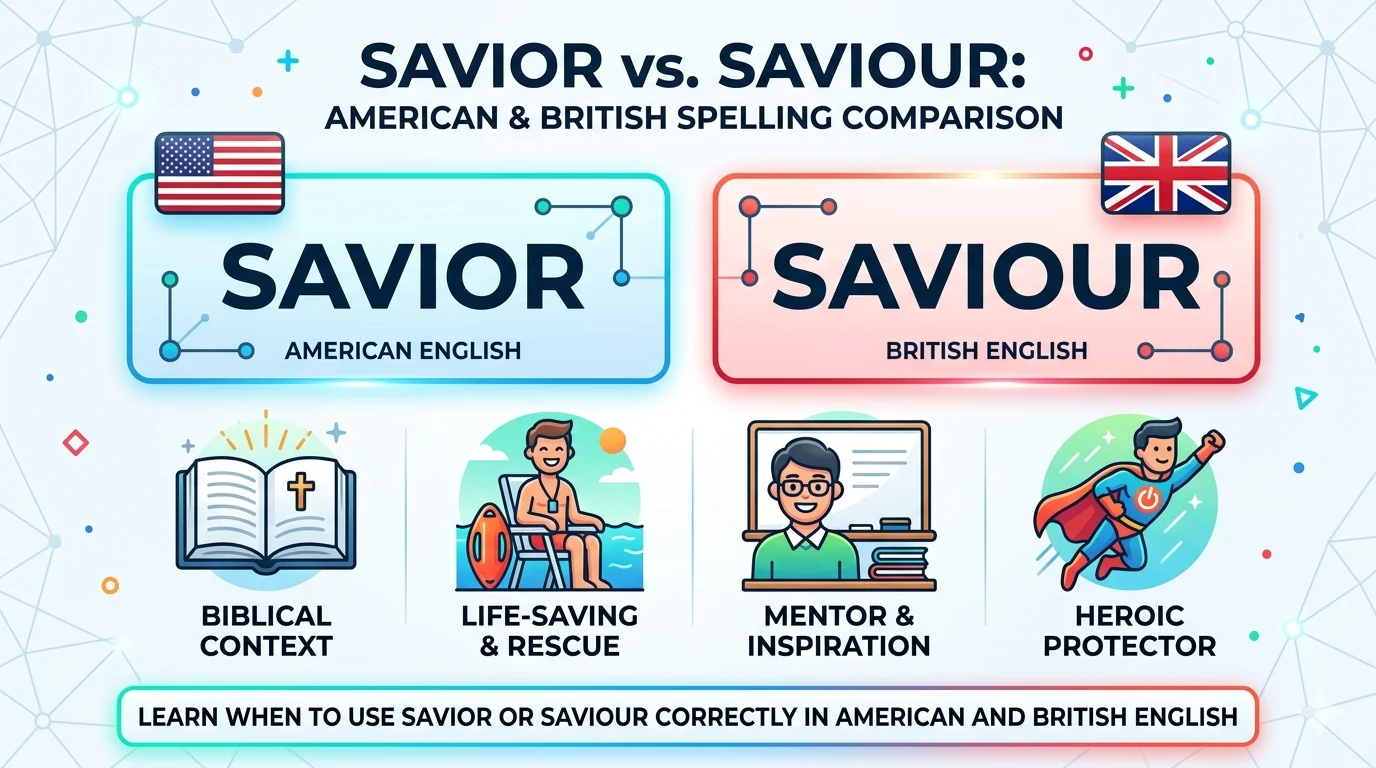
Have you ever paused while writing the word savior or saviour and wondered which one is correct? You are not alone! These two spellings sound the same and share the same meaning, but the correct choice depends on the style of English you are using. This can be especially confusing when reading religious texts, schoolbooks, or online articles.
In this article, we will explain the meaning of savior or saviour, highlight the key differences, and show you practical examples for everyday situations. You will also learn grammar tips, common mistakes, and memory hacks that make using these words easy.
By the end, even beginners will confidently know when to use savior or saviour in writing, conversation, and Bible references. Whether it’s your Lord and savior or saviour, a life savior or saviour, or simply correct spelling, this guide makes it simple.
What Does Each Word Mean?
Savior
- Meaning: A savior is someone who saves or protects another person from danger, harm, or difficulty.
- Part of Speech: Noun
- Usage: Commonly used in American English.
- Examples:
- Superman is a savior for the people of Metropolis.
- She became a savior when she helped me fix my broken car.
- Many consider Jesus as their personal savior.
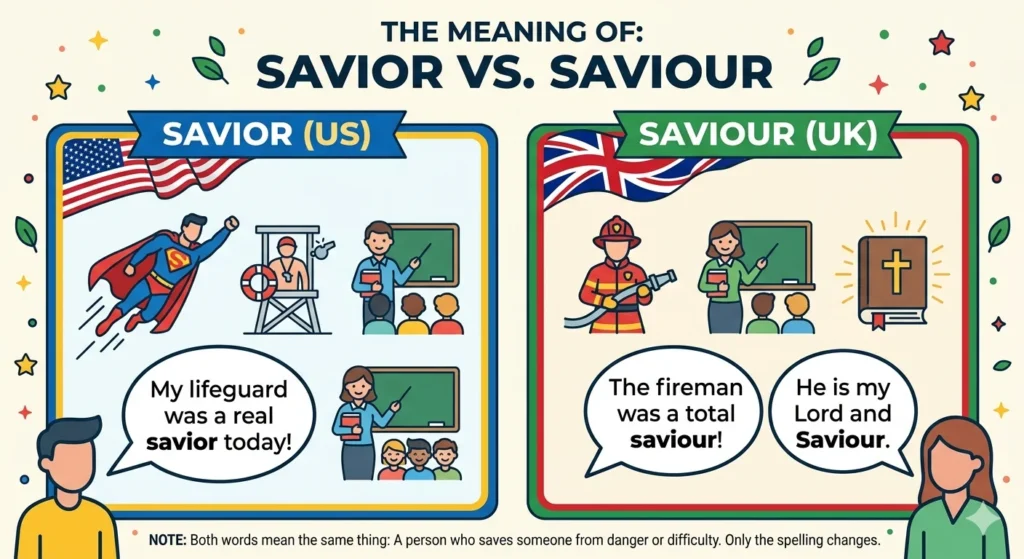
Mini Story: Imagine a child falling into a river. The lifeguard who jumps in to save them is a real-life savior. Simple examples like this make the meaning memorable.
Saviour
- Meaning: Saviour is the British English spelling of savior, with the same meaning: a person who rescues, protects, or saves.
- Part of Speech: Noun
- Usage: Commonly used in British English and in Bible translations like the King James Version (KJV).
- Examples:
- The firefighter was a true saviour during the fire.
- In the Bible, Jesus is called the Saviour of mankind.
- He became a saviour for the village during the flood.
Memory Tip: Think “Saviour = U in UK”. The extra “u” signals British spelling, similar to “colour” or “favour.”
The Key Difference Between Savior and Saviour
Although the meaning is the same, the spelling differs depending on your audience.
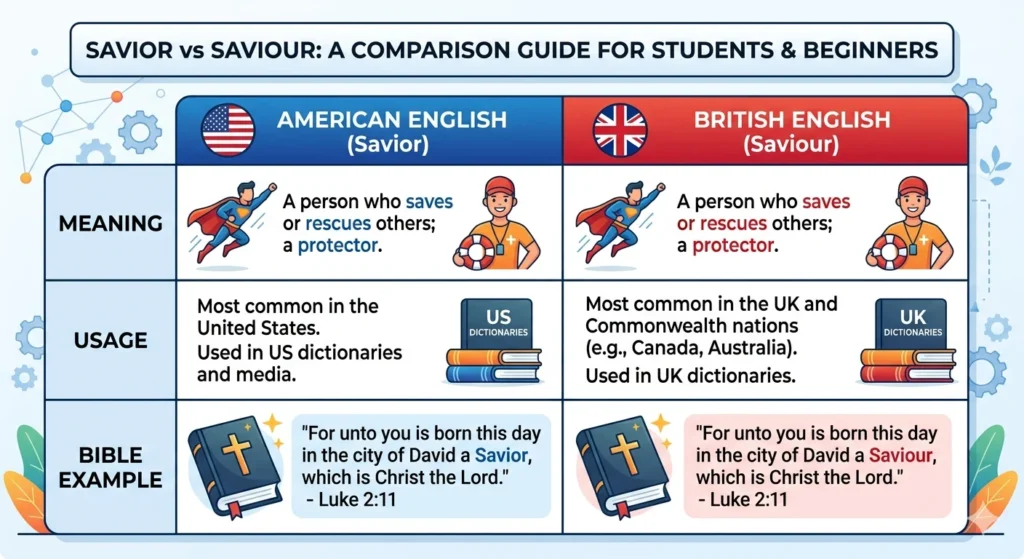
| Feature | Savior | Saviour |
|---|---|---|
| Spelling | American English | British English |
| Meaning | A person who saves or protects | Same meaning: a person who saves or protects |
| Bible Usage | Modern American translations use Savior | Traditional British translations use Saviour |
| Example Sentence | Jesus is my Lord and Savior. | Jesus is my Lord and Saviour. |
Quick Tip: Use savior for American readers and saviour for British, Australian, or Canadian readers.
Common Mistakes and How to Avoid Them
Many people mix these two spellings, especially when switching between American and British English. Here are frequent errors:
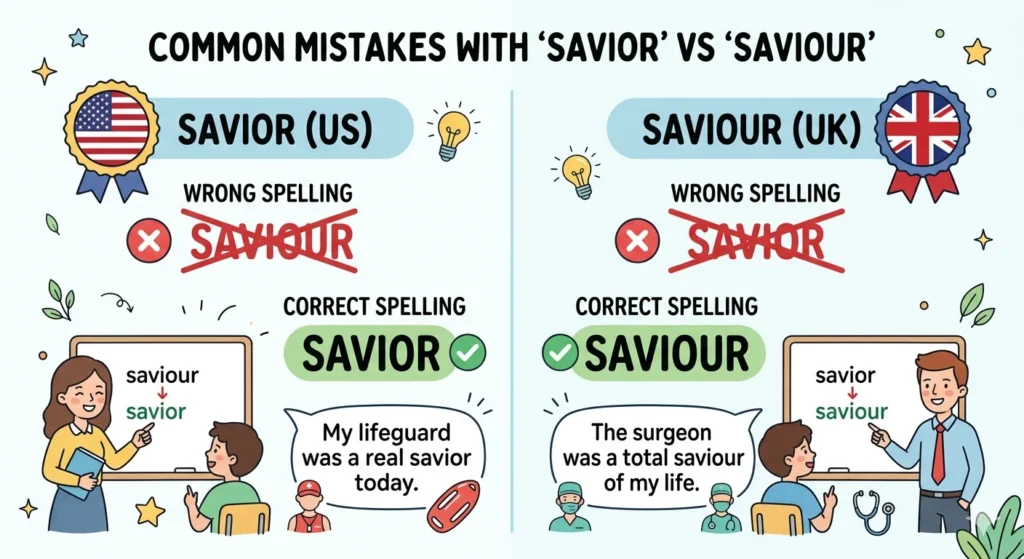
- Incorrect: Jesus is my Lord and savior. (British context)
Correct: Jesus is my Lord and Saviour.- Why: Using American spelling in a British text.
- Incorrect: She was a saviour during the storm. (American context)
Correct: She was a savior during the storm.- Fix: Match spelling style to your audience.
- Incorrect: Life saviour or saver? (Casual text)
Correct: Life savior (U.S.) or saviour (U.K.) - Incorrect: Which is correct saviour or savior?
Correct: Savior is American English; Saviour is British English.
Pro Tip: Once you know your audience, choosing the right spelling becomes automatic.
When to Use Savior
Use savior in:
- American English writing
- Newspapers, textbooks, essays in the U.S.
- Casual or formal online writing targeting U.S. readers
Examples:
- Superman is the savior of the city.
- Many call Jesus their Savior.
- She became a savior during the emergency.
- The charity acted as a savior for flood victims.
- In American literature, he is the savior of the hero.
Extra Tip: Think Savior = USA. This trick makes spelling easy to remember.
When to Use Saviour
Use saviour in:
- British English writing
- The UK, Australia, Canada, and other British English regions
- Religious texts, especially the Bible
Examples:
- Jesus is our Saviour according to the Bible.
- The nurse was a saviour during the crisis.
- He is seen as a Saviour by his community.
- Many poems praise the Saviour for guidance.
- The firefighter was the saviour of the trapped children.
Memory Hack: “Saviour = U for UK”. If you’re following UK English, include the “u.”
Savior or Saviour in the Bible
The Bible is one of the most common places people encounter this question.
- American translations: Use Savior (New American Standard Bible, NIV)
- British translations: Use Saviour (King James Version, Revised Standard Version)
Example Sentences from the Bible:
- “For unto you is born this day a Savior, which is Christ the Lord.” (American translation)
- “For unto you is born this day a Saviour, which is Christ the Lord.” (British translation)
Tip: Always match your spelling to the translation style if quoting Scripture.
Savior or Saviour Meaning in Daily Life
Beyond religious contexts, both words describe anyone who helps, rescues, or protects.
- Examples:
- A lifeguard is a savior when someone nearly drowns.
- A teacher who helps a struggling student can be a saviour.
- Your friend who lends you money in a crisis is a life savior or saviour.
- A firefighter rescuing a family from a burning house is a real-life saviour.
Mini Story: Imagine your car breaks down on a highway. The friend who comes to help you is a savior. Small examples like these make it easy to remember the meaning.
Quick Recap: Savior vs Saviour
- Savior: American English, used in U.S. writing
- Saviour: British English, used in UK, Australia, Canada
- Meaning: Someone who saves, protects, or helps
- Bible Usage: Both are correct depending on translation style
- Memory Tip: “Savior = USA” / “Saviour = UK”
Advanced Tips
- Origin: Both words come from Latin salvare, meaning “to save.”
- Formal Writing: Always match spelling style to your audience; consistency is key.
- Online Writing: Using the wrong version can confuse international readers.
- Synonyms: Rescuer, protector, deliverer, guardian, helper.
- Exam Tip: In essays or exams, never mix savior and saviour in the same document.
- KJV Note: The King James Version uses Saviour, often capitalized when referring to Jesus.
Mini Quiz
Fill in the blanks with savior or saviour:
- Jesus is my Lord and ________.
- The firefighter became a true ________ during the fire.
- In American books, the hero is the ________ of the city.
- The charity acted as a ________ for the victims.
- Many people consider the nurse a ________ during the accident.
- Which is correct, ________ or savior?
- He is a ________ in both American and British stories.
FAQs
- Which is correct, savior or saviour?
Both are correct. Savior = American English, Saviour = British English. - Is it savior or saviour in the Bible?
Both are used. American translations prefer Savior, British translations Saviour. - What does my saviour mean?
Someone who saves or protects you, often referring to Jesus in religious contexts. - When to use savior?
Use in American English writing, essays, newspapers, or casual U.S. texts. - What is the correct spelling of savior or saviour?
American English: savior | British English: saviour - Is Jesus our saviour or savior?
Both are correct; it depends on the English style of the translation. - Can I use saviour and saver interchangeably?
Not exactly. “Saver” usually refers to saving money or time, while “savior/saviour” refers to rescuing someone.
Conclusion
Now you can confidently use savior or saviour in your writing. Both words mean the same—a person who saves or protects—but the spelling depends on the type of English you are using. Savior is for American English, and saviour is for British English.
Practice spotting the words in books, online articles, and Bible passages. Write a few sentences using both spellings to strengthen your understanding. By following these simple tips, you’ll never confuse them again. Small details like these make your English writing more polished and professional. Keep practicing, and soon using savior and saviour correctly will feel completely natural.

