Have you ever written a sentence and suddenly stopped to ask yourself, “Is it whiney or whiny?” This confusion is surprisingly common among English learners, writers, and even native speakers. The two spellings look almost identical, and both feel like they could be correct at first glance, which makes the mistake even easier to make.
The confusion comes from the word whine, which means to complain in a soft, irritating, or high-pitched voice. Since many English words form adjectives by simply adding “-y” or “-ey,” learners naturally assume that the correct form should be whiney. However, English spelling does not always follow predictable patterns, and this word is one of those exceptions.
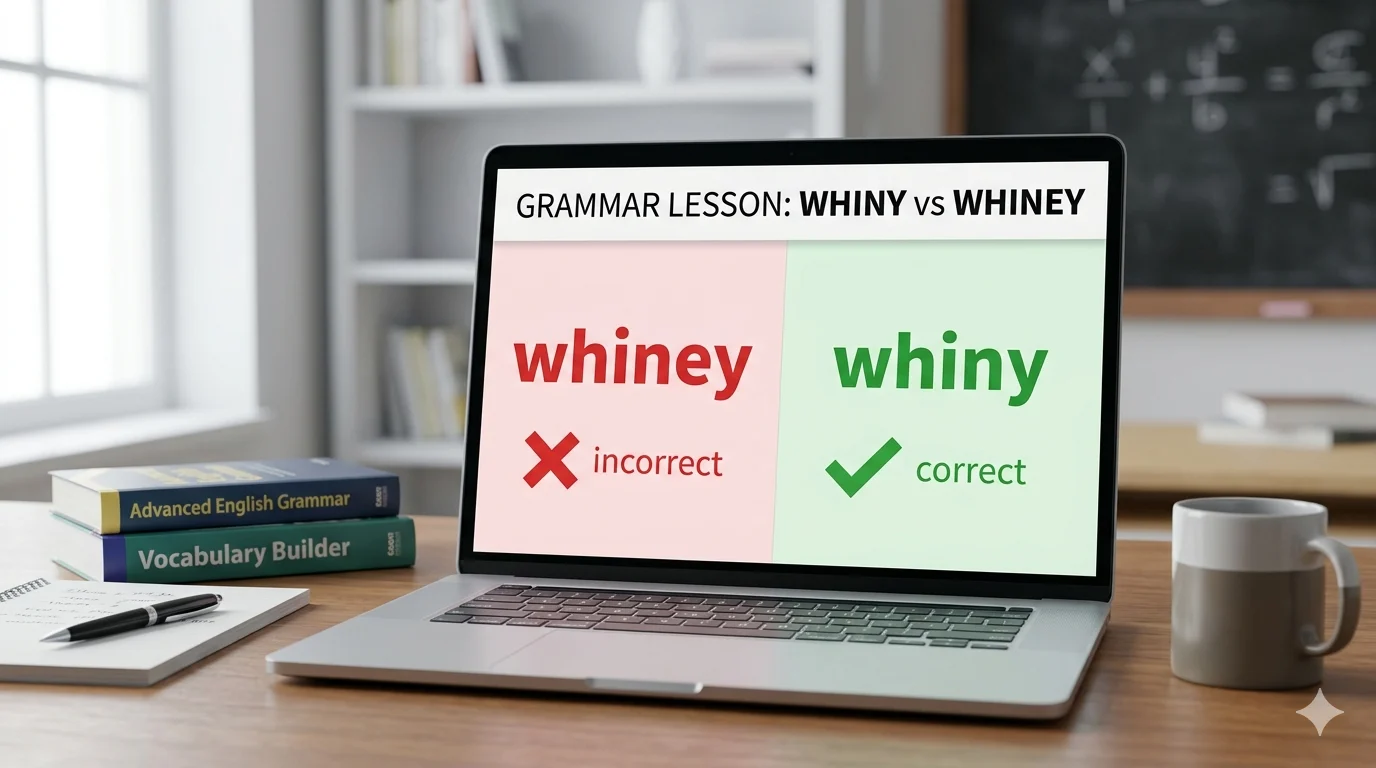
In modern English, the correct spelling is whiny, without the extra “e.” It is the standard form used in dictionaries, education systems, and professional writing. The spelling whiney appears occasionally in informal writing, but it is considered incorrect in formal English. In this complete guide, you will learn the correct spelling, meaning, pronunciation, usage, examples, common mistakes, and memory tricks so you never confuse it again.
What Does Whiny Mean?
Before understanding spelling differences, it is important to understand the actual meaning of the word whiny.
Basic Meaning of Whiny
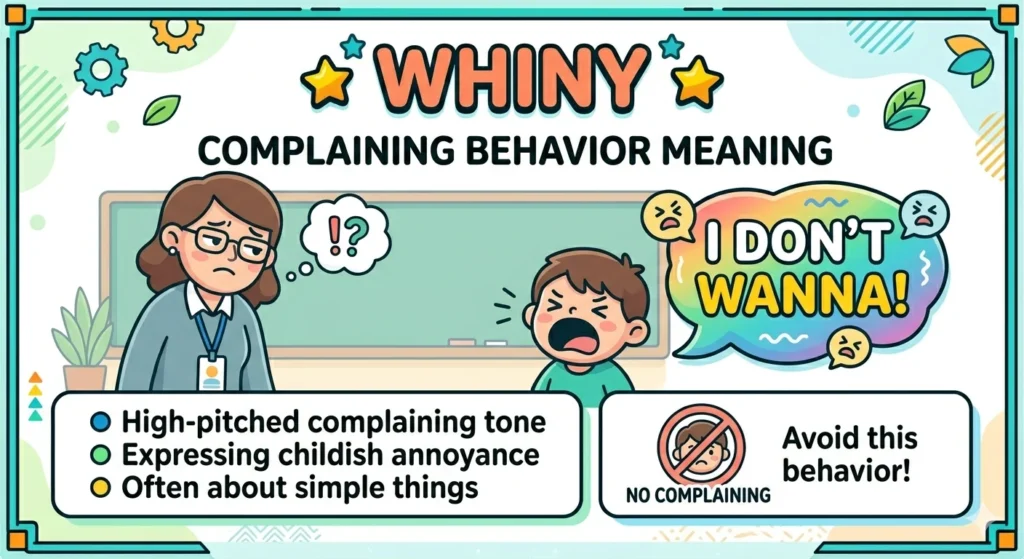
Whiny is an adjective used to describe a person, voice, or behavior that complains repeatedly in an annoying, irritating, or weak tone.
Simple Definition
👉 Whiny = complaining in an irritating or unhappy voice
What Kind of Behavior Is Whiny?
A whiny person usually:
- complains about small issues
- repeats complaints again and again
- sounds emotionally frustrated
- uses an annoying or childish tone
- exaggerates problems
Whiny is a Descriptive Word
It can describe:
- people
- children
- adults
- voices
- tone of speech
- behavior
Emotional Tone of “Whiny”
The word usually carries a negative emotional tone, meaning:
- annoying
- frustrating
- immature
- overly sensitive
Whiny in Real-Life Context
If someone says:
“This is too hard… I don’t want to do it…”
in a complaining tone repeatedly, that person is acting whiny.
Whiny Pronunciation Guide
👉 The correct pronunciation is:
WHY-nee
Break it down:
- WHY (like asking a question)
- knee (body part)
Common Pronunciation Mistake
❌ WIN-ee
✔ WHY-nee
Whiny in Simple Words
If we make it extremely simple:
👉 Whiny means “always complaining in a annoying way”
What Does Whiney Mean?
Now let’s address the confusing part.
Whiney Definition
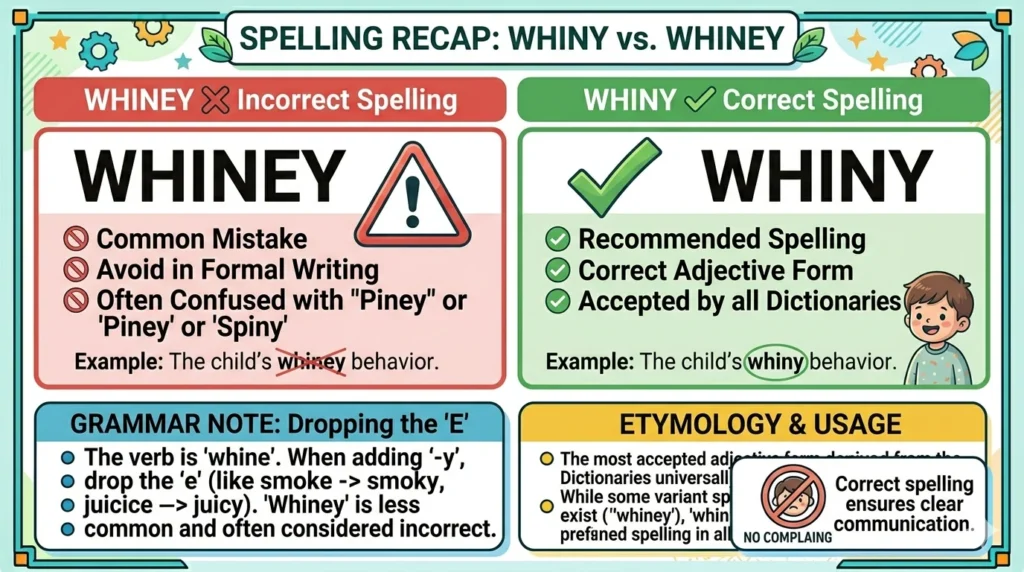
Whiney is an incorrect or nonstandard spelling of whiny.
It is not accepted in formal English writing.
Why Do People Use “Whiney”?
People often write whiney because:
- they assume spelling follows pronunciation
- they think “whine + y” should keep the “e”
- they copy informal internet usage
- they are unaware of spelling rules
Important Rule
👉 Only “whiny” is considered correct in formal English.
Comparison Example
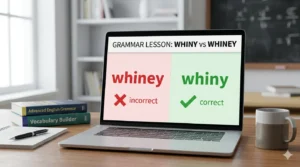
❌ She is very whiney today.
✔ She is very whiny today.
Whiney vs Whiny :
| Feature | Whiny | Whiney |
|---|---|---|
| Correct spelling | ✔ Yes | ✘ No |
| Formal writing | Accepted | Not accepted |
| Dictionary usage | Standard | Rare / incorrect |
| Academic use | Yes | No |
| Meaning | Complaining tone | Same meaning but wrong form |
| Recommendation | Use this | Avoid this |
Why “Whiny” Is the Correct Form
This is where many learners get confused.
Linguistic Reason
The base word is:
👉 whine
When forming adjectives, English often simplifies spelling:
- time → tiny changes in structure
- hope → hopeful
- whine → whiny
The “e” is dropped to maintain consistent adjective formation.
Standardization in English
Dictionaries and grammar systems standardized:
👉 whiny = correct
👉 whiney = nonstandard
Whiny vs Whinny vs Winey
These three words are often mixed up.
1. Whiny
👉 Complaining voice or behavior
Example:
The child became whiny when tired.
2. Whinny
🐴 The sound a horse makes
Example:
The horse gave a loud whinny.
3. Winey
🍷 Related to wine flavor or smell
Example:
The soup had a winey taste.
Key Insight
Even though they sound similar, they have completely different meanings.
Whiny in Everyday Life
Let’s explore how this word is used in real situations.
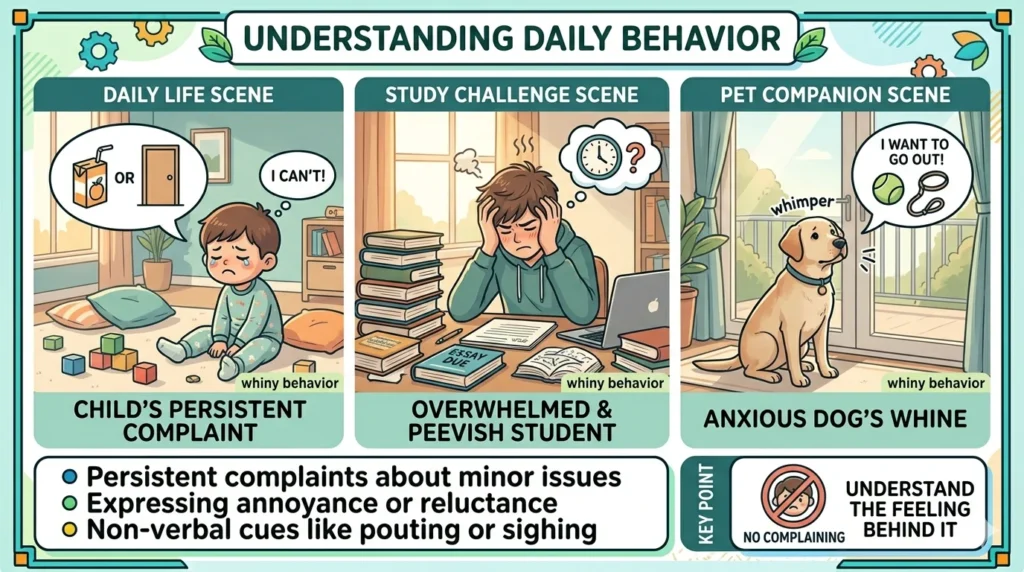
1. Whiny Children
Children often become whiny when:
- hungry
- tired
- bored
- not getting attention
Example:
The child became whiny after missing his nap.
2. Whiny Adults
Adults can also be whiny when:
- stressed
- frustrated
- complaining excessively
Example:
He sounded whiny during the meeting.
3. Whiny Voice
A whiny voice is:
- high-pitched
- repetitive
- emotionally draining
Example:
She spoke in a whiny tone.
4. Whiny Behavior
Behavior includes:
- constant complaining
- emotional reactions
- negativity
Real-Life Examples
- The baby is whiny because he is tired.
- Stop being whiny and solve the problem.
- Her whiny tone annoyed everyone in the room.
- The student gave a whiny excuse for not studying.
- My friend becomes whiny when things don’t go her way.
- The puppy made a whiny sound at night.
- His whiny attitude makes teamwork difficult.
- The employee sounded whiny during the complaint.
- She has a habit of being whiny when stressed.
- The child’s whiny behavior continued all evening.
Whiny Synonyms
To improve writing quality, you can use:
- complaining
- grumbling
- nagging
- moaning
- whining (verb form)
- irritating
- fussy
- negative
- dissatisfied
Example with Synonym
The grumbling child refused to eat dinner.
Whiny Person Meaning
A whiny person is someone who:
- complains frequently about small issues
- reacts emotionally instead of calmly
- tends to exaggerate problems
- uses an annoying tone
Example
He became a whiny person after losing the game repeatedly.
Whiny Girl / Boy Meaning
Used informally to describe:
- someone who complains often
- emotionally reactive personality
Example:
The whiny girl kept asking for attention.
Common Mistakes with Whiny
Mistake 1: Adding extra “e”
❌ whiney child
✔ whiny child
Mistake 2: Using both forms randomly
❌ He is whiny and whiney sometimes
✔ He is whiny
Mistake 3: Informal writing error
❌ stop being whiney
✔ stop being whiny
Whiny in Different Contexts
School Context
The student sounded whiny about homework.
Home Context
My brother gets whiny when he is hungry.
Workplace Context
The employee sounded whiny during feedback.
Social Context
She becomes whiny when ignored.
Whiny Usage Tips
- Use it for tone or behavior
- Avoid overusing in formal essays
- Use synonyms for variety
- Keep it descriptive, not insulting
Memory Tricks to Remember Whiny
Trick 1: “Short word = correct word”
Whiny is shorter → correct
Trick 2: “Extra e = extra mistake”
Whiney = unnecessary letter
Trick 3: Sound trick
WHY-nee → matches whiny
Mini Quiz
Fill in blanks:
- The baby became ______ after waking up.
- Stop being so ______ about everything.
- The dog sounded ______ at night.
- She gave a ______ excuse.
- My friend has a ______ personality.
✔ Answers: whiny
FAQs
1. Is it whiney or whiny?
Whiny is correct.
2. What does whiny mean?
It means complaining in an annoying voice.
3. Is whiney wrong?
Yes, it is nonstandard.
4. How do you pronounce whiny?
WHY-nee.
5. What is whiny behavior?
Repeated complaining or irritation.
6. What is whinny?
Horse sound.
Conclusion
The confusion between whiney or whiny is very common, but the rule is simple once understood. The correct spelling is whiny, and it is the only standard form used in English writing, education, and professional communication. The spelling whiney is considered incorrect and should be avoided.
Understanding small differences like this improves your grammar accuracy, writing confidence, and overall communication skills. With practice, you will naturally remember the correct form and avoid this mistake in the future.

Caribbean-born novelist Jean Rhys (1890–1979) explored alienation, identity, and female psychology with lyrical, haunting, and emotionally rich prose.